From the operations desk
The month in one line
July was the month operational promises needed a visible owner and finish line. New European route costs arrived, growing sellers reconsidered stock positions, stores and marketplaces needed controlled fulfilment tests, supplier versions changed, and after-sales queues exposed recurring quality signals. Across RyanFulfil, the strongest work made every open action recoverable.
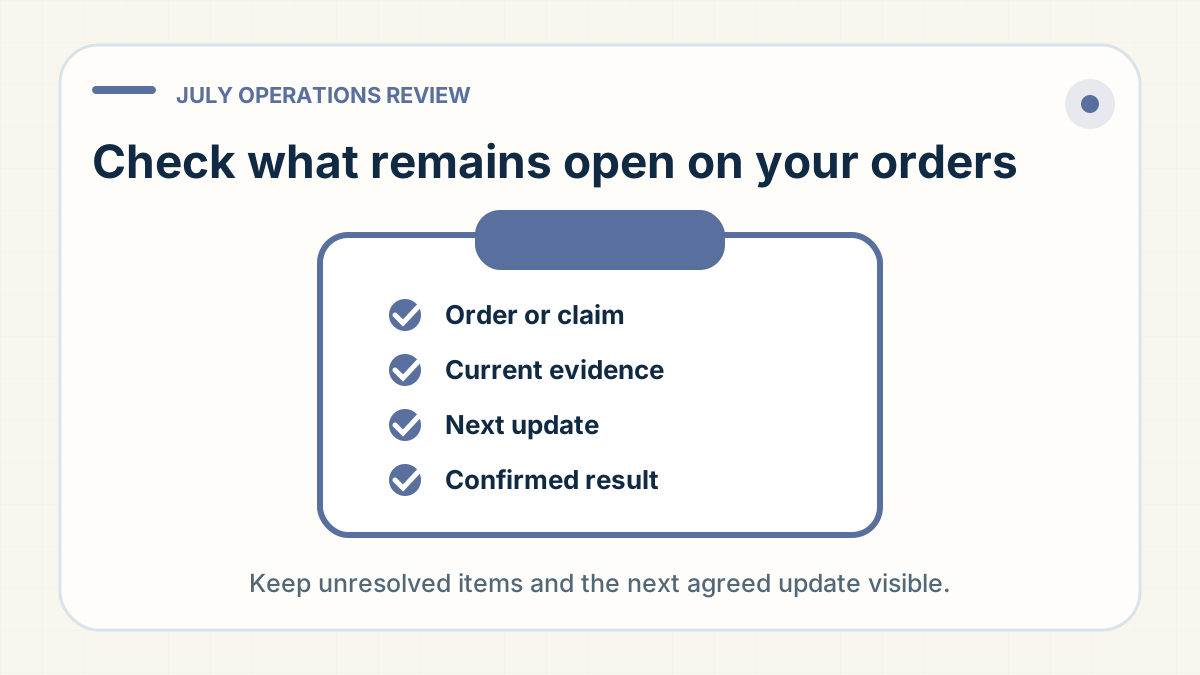
- 01Capture the requestIncluding the parts nobody has answered yet.
- 02Attach useful evidenceCarrier reference, product photo, supplier reply — whatever decides it.
- 03Assign owner and deadlineAcknowledgement is not the same operational state as completion.
- 04Record closure proofWhat makes this finished, so it cannot silently reopen.
July by the numbers
July's evidence base contains 31 dated daily operations notes and five weekly review windows. We grouped the recurring work into five case clusters—European route changes, inventory decisions, repeat quality signals, platform preflight, and privacy with ownership—and carried seven controls into August. This is a collective RyanFulfil review across DropFulfill and YRFulfill, not a claim about one customer or one channel.
The final review window alone contained dozens of likely new-seller conversations. "Likely" is important: those records included introductions, product enquiries, quotation work, samples, onboarding actions, first paid orders and live repeat fulfilment. They were not dozens of automatically confirmed clients. Across the month, the desk also handled live platform, tracking, cancellation, return, quality and supplier work, so intake volume and operational volume must be read separately.
The 31 reviewed days sit within five overlapping weekly windows; conversation counts are not unique customers. The examples cover five recurring case clusters, seven controls, and operating stages from no paid orders through low-tens flows and separate hundreds-of-units sourcing or stock discussions.
Markets repeatedly included the US, UK and Europe. Product categories included accessories, apparel and footwear, electronics, beauty and personal care, home and lifestyle, pet, and health and fitness. One returns-and-repacking workload reached the high tens, while other conversations concerned a single test order or one priority product. That spread is why July could not be reduced to one average client or one standard fulfilment package.
What sellers actually brought us
Some people were still deciding whether a product was viable. They asked for a source, delivered price and route, then discovered that sample evidence, packaging, product compliance or a target delivery promise also shaped the decision. For them, the useful outcome was a narrower first test—not a complex integration or premature stock commitment.
Some already had orders and were changing agents, factories or product versions. Their background included inherited open orders, unclear stock, discontinued variants and suppliers offering a broadly similar replacement. These were not ordinary sourcing conversations: the team had to preserve the approved customer promise while separating old responsibility from the new workflow.
Other sellers were planning growth. They were weighing China pre-stock, a destination-country warehouse, campaign demand or a larger factory buy. The practical constraint was rarely "Can stock be stored?" It was whether paid demand, SKU concentration, replenishment time, source stability and cash exposure supported moving inventory before the next proof point.
Live operations brought a different queue: connected stores that still needed a controlled test order; tracking numbers that had to return to the right order; customer changes racing the physical release cut-off; repeated replacements suggesting a supplier or batch problem; and parcels delayed by customs, weather, incomplete data or last-mile events. July's job was to keep those physical states connected to the promise made in chat.
For dropshippers, the relevance is immediate. An agent can help source, inspect, pack and route an order, and Dianxiaomi can support part of the internal order flow. Neither can decide what product difference is acceptable, whether an address change reached the warehouse in time, whether repeated defects require a stop-release decision or how much inventory your evidence justifies. Those decisions still need a visible human owner and proof of completion.
July at a glance: more live operations, more ways to lose context
July's reviewed work covered US, UK and European markets across accessories, apparel and footwear, electronics, beauty and personal care, home and lifestyle, pet, and health and fitness categories. Some sellers were still selecting a first product; others had first orders or low-tens flows; separate sourcing and stock conversations were already in the hundreds-of-units range. The examples below are composites across those conversations so the operating lesson is concrete without exposing a person, store, address, exact product or precise volume.
The shift from June was not simply "more work". More conversations now crossed boundaries: a supplier change affected the approved product, a store connection affected tracking, an after-sales remedy affected QC, or a European route change affected the landed-cost promise. July's best work left a recoverable record that connected those pieces.
The month week by week
June 28–July 4 opened with European fee changes, a customs rumour that needed checking, growing-store stock questions and a long client thread that had to be turned into one readable plan. The week established the month's central problem: a fast answer is not useful if nobody can recover the assumptions behind it.
July 4–11 focused on preventable small errors. A seller switching agents needed inherited orders separated from the new workflow; a changed source produced a bad batch signal; a warehouse flow was being built in stages; and first orders exposed delivery and handover gaps.
July 12–18 connected samples, custom work, weather disruption, warranty expectations and after-sales decisions. The shared control was to show the physical path behind a promise—what had been checked, what remained external, and when the next meaningful update would exist.
July 19–25 brought route tests, supplier comparisons, packaging, samples, cancellations and tracking into one open-action structure. This was the week where "fewer assumptions" became a practical operating standard rather than a slogan.
July 25–August 1 combined dozens of likely new-seller conversations with live platform, quality, tracking and after-sales work. The wrap deliberately distinguishes an enquiry from a quote, sample, onboarding step, first paid order or repeat account, and shows why each stage needs a different next action.
Case file: a European rule change reached the quote desk
A route or customs change first appears as information, but sellers experience it as a margin and customer-promise decision. July's European questions required the exact destination, product classification, effective timing, parcel composition and included-charge assumption to be checked together. A quote written before the change could not simply be reused, and a headline fee could not be multiplied blindly across every product in a mixed parcel.
The day the EU's new tax rule landed on everyone at once shows the immediate pressure. Chasing down a customs rumour while solving a warehouse puzzle shows the verification step, while The value of a clear route check turns the lesson into a repeatable destination-and-product decision.
Case file: growth changed the inventory decision
Several conversations involved sellers choosing among order-by-order fulfilment, Guangzhou pre-stock and inventory closer to the customer. The appropriate model depended on evidence: paid demand rather than a forecast, the concentration of demand across SKUs, supplier stability, replenishment time, working capital and the delivery promise. An overseas warehouse could shorten the final journey while adding inbound freight, receiving, storage and replenishment risk.
When a product takes off faster than the factory can keep up is the capacity signal. Building a more reliable warehouse flow shows the controlled response, and Switching agents and stopping a batch before dispatch shows why stock is not truly available until the approved version and quality state are known.
Case file: repeat remedies became a quality signal
A refund or replacement can be fair for one customer and still hide a systems problem. July included recurring complaints across broad device, apparel and custom-product contexts. Once cases repeated, the useful record needed a consistent defect category, actual evidence, approved reference, supplier or batch context, temporary release decision, root-cause owner and proof that the corrective action held.
Quality and packaging are the same conversation links the observed defect to the way the item was prepared. What a useful supplier comparison looks like prevents a replacement source from being approved on price alone. The late-month note When another replacement becomes a quality-control signal shows the escalation from remedy to prevention.
Case file: a connected store still needed a physical preflight
Store and marketplace questions often sounded technical, but the decisive test was physical. Could the correct order and variant be seen? Did an address or cancellation reach the release workflow in time? Which milestone counted as shipped? Would the customer's store receive a usable tracking number, including a later local-carrier handoff? What happened when a field was missing or a substitution needed approval?
Honest talk about shipping labels and the unglamorous work of operations separates label creation from movement. When "automatic" fulfilment still needs a human decision explains the exception boundary. A tracking number has to work where the order lives and The exact question before the easy answer complete the store-to-customer evidence trail.
Case file: privacy and ownership improved the handover
Operational accuracy requires access to customer and account data, but not every participant or broad chat needs the full record. July's safer pattern was to keep exact addresses, contact details, store links, credentials and identifiable order information in restricted systems; use a masked confirmation in coordination; and record the task owner, deadline and closure evidence without copying the private record into the public story.
Confirming details without spreading them gives the privacy pattern. What an open promise actually needs gives the ownership pattern: exact request, evidence, owner, next update and a condition that proves closure.
Where the internal order flow added useful context
Dianxiaomi helped explain one high-level internal bridge between connected stores, the RyanFulfil order queue and tracking updates. It did not replace the product reference, release rule, warehouse milestone or exception decision. July's improvement was to test the full store-to-customer path with a controlled order and to document the human decision points that should never be hidden behind the word "automatic".
Checks to agree with your fulfilment partner
- One open-action register spanning sourcing, stock, dispatch, tracking and after-sales work.
- A controlled store preflight covering order visibility, variant, address, hold or cancellation, release, tracking return and customer notification.
- A change-control trigger whenever the supplier, factory, material, model, colour or product version changes.
- A repeat-defect threshold that moves work from individual remedies into supplier corrective action and verified prevention.
- An inventory-position decision based on paid demand, SKU concentration, source stability, replenishment time and working capital.
- Stage-based reporting that keeps enquiries, quotes, samples, onboarding, first orders and repeat fulfilment distinct.
- Minimum-necessary data sharing, with sensitive customer and account details kept in restricted systems.
Where your order needs an explicit agreement
- A busy front door with mixed intent. A product question might come from someone comparing an idea, preparing a first order, moving an existing store or trying to rescue a supplier problem.
- External change arriving inside live work. European fees, customs uncertainty, remote-area constraints and route availability had to be translated into current product-and-destination decisions.
- Supplier changes presented as "similar". The team had to recover the approved reference, show the meaningful difference and decide whether a first affected batch needed renewed inspection.
- Remedies that could hide a pattern. Refunds and replacements solved an immediate customer issue but also had to feed a defect record capable of exposing a recurring product, batch or packing cause.
- Automation language running ahead of the physical operation. Connected orders still needed product, address, release, cancellation, tracking-return and notification checks before live volume depended on them.
- Private data mixed with coordination. Exact addresses, contact details, store access and identifiable order information had to remain restricted while the broader team still received enough masked context to act.
The hardest part was not any one tool or parcel. It was preserving context as work crossed seller chat, sourcing, supplier confirmation, warehouse release, tracking and after-sales. July's answer was an open-action structure: exact request, current evidence, owner, next update and the event that proves closure. That made a promise recoverable even when the original conversation had moved on.
What changed—and why it matters to a dropshipper
New conversations were reported by stage instead of being collapsed into a single client number. That protects a seller too: a call is not onboarding, a quote is not approved stock, and a forecast is not paid demand. Each stage now points to a different next action and prevents enthusiasm from becoming an unsupported inventory or delivery commitment.
Platform work moved toward a controlled end-to-end preflight. A test needs to prove order visibility, variant interpretation, address handling, hold or cancellation behaviour, physical release, tracking return and customer notification. For a dropshipper, passing that chain with one controlled order is more valuable than being told an integration is "automatic".
Repeat quality work moved from isolated remedy toward corrective action. The operating improvement is to classify the defect consistently, link it to the product version and source, set a threshold for holding release, investigate the cause and inspect evidence that the correction worked. This protects future customers instead of measuring service only by how quickly one replacement was sent.
Inventory conversations moved toward evidence-based positioning. Dropship, China pre-stock and overseas inventory are not status levels; they solve different constraints. July's decision rule was to earn the next commitment through paid demand, concentrated SKU performance, a stable source, known replenishment time and a delivery promise valuable enough to justify the cash and handling cost.
Privacy became part of operational quality. The team can confirm that an address or account detail has been checked without repeating it publicly, and can assign an action without copying store credentials into a broad group. That reduces both data exposure and fulfilment mistakes caused by competing versions of the same private record.
The controls to check are: stage-based intake, route decisions tied to current evidence, product-change approval, repeat-defect escalation, tested store handoffs, demand-led inventory decisions and minimum-necessary data sharing. These records describe operational controls, not measured conversion, savings or delivery improvements.
If July sounds like your current operation, start with one controlled platform preflight or one open-action register, then ask RyanFulfil to help connect the physical workflow before volume makes the gaps harder to see.