Newer figures: for orders paid 1 May – 3 October 2026, see Where 197,000 Dropshipping Orders Went.
The dataset, and its limits
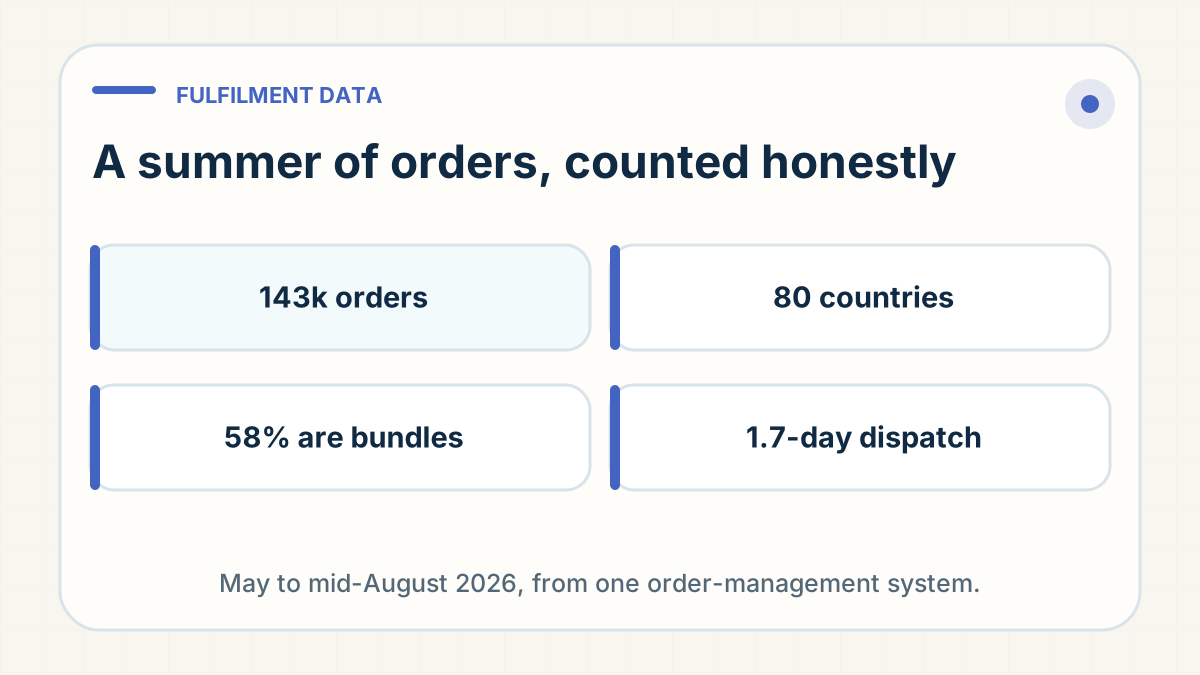
Between 1 May and 14 August 2026, a little over 143,000 orders moved through one of our order-management systems, sent by roughly 140 stores to 80 destination countries. This page reads that book of orders the way the demand analysis read public supplier requests: counted honestly, with the limits stated first. Orders fulfilled manually or through other systems are excluded, so every total here understates the real operation. Money figures are converted to US dollars at fixed exchange rates and rounded. No store, seller, customer or exact product is identified, and product types are generalised from customs descriptions to broad families.
Where the orders went
The United States was the single largest destination, taking roughly one order in four and about 27 cents of every dollar of order value. The next five markets — Spain, Japan, Germany, the United Kingdom and France — each took between seven and twelve per cent of orders. Together the top six destinations carried roughly seven in ten orders; the remaining three in ten spread across 74 further countries, from the Netherlands and Australia down to single-parcel destinations.
The currency mix tells the same story from a different angle. Euros were the currency of sale on about 45 per cent of orders, US dollars on 36 per cent, yen on nine per cent and pounds on six per cent, with Turkish lira, Nordic currencies and a long tail behind them. A store selling from China is, in practice, running a multi-currency European business earlier than most sellers expect.
What was inside the parcels
Attributing each order to the broad family of its first line item, and counting only orders whose customs description is recorded:
- Beauty and nail care — roughly 24 per cent of orders.
- Fashion accessories and small organisers — roughly 20 per cent.
- Sports, fitness and support gear — roughly 13 per cent.
- Apparel and underwear — roughly 11 per cent.
- Electronics and small gadgets — roughly 10 per cent.
- Eyewear — roughly 9 per cent.
- Home and kitchen, toys, pet supplies and a mixed tail — the remaining 13 per cent.
None of these are predictions about what will sell next quarter. They describe what a working fulfilment book looks like when nobody is curating it for a screenshot: a few large, unglamorous families — beauty, accessories, basics — carrying most of the volume.
The typical order is a bundle
The median order was worth about US$47, and 58 per cent of orders contained two or more units — the average order carried 2.5. Multi-unit is not the exception in this book; it is the norm. Volume discounts, colour packs and post-purchase upsells have quietly changed what a parcel is, and bundles, inserts and free gifts change fulfilment costs in ways a per-order price list does not show. If your fulfilment quote assumes one unit per parcel, it is describing a minority of modern orders.
Weight points the same direction. The median parcel in this dataset weighed about 60 grams — nail sets, accessories, small apparel items — and even the heavier branded-goods side of the book sat around 310 grams at its median. Lightweight economy lines and their weight bands matter more to unit economics than most sellers realise when they compare quotes.
How fast orders left the warehouse
Median time from payment to carrier handover was 1.7 days across the whole book — and that median held even as monthly volume nearly doubled. The orders that took longer were rarely a warehouse story: in the records, the slow ones were overwhelmingly waiting on stock replenishment rather than sitting in a packing queue. That is a purchasing-rhythm problem, and it is why a practical reorder point does more for dispatch speed than any promise a supplier can make about its packing bench.
Dispatch is also not delivery. These figures end at carrier handover; the delivery half of the journey depends on route and destination, which is why the same warehouse performance can feel fast in Rotterdam and slow in Riyadh.
Volume nearly doubled; dispatch speed held
Monthly volume roughly doubled between May and July, driven by existing stores scaling rather than new intake. Median dispatch time held under two days throughout. That elasticity is the operational fact a seller should actually test for when choosing a partner: not the quoted speed at today's volume, but what happens to that speed when a winning product multiplies the daily count.
What buyers ask for, and what actually ships
Read next to what 355 supplier requests reveal, this dataset is the other half of a conversation. In public sourcing communities, buyers lead with deadlines, no-MOQ asks and destination warehouses. The shipped book answers with bundles, sub-100-gram parcels and euro-denominated European demand. Both are real; the difference between them is roughly the difference between what sellers worry about and what their customers keep ordering.
What this means if you are choosing fulfilment
- Price the bundle, not the unit. A majority of orders carry multiple units, so per-parcel handling and QC assumptions decide the real cost.
- Ask about weight bands before carrier names. At a 60-gram median, the boundary between one economy band and the next moves margin more than the logo on the van.
- Treat Europe as several markets. Currency, language and customs behaviour differ; the euro share of this book says European demand arrives early and in volume.
- Ask for the dispatch record, not just an average. Any supplier can quote a headline speed; the useful question is what happens to their slowest orders and why, because that tail is where customer complaints live.
How this analysis is built
Figures come from order records in one of our order-management systems: one row per order, deduplicated, covering 1 May to 14 August 2026. Values in other currencies are converted to US dollars at fixed rates, so money figures are approximate; order and unit counts are exact for what the system captured, and orders fulfilled outside it are absent. Product families are generalised from customs descriptions. No store, seller, customer, exact product or precise per-store volume is identified, and counts are rounded throughout.
Need one order or route checked?
Worried about an order's tracking? Send us the order number on WhatsApp (wa.link/dropship) and we'll check what's going on.
Check Order on WhatsApp →