A free gift is not free to the parcel
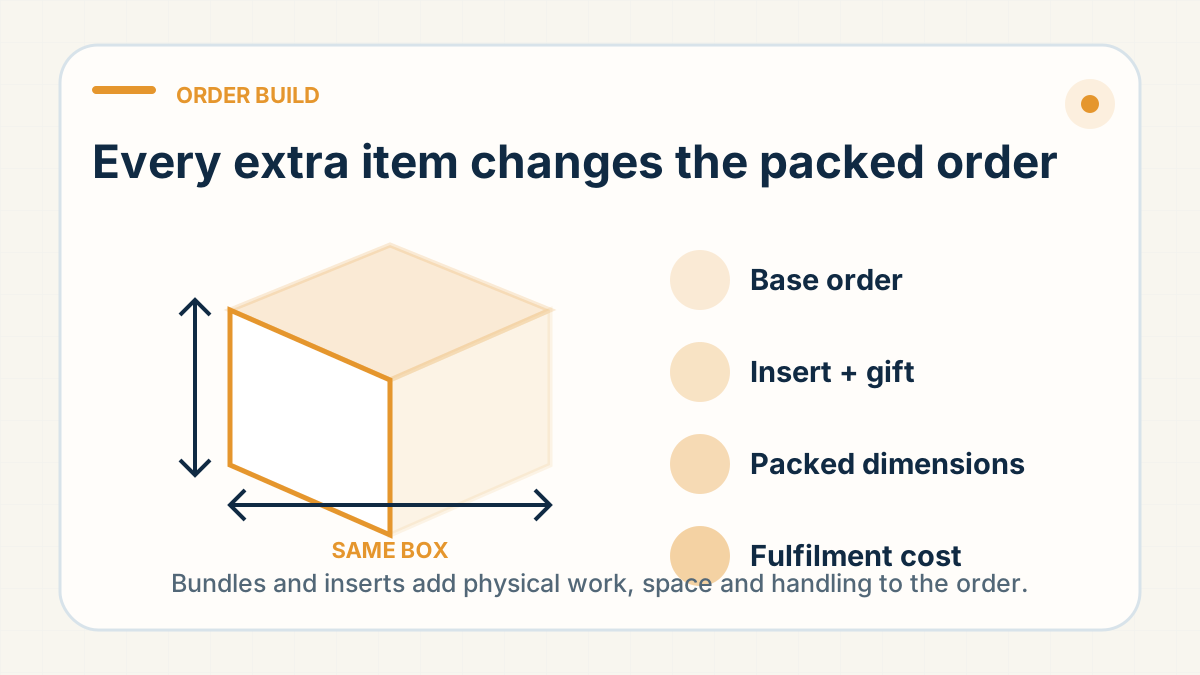
If you add a free gift or bundle to lift conversion, your store has created a new physical product even when the offer looks like a marketing change. Every component affects inventory, picking, packing, weight, dimensions and error risk. Price the complete customer-ready parcel before you launch it—not just the item you are giving away.
Define the bill of materials
Write every component and required quantity for each sellable bundle: main item, accessory, spare part, insert, pouch, sticker, branded box and protective material. Give components their own SKUs where they need inventory control. Shopify's bundle guidance illustrates why this matters: sellable bundle quantity is constrained by the component with the lowest available stock.
Recalculate the packed parcel
- Product and component purchase cost.
- Inbound movement and receiving checks.
- Pick, assembly or kitting work.
- Packaging material, insert and label cost.
- Actual and dimensional shipping weight after packing.
- Expected rework, replacement and storage cost.
For an EU low-value consignment, add the customs-item count as a separate line. The temporary duty follows the customs items represented by declaration lines, not simply the number of physical pieces or parcels. The EU €3 customs-item guide shows how to count the official T-shirt-and-watch example and test a mixed bundle without assuming every SKU creates another charge.
A lightweight insert may add little postage but still create artwork approval and picking work. A rigid gift may force a larger carton and change volumetric weight. A liquid, battery or magnet may change route eligibility even when the main product is straightforward.
Can you store my printed cards and put one in every parcel?
Yes. Cards and stickers are stored as a component and added at packing by your rule: one per order, or one per item. Say which before the first multi-item order arrives. In the week to 2 October 2026, several separate sellers asked this desk to add their own card to each parcel.
Cards you print yourself are sent in like stock: announce the inbound with its tracking, so its arrival is confirmed before packing starts. Cards printed in China start from a print-ready file, because the printer's minimum and price can be checked only against it. Expect print minimums in the hundreds, no return once production starts, and possibly a mock-up after the order instead of a single printed proof.
Ask whether inserting the card changes the quote; if it does, the extra is a separate line shown before you approve. Stored materials are applied to every order for as long as your orders keep flowing, and storage is free while orders are consistent, with a storage plan agreed before any charge.
Ask too what paper the factory already puts in the box: its inserts may need replacing or translating, and its files can be requested for you to revise. A card the product is mounted on, such as an earring card, is repacking rather than an insert, so confirm that step separately. The packaging ladder from sticker to custom box shows what usually follows a card.
Decide how inventory will behave
Choose whether components remain available for individual sale, are reserved for bundles, or are pre-kitted into a new stock unit. Pre-kitting can speed dispatch and reduce pick errors, but it ties up components and complicates changes. On-demand kitting preserves flexibility but requires clear pick instructions and enough processing capacity.
Test the actual final package
The bundle should be checked as it will ship, with production components and intended packaging. ISTA guidance emphasises identifying the tested product and package configuration; changing either can make earlier performance evidence less relevant. For fragile or high-value combinations, test movement, compression and component contact points rather than assuming the main item's old package still works.
Control promotional changes
- Start and end date or stock limit.
- Eligible products, variants, markets and sales channels.
- Approved substitution rule if the gift runs out.
- Customer-facing wording if the item is limited or may ship separately.
- Removal instruction so an expired promotion does not continue at the packing table.
Use a simple margin test
Calculate contribution after the complete packed cost, not only after product cost. Then compare the expected commercial benefit—higher conversion, order value, retention or clearance—with the extra fulfilment and exception burden. A popular bundle that regularly ships incorrectly can destroy the value it was designed to create.
A higher basket value is not enough on its own. Use the AOV and cart-quality audit to separate price, unit depth, attachment and delivered contribution before calling the bundle a win.
Cost the physical work behind the free offer
Treat every bundle in your store as a small product with its own components, packing specification, inventory rule and landed cost. Launch only after the final packed parcel has been costed and tested; that is how your marketing idea becomes repeatable fulfilment rather than a daily exception.
The rule: Approve and measure the complete bundle before pricing it. Every insert, gift and protective layer can change component stock, packing time, chargeable weight, route eligibility and whether the order remains one parcel, so the main item's old quote is no longer the decision basis.
Have a specific fulfilment question?
Send us the product, destination and order context on WhatsApp (+86 178 4666 9989), and we'll answer for that order instead of giving a generic estimate.
Ask Questions on WhatsApp →