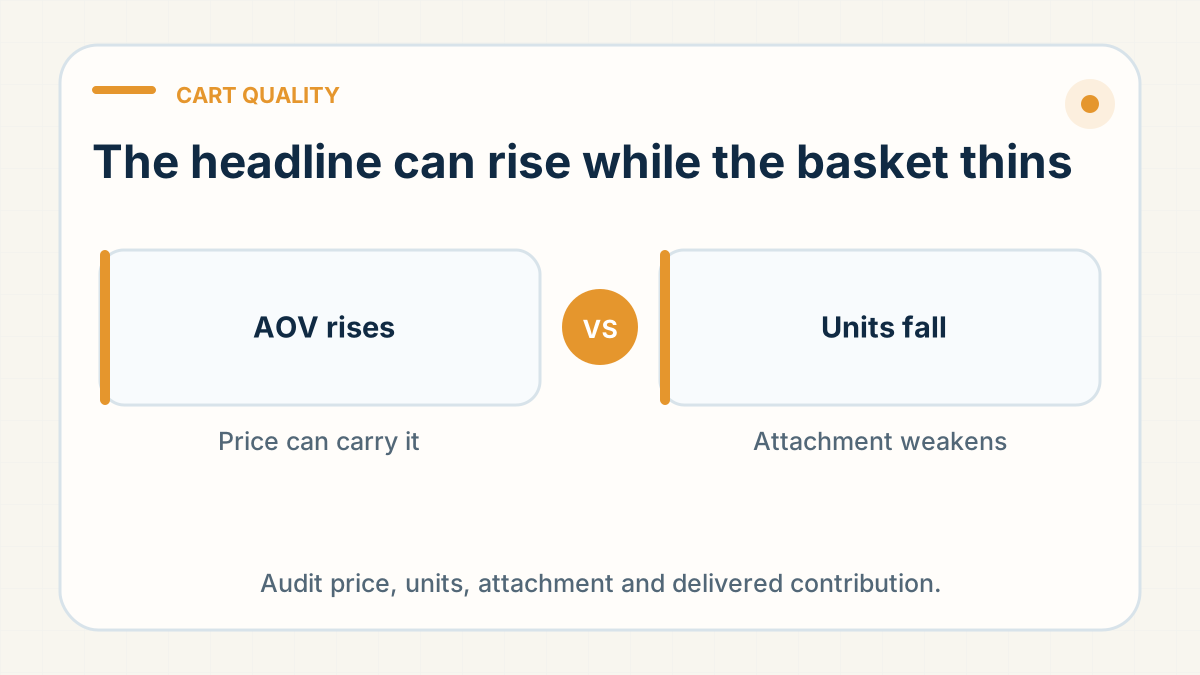
AOV is a headline, not a diagnosis
AOV is one division: revenue divided by orders. It cannot tell you whether the customer bought more, paid more for the same item or removed the second product before checkout. A store can therefore report a higher AOV while unit depth, bundle attachment and delivered contribution weaken underneath it.
That distinction matters because the second item often has different economics from the first. It may share the same acquisition cost, parcel and handling event. If customers keep the hero product but prune the relevant refill, accessory or second unit, revenue per order can look stable while the efficient part of the basket disappears.
The Q1 signal was "paying more, taking less"
Klaviyo analysed same-site activity from a stable cohort of 10,000 high-GMV brands and retailers in Q1 2026. In the US, average order value rose 1.7% year over year while average selling price per item rose 8.7% and units per transaction fell 6.4%. Klaviyo said the same broad pattern appeared in the UK, Australia and New Zealand, while product views per ordered product increased across verticals.
Read together, those figures describe a more selective basket: a modestly higher order value carried by price while unit count fell. They do not prove that any individual Shopify store has the same problem. The cohort is not a dropshipping sample, the figures are approximate and unaudited, and category mixes differ. They are a prompt to open the store dashboard and check what actually moved.
A stable basket can contain a worse order
Consider a simple illustration. The old order contains a $40 hero product and a $10 useful accessory: two units and $50 of revenue. The new order contains only the hero after its price rises to $51: one unit and $51 of revenue. AOV reports a 2% improvement. Units per transaction reports a 50% collapse. Neither tells you the delivered contribution until the product, discount, parcel and exception costs are applied.
Neither metric decides profitability alone. The higher-priced hero may contribute more cash, or it may merely pass through higher product, tariff or freight cost. The accessory may have been efficient because it fitted inside the same parcel, or expensive because it triggered a second supplier and split shipment. The point is not that fewer units are always bad. It is that AOV cannot reveal which version occurred.
The second item only matters when its economics are real
Many stores treat an attached item as almost free revenue because the first product already earned the customer. Fulfilment can overturn that assumption. A case, refill or second colour may change chargeable weight, require another pick, cross a route or customs constraint, increase breakage, or ship separately when one component is out of stock.
Price the customer-ready combination with the bundle and free-gift cost guide and calculate the full landed cost before calling the second unit high-margin.
- Product and supplier-movement cost for every component.
- Incremental checking, picking, packing and packaging.
- Actual combined packed dimensions, chargeable weight and route.
- Expected split-parcel, damage, support, refund and reship cost.
- The discount or free-shipping subsidy used to create the attachment.
A useful add-on completes the first decision
A generic "add anything for 20% off" message asks the customer to make a second buying decision. A relevant refill, replacement part, matching component or protective item can feel different because it completes the use the customer already chose. That is a hypothesis to test, not a reason to manufacture urgency or attach an unrelated product.
The add-on also has to be genuinely optional. If the hero product cannot deliver its advertised outcome without the accessory, include the missing component or fix the base offer. Charging customers to repair an incomplete promise may lift the basket once and damage refunds, reviews and repeat behaviour later.
Audit the stack below AOV
- Average selling price per unit: did price, mix or a premium variant carry the order value?
- Units per transaction: are customers buying fewer physical items per completed order?
- Attach rate by offer: which refill, accessory, second unit or bundle is being accepted?
- Delivered contribution per order: what remains after every variable fulfilment and exception cost?
- Delivered contribution per eligible visit: did the offer improve the whole funnel, not only completed baskets?
- Split-parcel and partial-stockout rate: did the larger basket create a second operational failure path?
- New-versus-repeat mix: are existing buyers behaving differently from first-time customers?
Keep the count beside every rate and compare the same market, product version, traffic source and period where possible. AOV can rise because the store sold more premium variants, because a low-priced item went out of stock or because discounts changed. The decomposition should explain the movement before the team writes a story around it.
If acquisition cost moved during the same period, run the Meta CAC diagnostic before asking a larger basket to repair an auction, creative or conversion problem.
Segment acquisition and retention before changing the offer
Klaviyo also reported that new-buyer discount rates in its Q1 cohort rose from 9.8% to 10.8%, while repeat-buyer discount rates edged down from 12.1% to 11.7%. That does not establish why the rates changed or prescribe a discount. It does show why one blended basket can conceal two different customer economics.
Separate first-time and repeat buyers when measuring attachment, discount, contribution and returns. A new customer may need a simpler first decision. A repeat customer who already owns the hero product may respond better to a replenishment or complementary item. Relevance should do the work before a larger discount does.
Run one cart-quality test at a time
Choose one hero SKU with enough stable traffic and one related item with approved product and fulfilment economics. Keep a clean control. In the treatment, present one specific add-on or bundle with an honest price and clear reason it belongs. Hold the main creative, product version, market and delivery promise as steady as practical.
- Pre-write the primary outcome: incremental delivered contribution per eligible visit.
- Measure conversion, AOV, units per transaction and attach rate as diagnostic outcomes.
- Follow the orders through delivery so refunds, reships and split parcels can mature.
- Record new and repeat customers separately when the sample supports it.
- Stop if quality, stock, dispatch time, damage or customer confusion crosses its limit.
Do not declare a winner because treatment AOV rose. The offer may have converted fewer visitors into larger baskets. It may have attracted discount-led orders that returned more often. Contribution per eligible visit connects the basket to acquisition; delivered contribution keeps the physical outcome inside the result.
Ask fulfilment before publishing the bundle
- Are the hero and add-on tied to stable, separately countable SKUs?
- Can both products travel together to the target market and remain protected in one approved pack?
- What happens when one component is unavailable: hold, split, substitute, remove or cancel?
- Does the combined parcel change chargeable weight, customs treatment, tracking or delivery range?
- Can the warehouse distinguish a paid bundle, optional add-on, free gift and repeat-order configuration?
- Which evidence will identify whether a return was caused by the hero, the add-on or the combined pack?
These answers determine whether the offer is one coherent order or two supply chains sharing a checkout. The difference rarely appears in the AOV tile.
Use an adjacent SKU to improve the customer job, not the catalog size
If the second item is new, make it pass the adjacent-SKU framework before asking the hero product to carry it. Test the item standalone, as an optional add-on and inside a clearly priced bundle so weak demand does not hide inside the original sale.
The strongest attachment usually has a reason that survives outside the discount: it replenishes, protects, fits, completes or extends the same customer job. Supplier convenience and visual similarity are not customer evidence.
Do not let theoretical LTV rescue a weaker cart
A smaller first basket can still be healthy when customers deliberately start with one item and later return through a proven mechanism. But the first-order margin and realised-LTV test should decide that with mature cohort contribution and a cash-safe payback window—not a hope that email will recover the missing add-on.
The reverse is also true. A larger discounted basket is not automatically a better customer. Track whether the cohort repeats, how much contribution actually arrives and whether the operational complexity was paid for.
Audit the cart beneath the AOV
AOV tells you what the average completed order was worth. It does not tell you what the customer removed, what the parcel cost to deliver or what remained after the exception risk. Decompose the number into price, units, attachment and delivered contribution before changing the offer.
The sharper question is not "How do we push AOV higher?" It is "What did the customer remove after deciding to buy—and did that removal make the order better or worse after fulfilment?" Your AOV is the headline. Units and delivered contribution are the footnote. Right now, the footnote may be the story.
What these figures can and cannot show
The Q1 2026 AOV, selling-price, units-per-transaction, browsing and discount figures are Klaviyo-reported observations from a stable cohort of 10,000 high-GMV brands and retailers. Klaviyo describes the data as anonymised, aggregated, approximate, unaudited and subject to adjustment. It is not a dropshipping study and does not establish what caused the changes. Use the cart-quality audit, fulfilment checks, test design and decision rules to examine your own store; they do not guarantee conversion, attachment, repeat purchase or profit.
Need a product checked before you spend on ads?
Send us the product link and destination on WhatsApp (+86 178 4666 9989). We'll check sourcing, packing and shipping with you before you commit.
Get Sourcing Quote on WhatsApp →