Back to blog
Sourcing Tips

An Unsized Driver Is Unknown, Not Zero

15 min read
Subtract what you cannot copy. An unsized driver counts as unknown, never as zero.

Subtract the drivers before you trust the number

A growth rate tells you how a company did. It does not tell you that a product will sell for you. Before a headline number gets you to place an order, name everything that could have produced it, size what the source lets you size, and mark the rest unknown. Unknown is not a small number. It is no number at all, and it is the honest answer far more often than a clean one is.

Of the eleven company results read for this guide, exactly one left something you could work out at all, and it turned out to be a reason not to source. In the other ten the company named a driver and then would not size it. Expect that. It tells you how much weight a public growth number can carry when you are choosing what to buy, which is very little.

The guide on what sits underneath a winning product pulls apart the demand behind your own product, and it is still the right place to start. This one is the outward half: it pulls apart somebody else's number before you let it move your money.

What these results do and do not tell you

These companies reported in August 2026: Zalando on 3 and 4 August, the other ten between 25 and 28 August. Each one is here because it shows one driver clearly, not because we like the shares. Every one of them has stores, brands, wholesale deals, local stock or a licence you do not have and cannot buy.

Read the year labels carefully. Every US retailer here calls a May-to-July 2026 quarter part of "fiscal 2026" except Best Buy, which calls the same months fiscal 2027. Zalando's quarter is the three months to 30 June 2026. None of it is a benchmark for you. A retailer's comparable-sales rate is not your conversion rate, and its shipment growth is not your sell-through.

Eight drivers behind a reported growth number

Run this list against any growth number before you treat it as a sign that a product will sell for you. Each driver is shown by a company that disclosed it in this window.

  • Something they bought. Zalando reported second-quarter GMV growth of 20.7 per cent and revenue growth of 20.8 per cent. On the pro-forma basis it publishes alongside, which puts ABOUT YOU into both periods, GMV grew 4.4 per cent and revenue grew 1.1 per cent. Its business-to-consumer arm reported 20.3 per cent revenue growth and minus 0.6 per cent pro-forma.
  • New space the comparison leaves out. Abercrombie & Fitch reported Hollister net sales up 2 per cent on comparable sales of minus 3 per cent. The gap is space the comparison excludes: new doors, and shops rebuilt or resized enough to drop out of it.
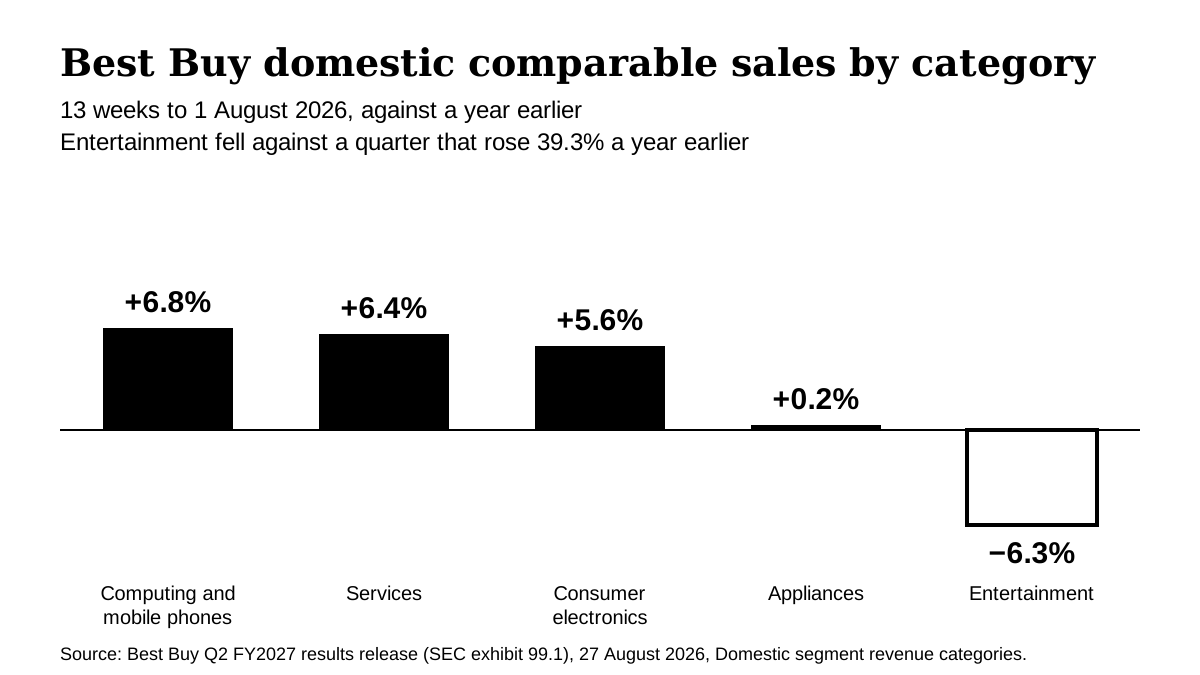
  • An easy comparison. Best Buy reported Domestic Entertainment comparable sales of minus 6.3 per cent against plus 39.3 per cent a year earlier, which management put down to lapping the June 2025 Switch 2 launch. The fall is the base, and so was last year's spike.
  • A one-off refund. Gap reported gross margin of 52.8 per cent, up 1,160 basis points, of which 1,140 basis points was the expected recovery of tariffs paid under a regime the US Supreme Court struck down in February 2026. Adjusted gross margin was 41.4 per cent, up 20 basis points.
  • Stock pushed into the channel, not sold to people. TCL Electronics reported Mini LED television shipments of 2.43 million sets for the half, up 77.1 per cent, citing Omdia brand-shipment data, against industry Mini LED brand shipments up 119.2 per cent to about 10.53 million sets. The rate that looks spectacular is well below the category it leads.
  • Price, not units. Gap brand reported comparable sales of plus 10 per cent while average unit retail rose across all brands, and the release does not split price from volume, so how much of that 10 per cent is units is unknown. Group comparable sales still fell 1 per cent.
  • A definition that moved. Bath & Body Works reports a line called International and Other, up 24.9 per cent, whose growth its quarterly filing puts first down to more domestic wholesale distribution, on a base of roughly 5.6 per cent of group sales. Read that as overseas shoppers wanting more and you have drawn a country conclusion from a channel fact.
  • A brand or licence you cannot get. Xtep's professional sports arm, up 11.4 per cent, is Saucony and Merrell run under licence, and the group paid royalties on it for the half. ANTA's all-other-brands revenue rose 44.2 per cent, which the company puts down to Descente and Kolon Sport together with Jack Wolfskin, bought on 31 May 2025.
A decision map, not a measured model: eight drivers are taken off a reported growth number, and only what is left is worth a test of your own.

Size what you can, and write the rest down as unknown

Write the subtraction out. What is left for you = reported growth - what they bought - new space - an easy comparison - a one-off refund - stock pushed into the channel - price rises - a changed definition - a brand or licence you cannot get. Most of those you will not be able to work out from a public source, and that is exactly why you write them down instead of carrying them in your head.

Here is the rule that matters: a driver you cannot size is unknown, never zero. ANTA is the clean case. The company names buying Jack Wolfskin as part of the 44.2 per cent, but publishes no like-for-like or currency-adjusted rate for that arm, so you cannot pull the organic part out of the filing at all. Treat the unsized part as nil and you have turned a company disclosure into a demand claim it never made.

Where a like-for-like figure does exist, use it and say which one you used. Zalando publishes both, and the two answers are 20.7 per cent and 4.4 per cent. The company calls its pro-forma figures illustrative and unaudited, so they are its own comparison rather than a reported result.

One row, worked to the end

Zalando is the best case here, because it is the only company that publishes a rate with the purchase taken out of both periods. Reported GMV growth 20.7 per cent. What they bought: ABOUT YOU joined on 11 July 2025, so it is in this period and not the one before; the company sizes it as the gap between 20.7 and 4.4 per cent. New space, easy comparison, one-off refund, channel stock, price and licence: not disclosed, so unknown.

What is left is 4.4 per cent pro-forma GMV growth, before a currency effect nobody has sized. On the revenue side, group revenue grew 1.1 per cent while the consumer-facing arm fell 0.6 per cent, so what growth exists sits in business services and retail media rather than in selling more clothes. So the sentence at the end of the row reads: European fashion demand was roughly flat to slightly down like-for-like, and there is no sign here that a product will sell. The row ends in a decision not to source.

That was the best case. In the other ten you could not get to the end at all: no like-for-like rate for ANTA, no global sell-through for TCL, no per-category comparable sales for Dollar General, no separate revenue for Merrell inside Xtep's arm. A check whose usual answer is "cannot be worked out" is still doing its job, because the alternative was buying on the headline.

When something does survive, write it down as one exact customer job: the use, the person, the product format, the country, the sales channel, the price band and the promise you make. Then run the AI product-research screen: is the problem real, does it fit your setup, can you prove it, and what do you keep once it is delivered. A zero on any one of those ends the test.

The same eight drivers sit behind the numbers you actually see

Most sellers never open a filing. You act on a supplier order badge, an order count in a research tool, a view count in an ad library or a traffic estimate for a rival store. Those numbers have the same eight things behind them, minus the disclosure that lets you name them.

  • A supplier listing showing thousands of orders is channel stock in miniature: orders placed with the supplier, many by other resellers, not units delivered to customers and kept.
  • A store that looks like it exploded may have bought the offer, the creative or the audience, and nobody announces that.
  • A tool showing a product doubling year on year is quoting a base you cannot see, and last year's figure may be a spike or nearly nothing.
  • A revenue estimate built from price times orders moves when price moves, exactly like a comparable-sales figure does.

Filings are the easy version of this read, and the only one where the drivers are named out loud: a company tells you it bought a brand, opened doors or got a refund. A research tool tells you none of that, so your unknown column gets bigger, not smaller.

Separate reported margin from margin your customers earned

A margin improvement is the number you are most likely to misread, because it looks like proof the product got better. Use this: margin your customers earned = reported margin change - the one-off refund. Four companies show how far apart those two can sit.

Gap reported gross margin up 1,160 basis points and 20 basis points adjusted, so it stays positive without the refund. Kohl's reported gross margin of 43.0 per cent, up 305 basis points, having received about 150 million dollars of tariff refunds, of which roughly 100 million ran through gross margin on 3,318 million dollars of net sales. That leaves the underlying rate at about 39.9 per cent, flat on last year.

Williams-Sonoma reported GAAP gross margin up 450 basis points, of which refunds gave it 610, leaving non-GAAP gross margin down 160. Bath & Body Works reported 45.7 per cent against 41.3 per cent, with a credit the company sizes at about 80 million dollars, which puts the underlying rate below last year.

So two of the four reverse direction, one goes flat, and only one is still positive. In none of them did the product economics improve by as much as the headline said.

Reported gross-margin movement against the same movement with the one-off refund taken out, for four companies reporting in August 2026. Company figures, not to scale, and not a benchmark for your own margin.

Two warnings matter if you ship from China. These refunds were of duties already paid under one tariff regime; the duties were replaced rather than removed, and Williams-Sonoma says its guidance assumes tariffs now in place stay, newer ones included. And a claim is not cash: Gap received 95 million dollars of refunds plus 5 million of interest in the quarter and expects the rest later, while Williams-Sonoma pushed 29.3 million dollars of refund income into stock. Your version is supplier credits, carrier reimbursements, chargeback reversals and ad credits. Treat them the same way.

The US retail quarter review does the same split across a different set of retailers and shows the transaction-versus-ticket arithmetic in full. Read that one for the worked sums; this one turns the pattern into a screen you run before you source.

A flat headline can hide two opposite businesses

Group numbers average away the only contrast that would tell you anything. Abercrombie & Fitch reported group comparable sales of zero: Abercrombie brands at plus 4 per cent and Hollister at minus 3 per cent, with Hollister the bigger of the two at about 53 per cent of net sales. Neither behaves like the figure that is supposed to describe both.

It works upward too. Xtep's professional sports arm grew 11.4 per cent while group revenue fell 0.6 per cent, because the arm is about 13 per cent of the group and the mass market shrank. ANTA's group revenue rose 12.9 per cent while its two biggest brand arms rose 4.8 and 6.1 per cent. A spread quoted without its weights is a story, not evidence.

Shipments are not purchases

Many quotable growth rates count units moving into a channel, not units bought by a person. Xtep says its revenue is the net invoiced value of goods sold after returns and trade discounts, with adult stores mainly run by distributors and payment usually due 90 to 120 days after delivery.

TCL puts part of the industry's shipment strength down to stock being built up ahead of the World Cup, and that stock unwinds in the half after these figures. It publishes no global sell-through volume or growth rate at all. The only end-demand series in the document is mainland Chinese industry retail sales volume, which fell 12.4 per cent, while TCL's share of that shrinking market rose. That is share, not growth. Before you read a shipment number as demand, look for a sell-through series in the same document, and note when there is none.

Run a 30/60/90-day test

  • Days 1 to 30: take the three growth numbers you have actually acted on this year, wherever they came from. Fill one row each: the figure, its period and basis, every driver you can name, which ones the source lets you size, and which are unknown. Write what is left as a sentence, and accept "cannot be worked out" as a valid one.
  • Days 31 to 60: if anything survives, turn it into one exact customer job and run a bounded test, with the strongest rival explanation written down before you start. Keep the product version, supplier, route and country fixed so you can tell what caused the result.
  • Days 61 to 90: review the orders once delivery, refunds and reships have settled. Compare what you kept against the rival explanation you wrote in advance, and record whether the growth number added anything your own store data would not have shown you.

Download the blank growth-driver worksheet. It holds no RyanFulfil rates, client data, company figures or thresholds. One row is one growth number you are deciding whether to act on.

Watch, reject, and say what you could not find

  • Watch: an arm grows while the group does not. That is a real contrast worth a question, but the arm may be licensed, bought, wholesale-loaded or tiny, and the source may not let you tell which.
  • Reject: a shipment, wholesale or invoiced-revenue growth rate sold to you as consumer demand when the same document carries no sell-through series.
  • Reject: a margin jump quoted without the one-off refund that produced it, and any suggestion that the company's sourcing or pricing got better.
  • Reject: any move from a growth number straight to a supplier search, and any product that needs a brand, character, patented design or licence you do not hold.
  • Could not find: how long a row takes, so budget most of an hour per filing, most of it spent finding the exhibit with the arm detail; how many results leave you something testable, which in this window was none of eleven; and whether the same drivers sit behind research-tool numbers, which no filing can tell you.

Match what you do to your stage

  • Testing: one row is enough. Do not start a supplier conversation about a number you have not pulled apart.
  • Holding stock or building a private label: make what is left survive a full settling window before it justifies stock, because getting this wrong costs you inventory rather than ad spend.

Where RyanFulfil fits

RyanFulfil can make the China side of that test checkable: whether the exact product version can be sourced and to what spec, what a sample shows, what the packed parcel weighs, which routes accept it, and how problems and returns actually get resolved. Each product, route and country still needs a current check.

You stay responsible for demand, pricing, advertising, legal and compliance decisions, stock levels and the decision to scale. RyanFulfil cannot guarantee sales, route acceptance, delivery dates, customs outcomes or profit.

Bring the spec you approved, the countries you sell to, the volume you expect and the decision you are trying to make. Contact RyanFulfil when what is left needs a current sourcing, sample, packing or route check from the China side.

Expect this to talk you out of things

Here is how you would know it failed: if products you found this way do no better, once refunds have settled, than products you chose with no growth number at all. Run it on your own store and it will usually tell you that somebody else's growth number added nothing your own data would not have shown you. That is the expected answer, not a failure, and it is worth an hour of your time before it costs you a purchase order.

What this does not prove

Last verified 30 August 2026. Every company figure was read from the primary document linked below: results releases and quarterly filings for Gap Inc., Abercrombie & Fitch, Kohl's, Bath & Body Works, Williams-Sonoma, Dollar General and Best Buy, plus Best Buy's earnings-call transcript for the launch-lap explanation its release leaves out; the Hong Kong exchange results announcements for ANTA Sports, Xtep International and TCL Electronics; and Zalando's half-year report and quarterly presentation. Where a percentage was worked out from disclosed amounts rather than stated by the company, the amounts are given beside it.

The eight drivers, the two subtraction sums, the unknown-not-zero rule and the 30/60/90 test are RyanFulfil's own tools rather than company statements, and no company named here has said anything about dropshipping or direct-parcel fulfilment. This is a screen you run before sourcing, not investment research or an opinion on any share. Check the decision again when the period, the arm definition, the ownership, the licence, the channel mix, the product version, the supplier, the route, the price or your own settled numbers change.

Need a product checked before you spend on ads?

Send us the product link and destination on WhatsApp (+86 178 4666 9989). We will help you assess sourcing, packing and shipping before you commit.

Get Sourcing Quote on WhatsApp →