The direct answer
Coffee-machine growth tells you where to look. It does not tell you what to buy. The product worth selling is not the accessory you see in every photo next to the machine. It is the smallest job the owner still does by hand, once you have taken away the machine, the tools in the box, the storage built into it and whatever they could grab from a local shop instead.
That changes your question. Not "coffee is growing, find me accessories", but "one exact owner still repeats one annoying job. Can my product remove it, safely, at a price that pays?" The first question fills a catalogue. The second one saves you from stock you cannot sell.
This is the category version of the rule in the guide on reading a growth number: a company result is not yet a sign that your product will sell. Here the subtraction is physical. Take away what the machine now does for itself, the tools already in the box, the storage already built in and the maker's own next offer. Test only what is left.
A strong result does not describe the next accessory buyer
SharkNinja reported that second-quarter 2026 Cooking and Beverage Appliances sales rose 36.5 per cent, driven by Ninja Luxe Café and Ninja Crispi. The official results release does not split coffee accessories out from cooking appliances. On the call, management put the coffee strength down to a new fully automatic machine and a push into more countries. That tells you more machines are selling. It does not give you a growth rate for accessories.
What the machine does matters more to you than the percentage. Someone who bought a fully automatic machine is a poor customer for a tool whose job is measuring or tamping by hand. A new country launch moves where machines are sold. It does not prove that an owner anywhere wants another object on the counter.
The other side stops you jumping the opposite way. De'Longhi described strength in both automatic and manual machines, with accessories becoming a bigger add-on. Its official H1 and Q2 results and the third-party-hosted earnings-call transcript do not say manual espresso is dying, or that every tamper is finished. They say your buyers split. People who want it easy and people who enjoy doing it by hand are two different customers with two different jobs.
Your free competitor is already in the box
Before you ask a supplier for a starter kit, read the exact machine page. The current US Ninja ES601 listing includes a portafilter, milk jug, two baskets, assisted tamper, funnel and cleaning tools. The current Breville Barista Express listing includes a dosing funnel, several filter baskets, an integrated tamper, a milk jug and cleaning tools, then sells you its own accessories and coffee on the same page.
Your bundle is not competing with an empty counter. It is competing with the box the customer already opened, the machine used the way it was designed, an ordinary tray or dish rack, and the maker's own add-ons. If you cannot beat those, you are adding an object without taking away enough work.
Owners of older machines are a separate group. A review saying a tool was missing may be about an older bundle, another shop or another country. Do not turn one old complaint into ad copy you run at everyone today.
A model number does not prove it fits
The live catalogue gives you a warning for free. The US ES601 page lists two baskets. The UK ES601UK page lists three. So the missing-basket upsell you were about to build for one country is not needed in the other.
The UK page also shows one dimension and weight set in its bullet points and a different set in its specification fields. Pick whichever numbers suit you and you have invented a level of precision the maker's own page does not give. The honest status is unresolved until you measure the exact unit yourself.
Fit is more than a diameter. Your customer has to fill it, prepare it, run it, take it out, empty it, clean it and put the machine back ready for tomorrow. An organiser can look perfect in a photo while it blocks the water tank, the drip tray, the storage compartment, the steam wand or a vent.
Use the blank coffee-accessory compatibility sheet to record the exact model, country, revision, the tools in the box, the access paths, the cleaning routine, the fair alternative, the packed quote and how sure you are. One row is one machine, one country and one revision, not a whole brand family.
A narrow range you have actually checked sells better than a wide one you have not. "Fits most coffee machines" is cheap copy that anyone can write. A page saying exactly which machine, country and revision you measured, what stayed clear, and what changed between bundles is harder to build and much more convincing at checkout. Start with one combination. Add the next only when you have its own evidence.
Fit evidence goes stale. A shop can change a bundle while the model name stays the same. A supplier can change a material or a tolerance and keep the same photo. A new machine revision can move an opening by enough to break a rigid organiser. Check again after any machine, country, bundle, supplier or product-version change.
The maker wants your customer's next question too
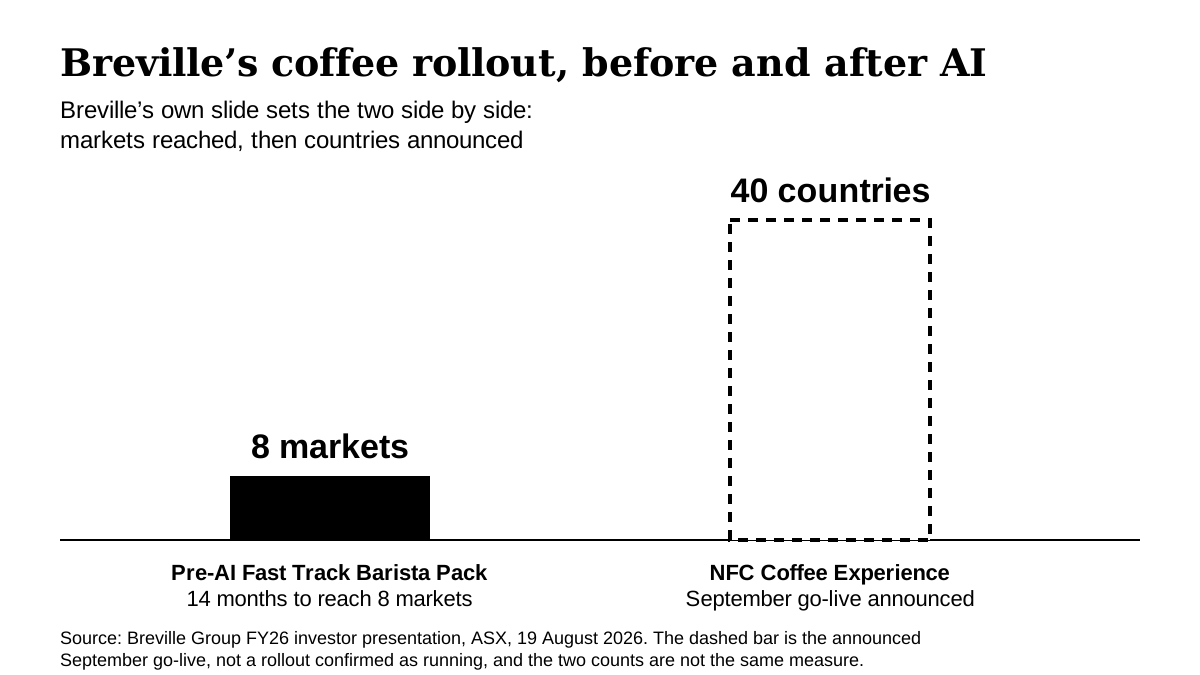
Breville's FY2026 presentation announced an NFC owner experience meant to cover setup, recipes, coffee, care, support and accessories across 40 countries in September. The official company-authored presentation describes a planned go-live. It does not show that the rollout is running, that owners use it, or that it is taking search traffic away from you.
The warning for you is narrower and more useful. If your only edge is setup content or recipes, you will meet the machine maker at the same question, and it got there first. What you own has to be your own: fit you physically checked, a routine you measured, a version-by-version comparison, or a genuinely better product.
Do not copy a manual, invent cleaning advice or make up measurements to fill a fit page. "Not measured" is worth more to you than a confident claim that comes back as a return.
Automation removes one task and leaves another
Fully automatic does not mean nothing to clean. The Ninja AutoBarista Pro page separates the dishwasher-safe parts from other removable parts meant to be washed by hand. That does not prove anyone wants a reset station. It points you at a job worth watching: what does the owner do with the parts they handled, and is a tea towel already good enough?
Small-space products need the same discipline. A front-fill Hamilton Beach coffee maker is built so the owner does not have to pull it forward. Sell a sliding tray to every coffee owner and you ignore that, and you take on your own questions about stability, heat, water and access.
The job worth selling into is the one that is left after the machine has been used properly. It is not a problem you created for the advert.
Do not guess an accessory budget from the machine price
Nestlé's half-year call gives you one more useful split. Management talked about progress in US Nespresso household reach, and also about softer consumption and weaker spending power in some newer households. The official H1 2026 results event publishes no forecast for accessory spending. A household with an expensive-looking machine is not proof of a budget for your organiser.
Keep your buyer types apart. Someone who wants it easy may want fewer objects and fewer steps. Someone who enjoys the manual routine may happily pay for one well-proven tool. A buyer whose box already has the basics is different again from an older owner replacing a lost part. One average price hides all four of them.
Broad category numbers will not fill that gap. The National Coffee Association's 2026 specialty-consumption summary describes a lot of people drinking specialty coffee. It does not count home-espresso owners, and it does not say any of them will buy an accessory. Multiply that percentage by a rate you invented and you get a market size with no product decision in it.
Three things to research, not three products to launch
- A reset tray that sits outside the machine. Start with one machine you have measured and one job the owner repeats after use. Drop it when built-in storage, a dish rack or their normal routine already handles it.
- A small-space access fix. Map every opening and every part that comes out first. Your answer may be a layout guide rather than a product. Do not start with an unengineered sliding platform under a hot appliance full of water.
- A cradle for people who work by hand. Start with the tools that group actually chooses. Sell tidiness and handling you can show, not better extraction, universal fit or a brand claim you have no right to make.
All three still need work on use, materials, safety and whether the design is yours. Food-contact status depends on the material and how the item is used; the FDA food-contact overview is a starting point, not approval of your item. What you owe depends on your market and your role; the EU General Product Safety Regulation should not be squashed into a supplier saying "EU compliant".
The parcel can reject an idea the research likes
Treat the numbers below as an illustration, not a quote. Say you sell at 39 dollars before tax. A 5 per cent revenue-refund allowance leaves you 37.05 dollars. Take off a 9 dollar product, 5.80 dollars of shipping, 0.80 dollars of packing and inspection, 1.40 dollars of payment cost and 1.10 dollars of later cost, and you are left with 18.95 dollars before you have paid for the customer, and before anything you forgot.
Ask for 5 dollars of profit after costs once the customer is paid for, and the most you can spend to win that customer falls to 13.95 dollars. Duties, handling, overheads, the cost of your money, returns from bad fit and a settled refund rate will all cut it further. And your customer still has to agree the product is worth 39 dollars.
A bigger bundle can lift what you make per buyer while dropping conversion enough that you make less per visitor. That is very likely when the buyer wanted a simpler routine in the first place. Get the real packed size, the real route cost to that country and the refund rate once it has settled into the decision before your stock grows.
Approve the next check, not the stock
- Watch one exact group of owners using the machine they have, with the tools they got. Write down the job they repeat, without pitching your idea at them.
- Use the maker's own storage and care guidance properly. Compare one fair local alternative, not a deliberately bad one.
- Measure the whole routine, cleaning included, on the exact country and revision. Your fit check ends only when the machine is ready for the next cup.
- If a problem survives all that, check materials and foreseeable use, get a real customer-ready sample and a packed quote, and write down what would make you drop it before you pay for a test.
- Judge paid demand after delivery, returns from bad fit, refunds and support have settled. Clicks and a machine-category growth rate are not what you decide on.
Where RyanFulfil fits
RyanFulfil can make the China side of this checkable for you: the exact product version, material evidence for that version, sample and packing checks, packed measurements, route options and the cost when something goes wrong. Those checks stop a research idea from turning into a vague supplier order.
You stay responsible for proving the customer problem, meeting your market's rules, being honest and original in how you sell, your acquisition numbers, your stock decision and the result. RyanFulfil cannot guarantee sales, fit, route acceptance, delivery dates, customs outcomes or profit.
Bring one machine model, one country, one revision, the job your customer is left with and your compatibility sheet. Contact RyanFulfil when the surviving idea needs an exact-version sourcing, sample, packing or route check from the China side.
What this does not prove
Last verified 1 September 2026. Company results were reviewed to 31 August; the product pages were checked on 1 September. Company results describe their own categories, channels and reporting, not accessory demand for your store. Live bundles, specifications, prices and support pages change by country, shop and revision.
No proposed product in this guide has been physically inspected, watched in a real kitchen, patent-checked, materials-tested, supplier-quoted or sold to anyone. The leftover-job filter, the whole-routine fit check, the example numbers and the test order are RyanFulfil's own tools. The best answer you can get here may be that the accessory is not needed.
Need a product checked before you spend on ads?
Send us the product link and destination on WhatsApp (+86 178 4666 9989). We will help you assess sourcing, packing and shipping before you commit.
Get Sourcing Quote on WhatsApp →