Back to blog
Sourcing Tips

Haircare Is Growing. That Does Not Tell You What to Dropship.

13 min read
Decide the role before you source the object. A growing category is not a product signal.

The direct answer

A hair tool does not become a good product for you because a beauty company grew quickly. The buyer may be paying for a brand they already trust, hearing about the item from a professional, collecting it locally within the hour, or adding it to an order they were placing anyway. Every one of those is a different business from the one you are in, which is paying to reach a stranger for a parcel shipped from China.

The research direction that survives the current company evidence is narrow. Look for an original, non-powered tool that makes one real hair-handling job measurably better. That is a place for you to start looking. It is not a validated product, and nothing in this guide has been sampled, tested or quoted.

This is the category version of a rule the library already sets out in the guide on growth drivers you cannot copy. A company result is not yet a sign that a product will sell for you. Here what you subtract is behaviour. Take away the brand the buyer already trusts, the professional who recommended it, the shop that had it in stock this afternoon and the basket it was dropped into. Research only what is left.

The most exciting growth figure needs a second look

Wella filed a preliminary Form S-1 on 31 August 2026. Its registration statement reports that Beauty Tech net revenues rose 14.3 per cent in the year ended 30 June 2026, against 9.4 per cent the year before. Read on its own, that looks like demand for styling devices speeding up.

The same filing takes the acceleration away. On a constant-currency basis the segment grew 8.4 per cent in fiscal 2026 against 8.5 per cent in fiscal 2025. Flat, not faster. The reported jump came from exchange rates moving the right way, not from more customers buying.

The filing goes one level further, and this is the level that matters to you. Of that 8.4 per cent, approximately 4.3 percentage points came from what Wella calls volume and product mix, with the rest from net pricing. The equivalent figure a year earlier was approximately 7 per cent. Volume and product mix are combined in that disclosure, so it is not a unit count; a shift towards more expensive devices lands in the same number as selling more of them. Either way you read it, the part of growth that is not price got smaller.

One segment, four different growth rates. The number that describes what customers did is the smallest and the least quoted.

The business is still growing, and none of this shows the styling-device category shrinking. It tells you that faster reported sales are not the same as faster real demand, and that the growth Wella did earn came largely from pricing and new products. Those are two things you do not inherit by sourcing something with a similar shape.

Electrical styling devices also bring heat, electrical safety, country-by-country approval and warranty duties that this research does not clear for you. Treat that category as out of scope for an ordinary first test.

A simpler tool business tells you more

BIC owns Tangle Teezer, a non-powered detangling brush. Its first-quarter 2026 release reports organic growth of 13 per cent, and its first-half results report that it sped up to 21 per cent in the second quarter. A manual brush is far closer to something you could actually dropship than a shampoo range or a beauty-conglomerate headline.

The explanation is where your caution belongs. BIC puts the growth down to gained distribution in retail and e-commerce, to a premium detangling range that doubled its net sales year on year, and to a licensed collection. You cannot separate those causes from each other with what is published. Nobody outside the company can say how much came from a genuinely better tool and how much from being easier to find, more premium or newly collectable.

So the conclusion is not "sell a cheaper version of that brush". A doubling premium range has no published base for you to measure it against, and licensed artwork belongs to somebody else. The question you can use is narrower: what hair-handling job does a specific person still struggle with, and can an original tool measurably improve it? That may be about grip, access, tension, sectioning or cleaning.

How it looks is not beside the point either. The evidence does not let you write off finish and identity as marketing noise. It does mean you test original looks and original function separately, and copy neither a protected design nor a licensed character.

Colour and care are not moving in the same direction

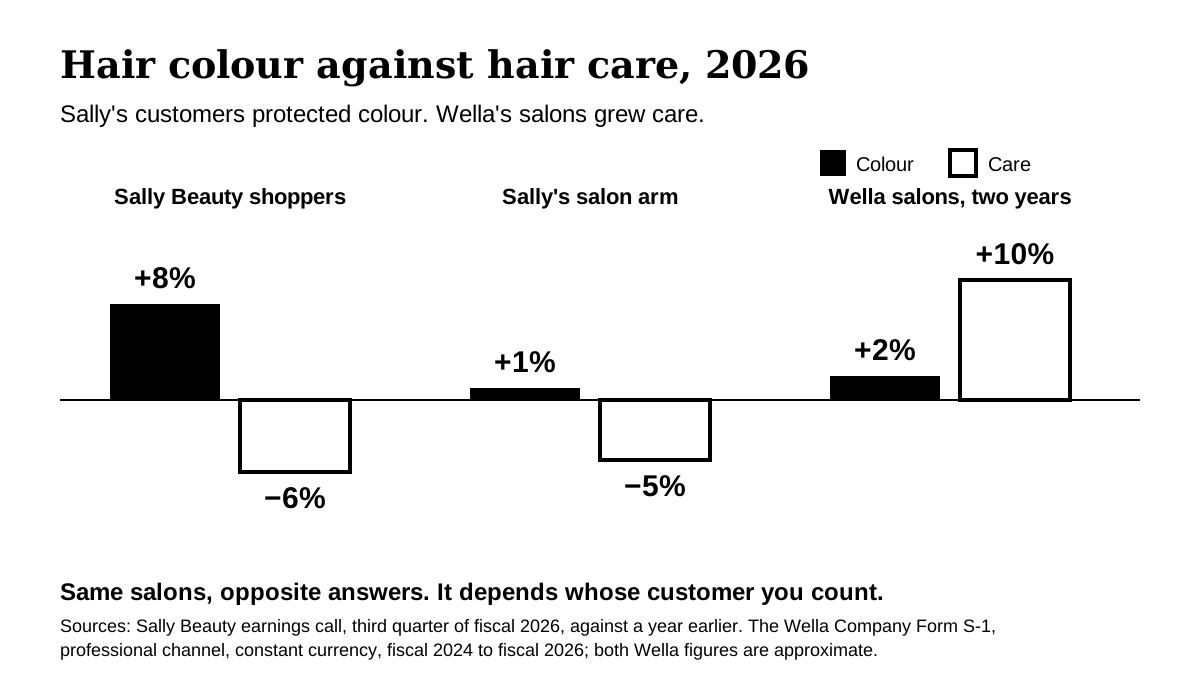
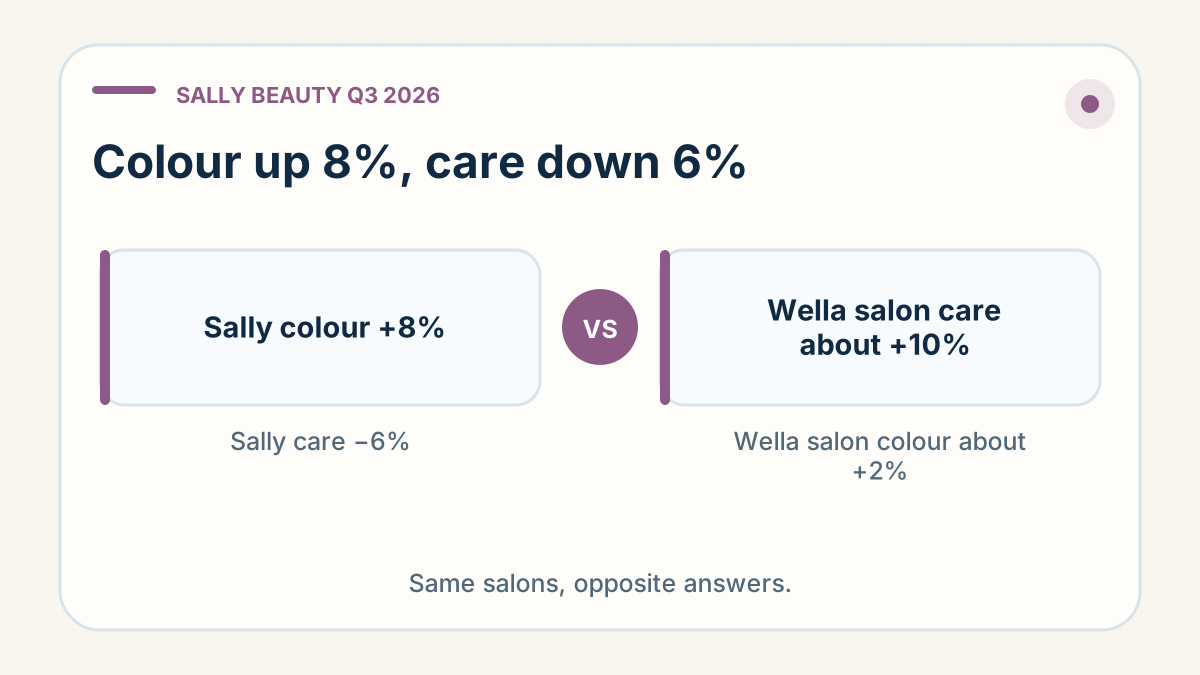
Sally Beauty's third-quarter fiscal 2026 results and its earnings call show colour up 8 per cent and care down 6 per cent in the Sally consumer segment, with the professional Beauty Systems Group reporting colour up 1 per cent and care down 5 per cent. Read quickly, that says shoppers are giving up on hair care.

That reading does not survive the other filings. Henkel reported organic growth of 4.2 per cent in its Hair business, naming colorants and styling as the strongest contributors. L'Oréal's Professional Products Division grew 11.6 per cent on its adjusted like-for-like measure and described growth in both volume and value.

The sharpest counterexample sits inside the same Wella filing. Its S-1 reports constant-currency growth in professional colour of approximately 2 per cent and in professional care of approximately 10 per cent between fiscal 2024 and fiscal 2026. Care grew five times faster than colour, in the professional channel, over the same broad period in which Sally's professional care fell. Two companies serving salons, two opposite patterns.

These are different scopes, periods and reporting bases, and you must not average them into a market index. That is exactly the point. There is no single haircare demand curve for you to ride. Sally's management put part of its weaker professional care comparison down to lapping a successful K18 launch in April 2025, did not say how much, and described salon appointment books as steady and colour services as strong.

What you take from this is about behaviour, not categories. Buyers protect one part of a routine and put off another. Before you source anything, decide which of four jobs your item does: core to the task, an upgrade to it, a replacement for a worn part, or an optional extra. Optional extras get put off first, and they are the easiest thing to build a store around by accident.

The same object can do four different jobs in a routine. Only one of them reliably survives a purchase being put off.

That is a reason for you to look at a small manual handling tool. It is not a reason to sell dyes, chemical treatments or a large professional-looking kit whose pieces nobody has been seen using.

The professional may shape the sale without taking the payment

Wella's filing reports that consumer net invoiced sales rose from approximately 45 per cent of total net invoiced sales in fiscal 2023 to approximately 52 per cent in fiscal 2026. That is a mix of invoiced sales, not a share to multiply against consolidated revenue, and the company frames it as a deliberate strategy: use the credibility it earned with professionals to grow in consumer channels.

The lesson for you is that advice, brand, checkout and delivery need not be the same business. A stylist can create the preference while somebody else takes the order. So the practical question for your store follows straight on: how will your buyer get confident enough to choose a product they have never heard of?

An honest demonstration of one ordinary job usually beats generic beauty content. Show the actual grip, the load the tool is rated for and the way it is cleaned, in conditions the product has really been tested for. It must not imply treatment, regrowth or guaranteed damage reduction without the evidence and review those claims need. Paying for qualified help to produce that demonstration can be worth it, as long as the expert involvement is real and its cost sits inside your numbers rather than beside them.

Online growth can still mean local service

Sally reported global e-commerce sales up 11 per cent to 110 million dollars, or 12 per cent of net sales, while consolidated net sales rose 0.2 per cent and comparable sales were flat. That is a digital channel growing inside a business that is broadly flat.

The call adds the detail that changes what it means for you. Management said buy-online-pick-up-in-store was the majority of app order volume in the quarter, and called it their most efficient delivery channel. The app is a subset of e-commerce, so this does not describe all of the 11 per cent. But the growing part of that channel is largely local stock, collected the same day. It is not a benchmark for your parcel travelling from China.

Sally also reported average weekly consultations above 5,200 through its licensed-colorist advice service, with new customers to that service up 28 per cent. So you are not only up against a price on a shelf. You may be up against help choosing the product, and the ability to collect it before this evening.

A planned purchase will wait for a slower delivery promise; something needed for today's routine will not. Ask why the purchase is happening now before you assume small and light means it suits a parcel, and put the honest range on your page. The reasoning is in the delivery gap.

A strong add-on can be a weak standalone product

The most useful answer in Sally's call was about fragrance. Management described it largely as an existing customer adding to their basket rather than as something bringing new customers in, at prices mostly north of twenty dollars. This is not a suggestion that you dropship fragrance. It is a warning about the job a product does.

A hair-tool cover, a travel case or a small accessory can do well inside a basket somebody was already filling and still fail completely when you pay to reach a stranger. A product that sells as an add-on is not proof that it will win you new customers. You have to test those two jobs separately, because a healthy attach rate inside an existing order tells you nothing about cold traffic.

The same trap shows up in how you build bundles. Say a simple offer leaves you 13 dollars after costs and before you pay for the customer, at a 2 per cent conversion rate: that is 0.26 dollars per qualified visitor. A larger bundle leaving you 18 dollars at a 1.2 per cent conversion rate gives you 0.216 dollars. More per buyer, less per visitor. These are made-up assumptions rather than benchmarks, and the sum only matters because the direction is so easy to get wrong.

Research the routine before you design the product

  • Choose one adult, non-medical routine and watch it before you propose anything. Include people who are perfectly happy with the tool they already have. They are your control, and they are usually missing from product research.
  • Compare any prototype against the best branded or locally available option, used properly. A deliberately weak control gives you a demonstration that will not survive a customer.
  • Write down the exact material, dimensions, surface, flexibility or closure behaviour that makes the benefit true. A factory swap you cannot see in a photo can wipe out the whole demonstration.
  • For a multi-piece kit, find out which pieces people actually pick up. A high piece count does not make up for a sequence of jobs nobody follows.
  • Only then get the customer-ready packed quote, the destination requirements and a price real buyers will pay. A supplier unit price is not your delivered cost.

Record it as you go. The blank routine-role worksheet holds the routine you watched, the happy-user control, the job you assigned and why, the best local alternative, the packed quote, and whether you tested the product cold as well as attached to an existing basket. It also has a rejection-condition column, which is the field most worth filling in before you pay for the test rather than after it.

Stop when the workaround people already use does the job just as well, when your proposed advantage is mostly borrowed brand identity, when you cannot support the claims, or when the delivered price you can actually get leaves no room to pay for customers and for things going wrong. Reaching a clear no quickly is a good outcome here, not a failed one.

What the new filing does and does not change

Wella had filed, not listed, when we cut this research off; a report of the filing confirms the event and nothing more. SHEIN's Hong Kong trading debut on 1 September is a separate event to watch; we did not obtain its prospectus for this analysis, so we draw nothing from it about how the business runs.

A new listing adds to how much disclosure you can read. It does not create demand for a product, and a company reaching an exchange tells you nothing about whether somebody else can sell an unbranded version of its category at a profit. What a filing genuinely gives you is the breakdown above: reported against constant currency, price against volume and mix, professional against consumer, one category against another inside the same house.

The next useful evidence for you is not another growth percentage. It is a customer job you have watched, a fair comparison, an approved sample and real delivered numbers.

Where RyanFulfil fits

We can make the China-side half of this checkable for you: the exact product version, the material evidence supplied for that version, sample and packing checks, packed measurements, route options and exception costs. Those checks stop a research direction turning into a vague supplier order.

You stay responsible for working out the customer problem, the product and market duties you have to meet, honest and original positioning, what you can afford to pay for a customer, the stock decision and the commercial outcome. RyanFulfil does not guarantee sales, fit, route acceptance, delivery dates, customs outcomes or profit.

Bring the routine you watched, the exact version and the markets you actually sell to. Contact RyanFulfil when an idea that survived needs an exact-version sourcing, sample, packing or route check from the China side.

What this does not prove

Last verified 1 September 2026. Every company figure above was read from the official release or filing named beside it, or from the linked earnings-call transcript. Wella's figures come from a preliminary registration statement that may be amended; the company had filed and not listed at this cutoff, and we did not audit the complete filing or its risk factors. Reported, constant-currency, organic, like-for-like and adjusted like-for-like are different bases, and you cannot compare them across these companies. Volume and product mix is a combined disclosure, not a unit count. Net invoiced sales is not net revenue. When management explains why a number moved, that is their reading of it, not proof of cause.

No product in this guide has been physically inspected, field-observed, patent-cleared, materials-tested, supplier-quoted or commercially validated. The four-job filter, the growth breakdown and the made-up bundle sums are our own tools, not measured outcomes. The strongest and most acceptable result of this process may be that no new haircare product is worth sourcing.

Need a product checked before you spend on ads?

Send us the product link and destination on WhatsApp (+86 178 4666 9989). We will help you assess sourcing, packing and shipping before you commit.

Get Sourcing Quote on WhatsApp →