Ask which slice of their growth could reach your store
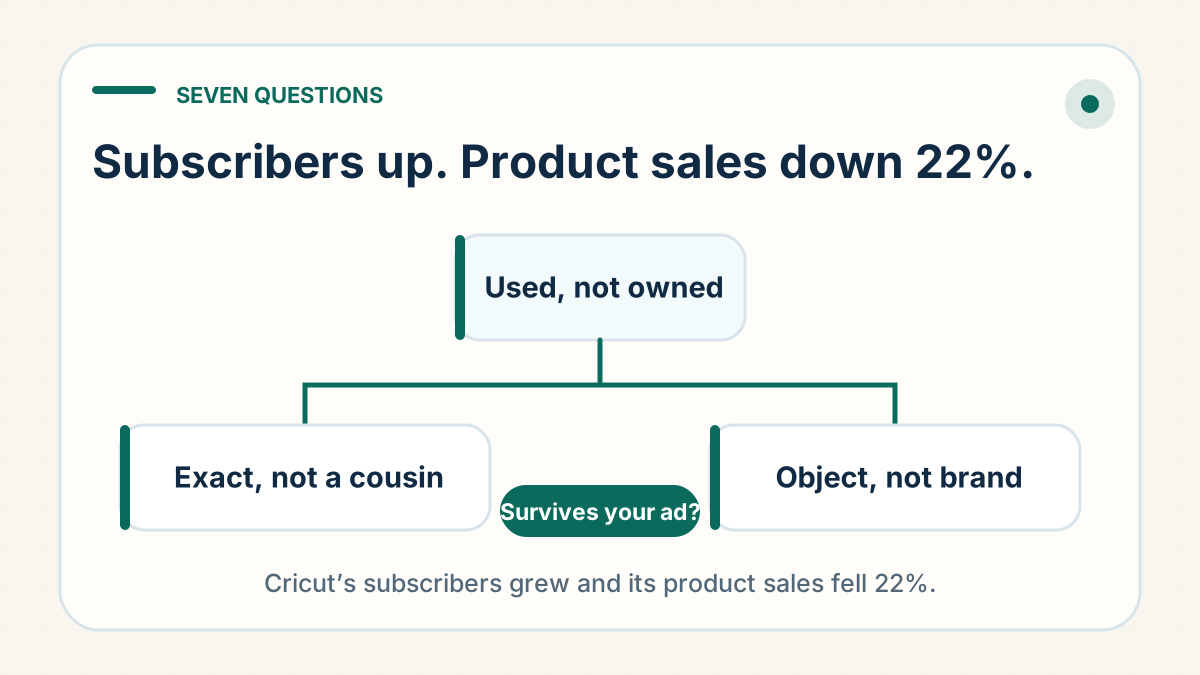
Cricut's paid subscribers rose 3 per cent year on year to 3.10 million at the end of its second quarter. Its revenue from machines and materials fell 22 per cent against the same quarter a year earlier, even as it reported double-digit growth in machines sold through to shoppers. The part of Cricut's own revenue that grew is a subscription nobody can source. A big company's growth is theirs.
It comes with their brand, their shops, their saved customers and their refund cheques, and none of that ships with the product. So before you source what they sell, ask which slice of that growth could reach a stranger who has to click your ad and wait for your parcel. Usually it is a thin slice. Sometimes it is nothing. Now and then it is one exact thing worth a sample.
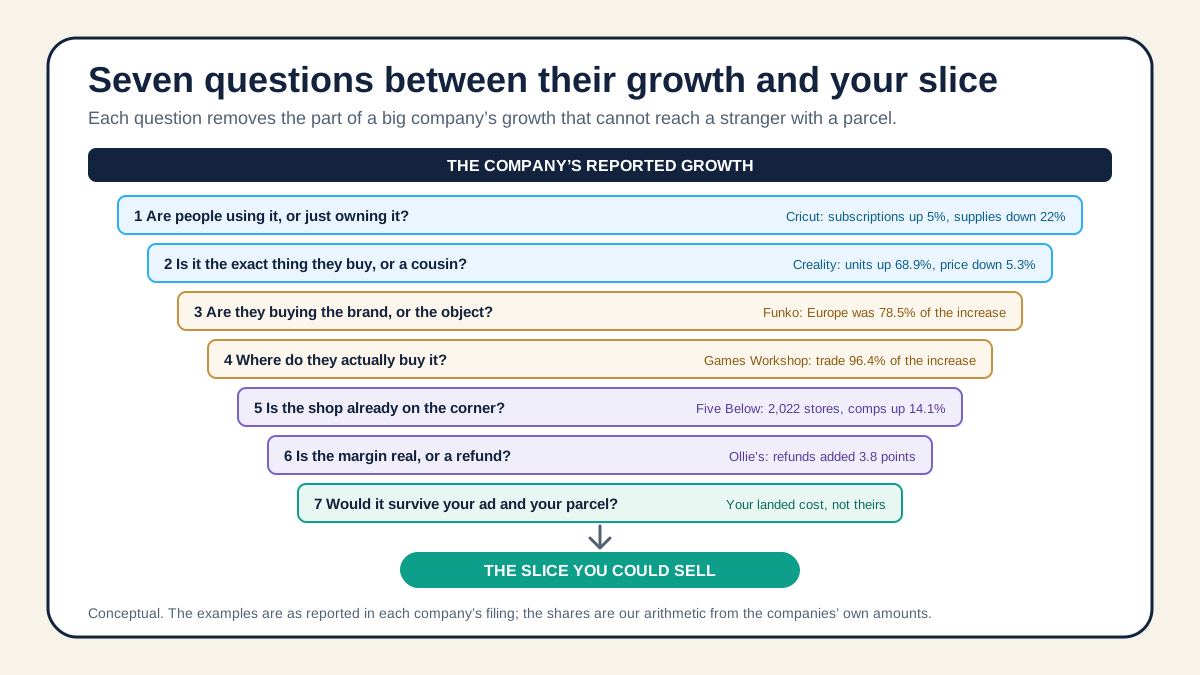
Seven questions follow, and behind each one is a company's own filing. None of these companies has said a word about dropshipping.
Two guides get you to the edge of this one. Subtract the drivers before you trust a growth number asks what is inside a company's figure. Haircare is growing, and that does not tell you what to dropship shows it for one category. This one asks what, if anything, gets out of the number and into your store.
What these numbers do and don't tell you
Five Below and Ollie's reported on 2 September for quarters that ended on 1 August. Cricut reported on 4 August, Funko on 6 August, On on 11 August, Samsonite on 13 August, Amer Sports on 18 August and MINISO on 28 August, and Games Workshop published its year to 31 May on 28 July. Creality's figures come from its Hong Kong prospectus of 20 May and cover 2025, not this year. Currencies are the companies' own. Where we work out a share ourselves we say so and show the amounts.
Not one of these companies is a benchmark for your store. They own the brand, the shelf, the customer account and the shipping network. What their numbers give you is a way to see which kind of growth you could take a slice of, and which kind you cannot.
1. Are people using it, or just owning it?
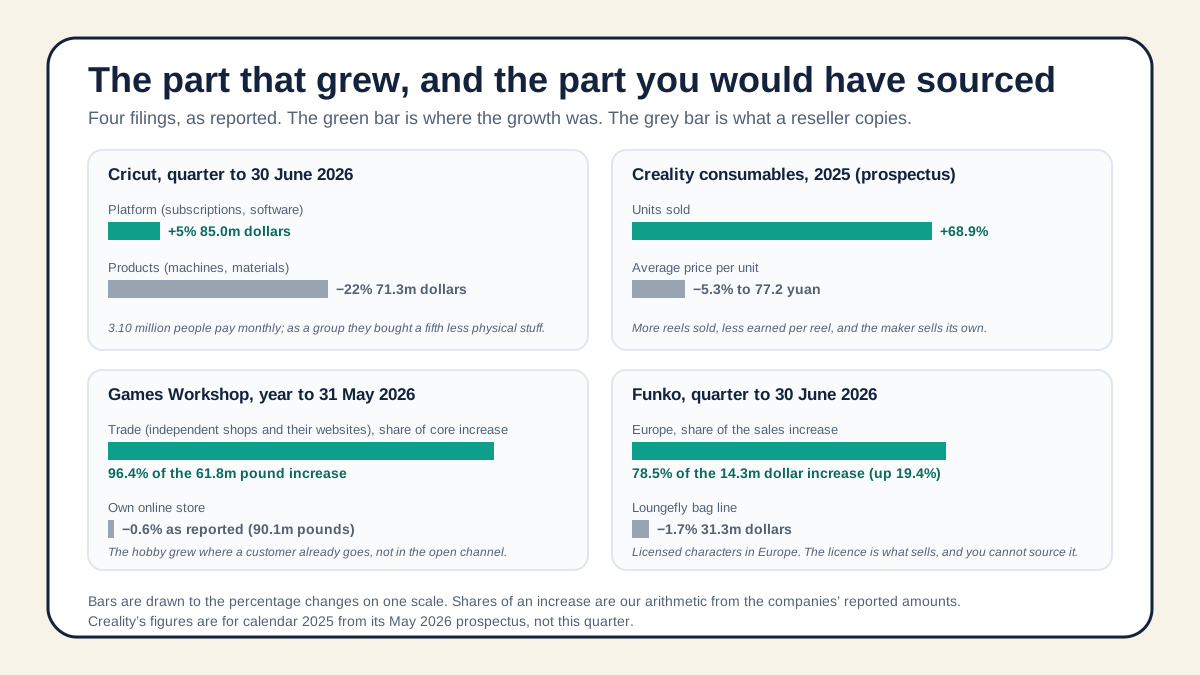
Cricut sells cutting machines, the supplies that go through them, and a subscription to the software that runs them. Its second-quarter release shows revenue of 156.3 million dollars, down 9 per cent. Inside that, platform revenue, the subscriptions and software, was 85.0 million, up just over 5 per cent, while products revenue, the machines and materials, was 71.3 million, down 22 per cent. Paid subscribers rose 3 per cent to 3.10 million.
Read that as a seller. Three million people pay Cricut every month to keep using the machine, and Cricut booked a fifth less product revenue than a year ago. If you had read "crafting is growing" and sourced blanks, vinyl and mats, you would be selling into the part of the business that fell 22 per cent. Owning a machine is not the same as buying supplies for it this month.
The question to ask before you source anything for a hobby: are people actually using it right now, and what did they buy separately last time? Ask three owners about their last project. What slowed them down, what the starter bundle already covered, what they went and bought on their own. That is the supply worth looking at, if any.
2. Is it the exact thing they buy, or a cousin?
Creality makes 3D printers and the filament they use. Its Hong Kong prospectus shows consumables revenue of 418.4 million yuan in 2025 against 261.5 million the year before, about 60 per cent more. But the number of units sold rose 68.9 per cent while the average price fell 5.3 per cent to 77.2 yuan a unit. More filament sold, less earned per reel. A reseller riding that wave earns less on each sale every year, and Creality sells its own.
Samsonite shows the other version of the same trap. Its first-half results show sales of 1,680.6 million US dollars, down 0.7 per cent in constant currency. Travel, the suitcases, fell 2.4 per cent; lifestyle bags rose 2.4 per cent. "Bags are growing" means the everyday backpack and tote, not the suitcase. Source the cousin and you have sourced the part that is shrinking.
3. Are they buying the brand, or the object?
Funko's second quarter shows sales of 207.7 million dollars, up 7.4 per cent. Europe was 69.0 million, up 19.4 per cent, and Europe's increase was 78.5 per cent of the company's whole increase: 11.2 million out of 14.3 million. Loungefly, the bag line, was 31.3 million, down 1.7 per cent.
So the growth is licensed characters selling in Europe. What a customer is paying for is the licence, and you cannot source a licence from a factory. The same lesson sits in Games Workshop's annual results, where licensing income fell to 32.9 million pounds from 52.5 million on the timing of video-game releases: a brand's demand moves with the brand's own calendar, not with a supplier's catalogue. A lookalike is not a slice of that growth. It is a takedown notice.
4. Where do they actually buy it?
Games Workshop's core revenue was 626.8 million pounds, up 10.9 per cent. Trade, meaning independent game shops and their own websites, was 405.3 million, up 59.6 million, or 96.4 per cent of the whole core increase. The company's own online store was 90.1 million, down 0.6 per cent as reported and up 2.3 per cent in constant currency. The hobby grew through shops and their websites, where a customer already goes, not through open channels where a stranger with a parcel can compete.
Amer Sports, which owns Arc'teryx and Salomon, reported the same pattern in a different industry. Its second quarter shows direct-to-consumer sales up 39.9 per cent, 757 of its own stores, up 39 per cent, and comparable growth across its own stores and websites of 17, 28 and 22 per cent by segment. Growth booked in the maker's own shops is not growth you can intercept with an ad.
5. Is the shop already on the corner?
Five Below's quarter shows net sales of 1.26 billion dollars, up 22.9 per cent, comparable sales up 14.1 per cent and 2,022 stores, up 8.8 per cent. Ollie's, in the same week for the same quarter, reported net sales of 741.3 million dollars with comparable sales down 1.8 per cent on a smaller average basket, and 686 stores, up 11.9 per cent. Both sell cheap things. One is growing on the shop floor and one is not, which tells you cheap on its own is not the reason people buy.
MINISO's half year shows revenue of 11,498.9 million yuan, up 22.4 per cent, with overseas revenue up 14.9 per cent while same-store sales overseas fell by a low single digit, and its TOP TOY brand up 32.7 per cent. New stores drove the growth. The shop is opening on the corner in your customer's country.
A five-dollar item grabbed on the way to a birthday party from a store a mile away is not the same product as a five-dollar item plus your ad plus nine days of shipping. Before you source a low-price impulse product, check where the customer would get it this afternoon.
6. Is the margin real, or a refund?
This quarter, several US companies received refunds of tariffs they had paid earlier, and the refunds landed in their margins. Five Below booked 163.6 million dollars of pretax tariff refunds; its adjusted operating income was 113.2 million against 55.1 million a year earlier. Ollie's gross margin was 43.5 per cent, and its release says refunds added 3.8 percentage points; its finance chief said on the call that about 0.7 points went back to customers in price. Cricut's gross margin was 74.5 per cent after a 17.9 million dollar refund benefit and a 6.4 million reserve release. Funko booked a 25.4 million pretax benefit.
On, the running-shoe brand, went the other way and said so: its second quarter reports a 65.4 per cent gross margin "excluding any tariff refunds". Samsonite reported 60.5 per cent and 59.5 per cent without the refund. When a margin jumps in a quarter when the government sent cheques, ask what it was before the cheque. Your margin has no cheque coming.
7. Would it survive your ad and your parcel?
The last question is about your numbers, not theirs. Take the exact product, the country and the packed weight, and work out what you keep on one order after the ad, after the customer refunds that will come once orders settle, and after shipping. The landed-cost guide shows the arithmetic. Then ask whether the customer will wait: a purchase tied to a date, a party, a season or a project deadline needs a route that matches how long they will wait, and Five Below's growth sits in exactly those moments.
On's apparel grew 47.7 per cent to 54.2 million francs and its accessories 88.3 per cent to 14.5 million, on a total of 850.3 million. Big percentages on small bases are where sellers get excited. The percentage is real. The base tells you the brand is still doing it mostly with shoes, and that the growth is worth 14.5 million francs to a company with its own stores and runners who already own its shoes. What it is worth to you is whatever survives question seven.
Run the seven questions on one product
Download the blank seven-questions worksheet. One row is one product you are tempted by. Answer each question in a line. A no on questions one to three means the product is not the thing people are buying; drop it. A no on four or five means you would be competing on convenience with a shop; only an original version survives that. Questions six and seven decide whether it is worth a sample and a quote.
What to watch and what not to assume
- Watch: Creality's first-half 2026 result, which had been announced but not analysed here; Golden Pet, a pet-food business reported to be preparing a listing, with no filing yet; and cado, which has applied for a Tokyo Pro Market listing planned for 25 September, still conditional at the time of writing.
- Ignore: "value retail is booming, so sell cheap"; "3D printing is growing, so sell filament"; "crafting is growing, so sell blanks"; "Funko is growing, so sell collectibles". Each one skips at least three of the seven questions.
- Check unit economics for your own product and evidence of demand reaching independent stores. The company figures do not establish either, or show that an unlicensed lookalike will sell.
Where RyanFulfil fits
Questions one to five are yours to answer, and mostly they are answered by talking to customers and looking at shops, not by talking to a sourcing agent. Where a China-side team helps is the moment a product survives them: we can find out whether the exact version exists at a factory rather than a cousin of it, get a sample in your hands, and quote it packed and shipped to your country so question seven is real arithmetic rather than a guess.
We cannot tell you whether a shop a mile from your customer already sells it, whether your ad will work, or what a licence holder will do. Those stay with you.
When a product gets past question five, send us the exact product and the country and we will check the version, sample it and quote it with shipping.
Source the slice, not the headline
A company's growth number is a headline about them. The slice you can sell is whatever is left after seven honest answers: something people use rather than own, the exact thing rather than a cousin, bought for the object rather than the brand, in a channel where you can compete, that no shop on the corner sells this afternoon, at a margin that was never a refund, that still leaves money after your ad and your parcel.
Here is how you would prove us wrong. If a store sourcing straight from a big company's growth headline, without the seven questions, keeps more profit once refunds have settled than one that runs them, this guide is wrong. Run them on the next product you are tempted by and see how many get past question three.
Where the figures come from
Sources as of 3 September 2026. Company figures are from the documents linked in the text and listed below: the results releases of Five Below and Ollie's dated 2 September 2026 and Ollie's earnings-call transcript on a third-party host; Cricut's release from its filing with the US Securities and Exchange Commission; Creality's Hong Kong prospectus of 20 May 2026; and the results releases of Funko, MINISO, Games Workshop, On, Amer Sports and Samsonite. The two calculated shares use the companies' reported amounts.
Use the seven questions and worksheet to investigate your own product, supplier, route and returns. The companies do not comment on dropshipping. No product mentioned is a recommendation, and this is not investment research or an opinion on any share. Re-read it when Creality publishes its first-half figures, when Golden Pet or cado file, or when your refund numbers for a product sourced this way have settled.
Need a product checked before you spend on ads?
Send us the product link and destination on WhatsApp (+86 178 4666 9989). We'll check sourcing, packing and shipping with you before you commit.
Get Sourcing Quote on WhatsApp →