Back to blog
Sourcing Tips

Low Inventory Is Not a Dropshipping Moat Anymore

16 min read
Low inventory limits risk. The loop is the moat. Measure the time to a decision you can trust, not the time to launch.

Keep running lean. Stop calling it your edge.

Keep running lean. Holding little or no stock is still the cheapest way to test a product, and it still protects your cash when a product dies. Just stop treating it as the reason a customer should buy from you. It never was, and the numbers the big players published last month show they test in small batches too.

What separates stores now is how fast you get from "this might sell" to a decision you can trust, without losing track of what you actually shipped. One store launches in three days and takes two months to find out its supplier quietly changed the material. Another spends a week approving one exact version and knows where it stands five weeks later. The second store is faster where it counts.

This is the operations half of a point the library already makes about demand. The winning product is only the surface asks whether a sales spike is real or a fluke. This guide asks how quickly your own setup turns that spike into a decision, using eleven company filings from August and early September 2026.

What these numbers do and don't tell you

The filings are all from August and early September 2026: SHEIN's Hong Kong prospectus of 24 August, with trading from 1 September; Shiprocket's red herring prospectus of 5 August, listed in India the same month; and the latest results of PDD, Sea, Alibaba, JD.com, Shopify, Klaviyo, DHL, Global-e and Adyen. Unless we say otherwise, the figures cover the quarter or half year to 30 June 2026.

None of these companies is a benchmark for your store. Their numbers come from platform money, their own inventory, local delivery networks and millions of saved customer accounts you do not have. They show a direction, not a target; any small-store number in this guide is an example.

SHEIN tests in batches of 100 to 200, then the machine takes over

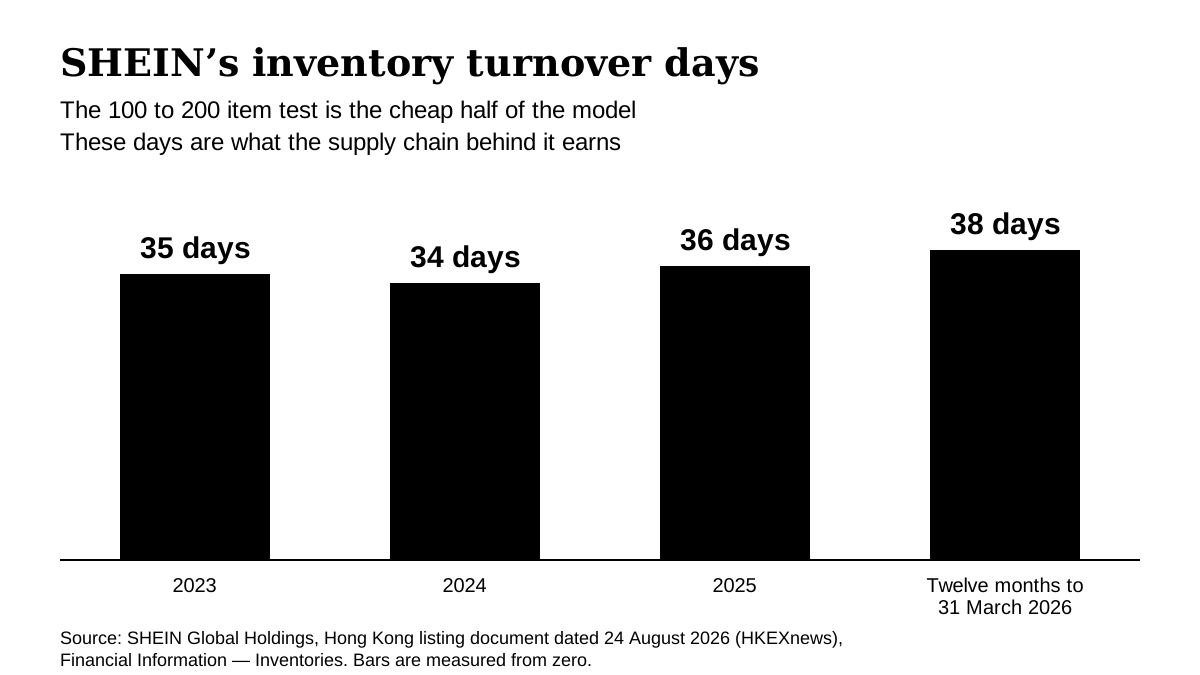
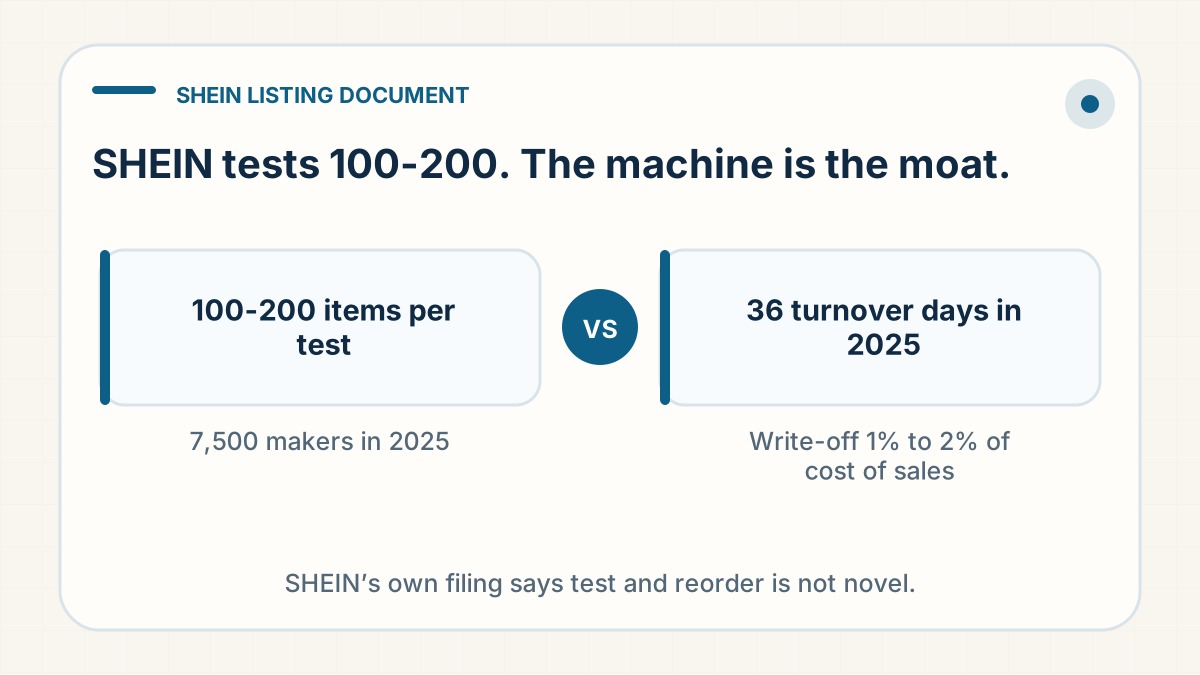
The part of SHEIN's model you will recognise is the test. Its prospectus describes launching new products in small initial batches of approximately 100 to 200 items, watching customer feedback in real time and re-ordering what sells, with the testing and re-ordering described as highly automated. That is small-batch sourcing across over 7,500 contract manufacturers in 2025, behind a business that reported revenue of 41.8 billion US dollars for that year.

The rest of the model is what a one-product store does not have. The same document describes cloud software given to suppliers free of charge to manage orders, production, quality checks and shipping, and a system that hands each order to a supplier by skill, price and capacity. In a typical Shopify store the same facts live in the ad account, the order list, a WhatsApp thread with the supplier, a tracking export and a refund spreadsheet, and none of them talk to each other.

So the first lesson is uncomfortable but useful. Small-batch testing is not what makes you different; it is the one thing you have in common with the largest fast-fashion retailer in the world. Running lean cuts your stock risk. On its own it does not help you pick better products, earn a customer's trust or keep more profit per order. Copying the designs is the wrong lesson too: it shortens the time to a takedown as fast as the time to launch.

Shipping is becoming one part of the service, and the filing puts a number on it

Shiprocket matters here because its red herring prospectus shows what a shipping company now sells. It calls itself an e-commerce enablement platform, with tools that cover the whole life of a customer order. Its core business is domestic shipping and shipping apps. Its emerging business is everything else: a cross-border service, a checkout product, marketing tools, same-day delivery and loans.

The filing gives the split. Revenue from operations was 20,241 million rupees in its fiscal 2026, and the emerging business was 26.62 per cent of it, up from 17.58 per cent two fiscal years earlier, across 214,769 active merchants. Shipping is still roughly three quarters of the business. But the non-shipping side grew from under a fifth to over a quarter of revenue in two years. "We ship your orders" is turning into one feature inside bigger platforms, and an agent that lists sourcing, checking, storage, packing and delivery as separate menu items will look more replaceable than the work really is.

For a China-side team, the part that is hard to replace sits closer to the product than to the label. Which exact version did you approve? Which factory and batch made it? Did the material, size or packaging change? What did the parcel weigh once it was packed? Which line carried it to which country? Which defects, refunds and reships came from that version on that route? Software can carry those answers. It cannot produce them.

Four marketplace results, one message

PDD, Sea, Alibaba and JD run different businesses and should not be averaged into one growth rate. What their management said this quarter points the same way: what wins is the whole system, from finding customers to earning their trust, and it is being paid for as a system.

PDD, which runs Temu, reported revenue of 112.4 billion yuan for the quarter, up 8 per cent, while net income attributable to ordinary shareholders fell 12 per cent. Its results release quotes its finance head: the company "stepped up our ecosystem investments in the second quarter" and its priority "is helping merchants thrive and strengthening the broader industry ecosystem."

So the price or delivery promise you see on a marketplace may be partly paid for by the platform. Before you buy more traffic for a product that also sells on Temu, compare the price you need with the exact delivered price, the delivery promise and the review count on the marketplace. If the item is identical and the gap is large, your landing page is not the problem. The offer itself is weak.

Sea's Shopee figures show the other lever. GMV rose 28.4 per cent to 38.3 billion US dollars and gross orders 27.5 per cent to 4.2 billion, but marketplace revenue rose 48.9 per cent, which the company puts down to GMV growth and what it calls improved monetisation. Core marketplace revenue, mainly fees and advertising, rose 65.6 per cent, and cost of revenue rose 51.9 per cent, largely logistics. A seller buying ads inside Shopee gets saved payment details, reviews and familiar return rules along with the click. You, buying cold social traffic for a new store, are running a different experiment.

Alibaba's June-quarter release reports group revenue up 9 per cent to 268,953 million yuan, with China quick-commerce revenue up 45 per cent to 53,295 million yuan while customer management revenue fell 7 per cent, and it describes AI tools that write listings, run stores, buy ads and answer customers for merchants. The weak reading is "use AI". The stronger one is that when AI does the browsing, accurate product data matters more and a wrong compatibility claim travels further. A shopping assistant cannot fix a supplier swap you never wrote down.

JD.com, which calls itself a supply chain-based technology and service provider, reported net revenues of 346.4 billion yuan, down 2.9 per cent on what its release calls a high base effect, while income from operations turned to 4.5 billion yuan from a loss a year earlier. Its low prices are paid for by buying power, its own stock, its own delivery network and customer trust that a small store cannot copy. Cutting your price harder just removes the money that pays for ads and for things going wrong. Your options are narrower: a spec that does the job better, a bundle built for one task, your own design, better proof, or a product people will wait for.

The other side: stores like yours are not losing

The lesson is not that marketplaces win. Shopify's second-quarter release reports GMV of 115.6 billion US dollars, up 32 per cent from 87.8 billion, revenue of 3.58 billion dollars up 34 per cent, merchant solutions revenue up 37 per cent and free cash flow of 654 million dollars at an 18 per cent margin. On the earnings call management said AI-driven traffic and orders to Shopify stores tripled year over year, then added that the volume "is still small relative to our massive GMV". Either way your job is the same: make your listing true and machine-readable, with one stable version ID, exact sizes and materials, live stock, delivery by country and a last-updated date.

Three more results sharpen the loop rather than the traffic. Global-e's quarter shows GMV up 44 per cent to 2,089 million dollars and revenue of 299.0 million, of which 159.6 million was fulfilment services, so more than half of a cross-border specialist's revenue is duties, shipping and returns handling rather than translation. Adyen's first half reports processed volume up 24 per cent to 803.8 billion euros and a company-cited average conversion lift of 0.9 percentage points from its identification products; the vendor's own number, but the point stands: a clunky checkout can look like weak demand.

Klaviyo, with more than 205,000 paying customers in its release, now pitches its product as autonomous customer relationship management, meaning messages triggered by a real event, delivered or running out, not a number of days after checkout. DHL Group's second quarter shows revenue of 22.4 billion euros, up 13 per cent, and operating profit of 1.9 billion, up 30 per cent. It tells you the network is healthy. It cannot tell you the time by which 9 in 10 of your parcels arrive on one China line to one postcode area, which is the only figure your delivery promise should rest on.

Measure how long it takes you to learn

Most sellers measure how fast they can launch. That is one clock out of four. The one that decides whether you learn faster than the next store is the full time from a sign that something sells to a decision you can trust.

  • Spotting: from a real change in your search, ad or order numbers to a written decision about the product or the offer.
  • Making: from that decision to a version you have approved, can ship, and have described honestly on the listing.
  • Waiting: from the first order until delivery, refunds, reships and chargebacks have settled enough to read.
  • Acting: from settled numbers to what you actually do next, whether that is scale, pause, change the product, re-quote, switch supplier, hold stock or kill it.

Add the four together and you have how long it takes you to learn. Shorter is not always better: a product with a safety question should move more slowly before launch, and a long shipping route makes everyone wait longer for results. Writing the four numbers down is how you find the waiting you could avoid and the speed that is only for show.

An example, with made-up days, of two stores acting on the same sign. Store A launches in three days, skips checking the listing against the sample, waits 42 days for delivery and refund data to settle and takes 14 days to decide: 59 days in total. Store B spends eight days, four of them approving one exact version, gets settled numbers in 28 days on a route with fewer late parcels and decides in three: 39 days. The slower launch trusts its decision 20 days sooner, and Store A's decision may still be wrong, because its 42-day wait ends with a material change nobody recorded.

Illustrative day counts, not a benchmark: the four clocks drawn end to end for two stores acting on the same sign. In the diagram they are labelled signal, execution, outcome and reallocation; spotting, making, waiting and acting are the same four. A fast launch on its own can hide a slow loop.

These four clocks are not the four clocks that tell you why a winner is fading. Those separate a product that has run its course from tired creative, a changed audience and slow operations once sales have dropped. These measure how long your whole setup takes to learn anything at all.

One ID for the exact version you sell

The ad promises a product. The factory makes a version. The warehouse packs a unit. The courier moves a parcel. The customer reviews what turned up. In most stores those five records carry five different names, so when refunds rise nobody can say whether the new supplier caused it, or the route, or one colour, or a packaging change, or a bundle that lifted order value while quietly cutting profit.

The shortest list that works: store, product, approved version, supplier, batch, order, route, country and what happened after refunds settled. Every record that matters should carry it, and a product name, a supplier URL or a store handle is not a stable ID for any of them.

A minimum, not a software spec: nine linked records from store to settled outcome, and the places where a small store's chain usually breaks.

The practical way to do the version part is already in the library: give every version you sell one shared identity with an approved reference and a clear status. The ad-side half, tying creative claims to exact versions and kept orders, is in the guide on AI media buying and kept orders. What this guide adds is the reason to do both now: the shared ID is what turns running lean from a cash policy into a way to learn faster.

Ten questions for one product this week

Pick one product and answer these in writing. A missing answer is not a reason to stop selling; it is your next job.

  • Can you name the exact approved version in every order, including the batch it shipped from?
  • Can your supplier change the material, size or packaging without your written OK?
  • Do you know the packed weight and the route, or only the factory unit price?
  • Can you tell supplier defects from delivery damage in your refund reasons?
  • Do you plan on the time by which 9 in 10 parcels arrive, or on the average?
  • Have refunds, reships and chargebacks settled before you raise what you are willing to pay per customer?
  • Have you compared the exact marketplace offer, delivered price, promise and reviews included?
  • Does your customer have a reason to wait for your parcel that a local shop or a marketplace listing does not give them?
  • Which decision changes when the next 50 orders have settled?
  • Will what you learned survive if you change stores or suppliers?

Download the blank learning-loop audit worksheet. One row is one layer of the loop for one product; it holds no RyanFulfil rates, client data or thresholds, and the avoidable-delay column is where the four clocks become a number you can act on.

What to do at your stage

  • Testing: keep stock low, but test one customer problem, one approved version and one country. Get a quote with shipping included, compare the delivered marketplace price, and set your kill rule before you buy traffic.
  • First real volume: tie orders to supplier, version, batch and route. Stop unapproved substitutions. Wait for settled refund numbers before treating early ROAS as permission to scale.
  • Established winner: reserve capacity for the approved version, keep a golden sample and a change log, line up a backup supplier, and compare direct parcel with China or local stock country by country.
  • Brand or hybrid: use what you learned to justify your own changes, packaging, certification and local stock. Do not make those commitments because a marketplace category grew.

Two rules from the library apply at every stage. Scale at the speed of settled cash rather than captured sales, and match the route to how long your customer will wait before you promise a delivery window.

What to watch, what to ignore, what we could not find

  • Watch: whether SHEIN's next reports give production-cycle figures, and whether Shiprocket's non-shipping share keeps rising because merchants use those tools or because prices changed.
  • Ignore: "SHEIN proves dropshipping is dead", "Temu is growing so sell cheaper", "stock levels no longer matter" and "a marketplace bestseller is validated for Shopify".
  • Ignore: "ship faster" without a named route and a customer who will wait, and "more suppliers means resilience" unless they make the same approved version.
  • Could not find: a universal target for how long learning should take; a measured gap in customer acquisition cost between an independent store and any marketplace; and any proof that running the whole loop lifts results, because no client's orders were tied together for this guide.

Where RyanFulfil fits

No sourcing or fulfilment agent can promise you a winning product, and we do not. What a China-side team can do is keep one record from your product brief to the delivered parcel: which version you approved, which factory and batch made it, what the inspection found against that spec, what the packed parcel weighed, which line carried it and how problems were sorted out. That record is what makes your next decision better informed.

You keep responsibility for demand, pricing, advertising, legal and compliance decisions and the decision to scale. RyanFulfil cannot guarantee sales, route acceptance, delivery dates, customs outcomes or profit, and every product, route and destination still needs a current check.

Bring the exact product spec, the countries you sell to, your current order volume and the decision you are trying to make. Contact RyanFulfil when a version, sample, packing or route question is the clock that is running slow.

Keep running lean. Measure how fast you learn.

The stores that learn fastest will not be the ones that upload the most products or launch in the fewest days. They will be the ones that know exactly what they sold, how it was made, how it travelled, what failed and what to change next. Running lean buys you the chance to run that loop cheaply. It does not run it for you.

Here is how you would prove us wrong. If stores that differentiate on nothing but low stock keep more profit, once refunds have settled, than stores with joined records and a measured loop, this guide is wrong and your edge has not moved. Run the ten questions on one product and you will find out which side of that line you are on.

Evidence boundary

Last verified 2 September 2026. Every company figure was read from the primary document linked in the text and listed below: SHEIN's Hong Kong prospectus of 24 August 2026 and its allotment-results announcement of 31 August; Shiprocket's red herring prospectus of 5 August 2026; the results releases of PDD Holdings, Sea Limited, Alibaba Group, JD.com, Shopify, Global-e, Adyen, Klaviyo and DHL Group for the quarter or half year to 30 June 2026; and Shopify's earnings-call transcript on a third-party host. Shiprocket's figures are in Indian rupees for fiscal years ending 31 March.

The four clocks, the nine-part ID list, the ten-question audit and the two-store example are RyanFulfil's own tools, not company statements, and no company named here has said anything about dropshipping. We did not use any client data for this guide. Adyen's conversion figure is the vendor's own claim and its method is not published. This is not investment research or an opinion on any share. Re-read it when the next results land, when SHEIN or Shiprocket publish a first report after listing, or when your own refund and reship numbers by version and route have settled.

Need a product checked before you spend on ads?

Send us the product link and destination on WhatsApp (+86 178 4666 9989). We will help you assess sourcing, packing and shipping before you commit.

Get Sourcing Quote on WhatsApp →