Shopify grew 32%. That is not the important number
Shopify reported Q2 2026 GMV of $115.6 billion, up 32% year over year, and revenue of $3.58 billion, up 34%. It was the fifth consecutive quarter in which GMV grew by more than 30%, and the company guided Q3 revenue to grow at a low-thirties percentage rate. Those figures show a platform still expanding at scale. They do not diagnose why one store is growing or flat, because Shopify aggregates merchants of many sizes, business models, countries and channels.
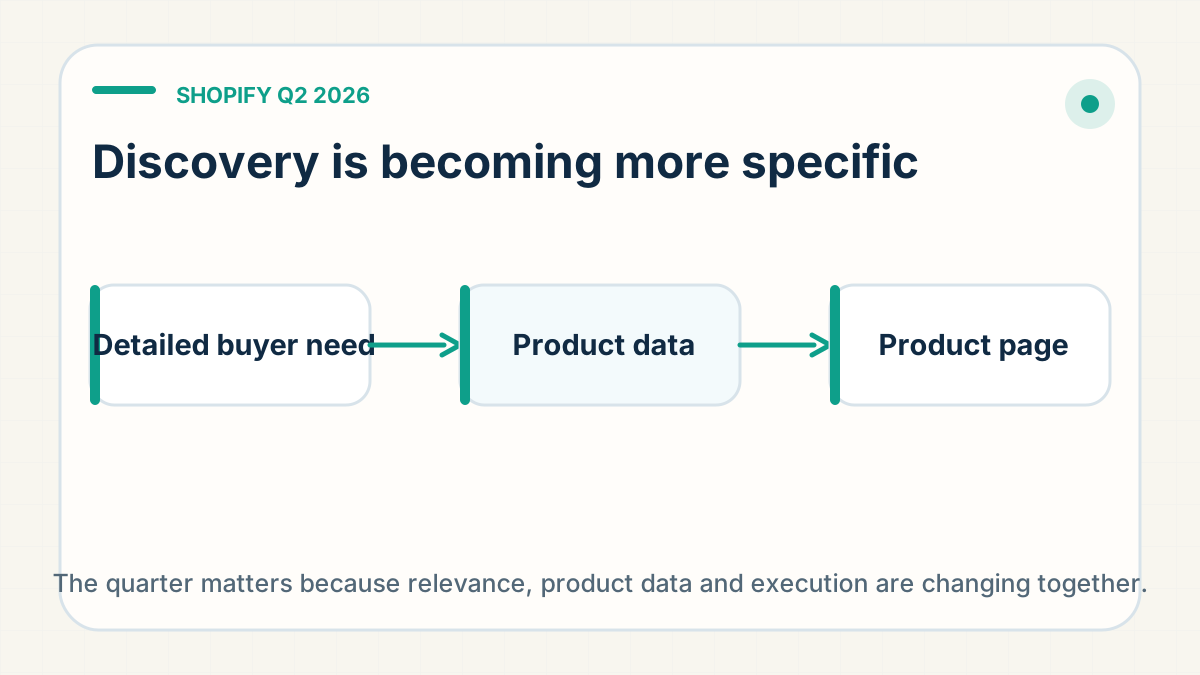
The more useful shift is happening before the shopper reaches the homepage. AI-led discovery can interpret product data, select a result and send a buyer directly to the product page. The catalog is therefore becoming three things at once: pre-click creative, the buyer's first impression and a warehouse instruction. If those three describe different products, AI does not create an advantage. It scales the mismatch.
- Discovery record: the title and attributes tell a machine exactly which need, dimensions, compatibility and limitations the product matches.
- Sales record: the page lets a buyer verify the same facts without needing the homepage to supply missing context.
- Fulfilment record: the SKU, approved sample and warehouse instruction identify the exact physical version that must ship.
AI may reward the long tail — but only when the match is real
Shopify said 75% of AI-attributed purchases in Q2 came from outside its top 100 product categories. Management linked that pattern to highly specific requests: a product for a small space, a particular fit requirement or a combination of attributes that a generic search phrase does not express well. Shopify's interpretation is that small, specialised merchants may have a structural advantage when their product is unusually relevant to a narrow need.
That is a company-reported attribution statistic, not an audited market share study. Shopify has not published the underlying order count, category definition or full attribution method. It also said agentic-commerce volume remains small relative to its $116 billion quarterly GMV. The responsible conclusion is therefore not that trending products have stopped working. It is that specific-intent matchability has become a serious product-research hypothesis worth testing beside conventional demand evidence.
A seller can act on that without guessing. Write the buyer's complete need in one sentence. Identify the dimensions, compatibility, material, use environment and exclusions that decide whether the item fits. Then ask whether the exact supplier version can prove those facts through a sample, measurements, current photos or documents. Specificity only creates an advantage when the physical product can support the promise.
The homepage is losing first-contact privilege
Shopify said half of AI-referred sessions landed directly on a product-description page, 2.5 times the share it sees with traditional search. Management also said conversion from AI search ran nearly 80% higher than traditional organic search. That suggests many AI-referred visitors arrive after expressing a detailed need, but the figures do not prove that AI traffic will convert better for every store or product.
The operating implication is still important: a product page increasingly has to work as a small standalone storefront. A visitor may not see the homepage, brand story or collection page first. The page itself needs to establish what the item is, who it is for, what problem it solves, what is included, the exact variant, dimensions, materials, compatibility, delivery expectation, return terms and any important limitation.
This is not an argument for making descriptions longer for their own sake. It is an argument for making product facts complete, consistent and recoverable. If the title says one material, the variant record says another and the supplier silently changes the construction, richer copy only makes the mismatch more expensive.
Catalog hygiene is becoming acquisition work
Shopify said AI searches powered by its Catalog converted at twice the rate of searches using scraped product data. Catalog contains more than one billion products and structures merchant data so agents can understand and recommend it. This is Shopify's comparison inside its own commerce infrastructure; it does not mean adding a few attributes guarantees placement in an AI answer.
The useful action is to treat product data as an operating record rather than marketing decoration. A supplier feed is a draft, not product truth. Keep titles, variants, SKUs, dimensions, materials, images, inventory states, delivery information and policy details aligned with the customer-ready unit. When a supplier, material or product version changes, update the approved reference and storefront together instead of letting the listing describe the old item.
AI is additive; search is not dead
Both AI-driven traffic and orders to Shopify stores tripled year over year in Q2, and Shopify said new-buyer orders from AI channels arrived at nearly twice the rate of other channels. In the same call, however, management said traditional search still represented roughly one-third of storefront sessions and those sessions were up 1.3 times over two years.
A sensible acquisition plan therefore keeps SEO, paid social, creators and direct-response testing while adding AI-channel visibility and richer product data. The growth multiples are not directly comparable with prior-quarter multiples because Shopify does not disclose the changing base or a complete methodology. Treat them as evidence that the channel is measurable and growing, not as a budget-allocation formula.
International growth is a research prompt, not a country recommendation
International GMV grew 37% in Q2. North America grew 28%, while Europe grew 34% in constant currency. Shopify Payments reached 68% of global GMV, payment penetration in Europe rose by more than 350 basis points, and Shopify said it now dynamically surfaces relevant payment methods to reduce checkout abandonment.
These are platform-wide figures. They do not reveal which European country, ad audience or dropshipping category will work for a particular seller. They do justify testing whether a store has become too US-centred. A market test should still combine product demand, advertising cost, language, local payment preference, taxes, route eligibility, delivery time and returns. Translation and currency alone are not complete localisation.
Shopify is adding more demand and conversion surfaces
Shop app native GMV grew more than 70% year over year, and Cart Sync represented more than 30% of Shop app GMV. Shop Pay GMV grew 53%, while lifetime accelerated GMV passed $400 billion. These figures support a broader shift: Shopify is not only providing storefront software; it is also building identity, discovery, checkout and repeat-purchase surfaces across stores.
For a smaller merchant, the immediate job is not to assume Shop will replace Meta, Google or TikTok. It is to check whether the store is eligible, whether products and policies are complete, whether Shop Pay and relevant payment methods are correctly available, and whether a buyer can move from discovery to checkout without encountering a conflicting price, variant or delivery promise.
The cost of execution is falling
Sidekick was used to create more than 36,000 custom apps in Q2, up from 12,000 in Q1. Daily active merchants using it grew 3.6 times year over year, and Shopify said personalised onboarding guidance increased the share of new merchants reaching five orders within 15 days by 8%. These are Shopify's internal product results, not a promise that using Sidekick will lift a specific store by the same amount.
The competitive meaning is clearer than the individual metric. Store setup, reporting, simple tooling and experimentation are getting faster and cheaper. Knowing how to assemble a Shopify store is becoming less differentiating. Product judgement, offer design, creative judgement, supplier verification, fulfilment, customer experience and learning speed become more important when more operators can execute the basic setup quickly.
What to do in the next 30 days
- Choose three important products and write the exact buyer need each one solves, including constraints and exclusions.
- Audit every product fact against the exact approved supplier version: title, variant, material, dimensions, compatibility, included parts, images and packed unit.
- Open each product URL as if the visitor skipped the homepage. Check trust, offer, delivery, returns and product limitations without relying on another page.
- Keep existing search and paid acquisition tests running. Add AI-channel attribution only where the Shopify admin exposes reliable data for the store.
- Select one international market for a controlled test only after checking payment preference, tax, route, delivery and returns together.
- Use AI tools to reduce setup and analysis time, then spend the saved time on samples, creative, customer language and supplier control.
The outlook for dropshippers
Shopify's Q3 guide and broad merchant growth do not point to a platform entering contraction. The more important outlook is competitive: discovery surfaces are multiplying while execution becomes easier. Generic products, copied supplier descriptions and an unverified shipping promise will be easier for many sellers to reproduce.
The durable opportunity is narrower and more operational. Find a specific customer problem, source an exact product that can prove the required attributes, present those facts clearly, connect the order flow, and deliver the version the page promised. AI may make that product easier to discover. It does not remove the physical work that makes the recommendation true.
The first customer reading your store may no longer be human. The final customer opening the parcel definitely is. The catalog has to tell both of them the same truth.
Where the figures come from
Financial figures and outlook come from Shopify's filed Q2 release. Commerce, Catalog, AI, Shop and Sidekick metrics are company-reported statements from the Q2 presentation and earnings call. Shopify did not disclose every denominator or attribution rule, and the results cover its whole merchant base rather than dropshippers alone. Treat the seller actions above as decision prompts, not Shopify claims or guaranteed outcomes.