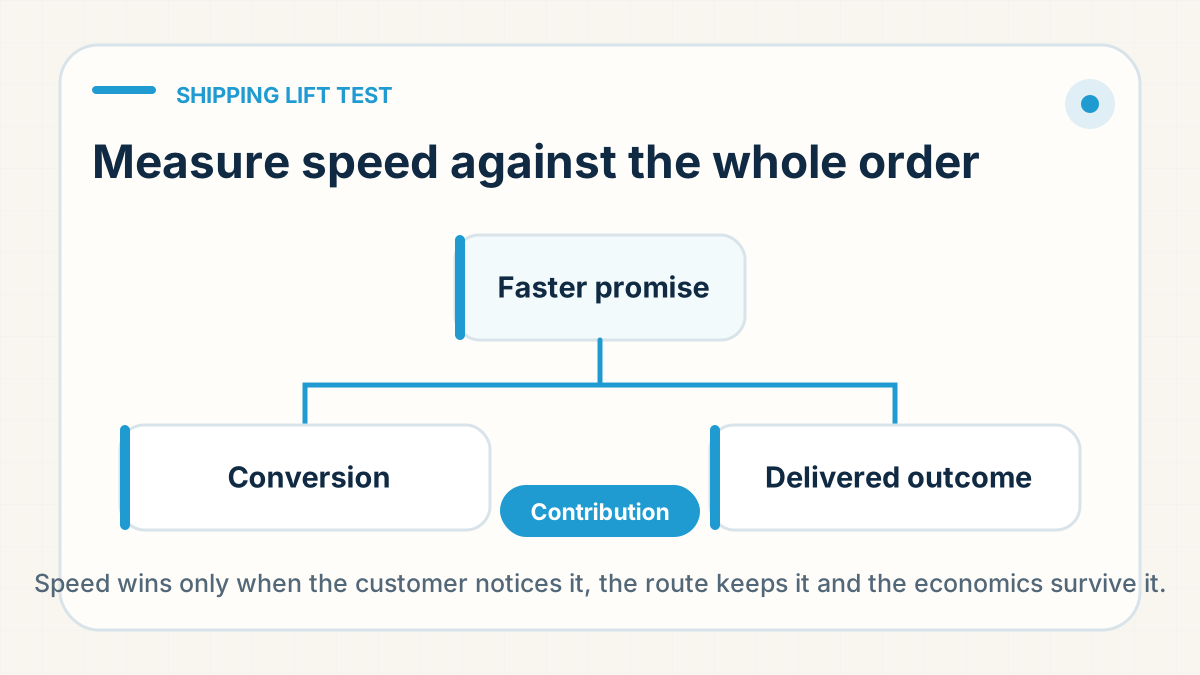
Faster is not valuable unless the customer notices it
Faster shipping has to win three times. The customer must notice a meaningfully better promise, the operation must keep it, and the delivered margin must survive the premium. The available company data does not prove that changing a Shopify route will cause a particular sales lift. Sea has reported a repeated pattern on Shopee: buyers using faster services spent more, fulfilment adoption grew, and listings that converted to Shopee fulfilment saw higher first-month orders on average. Every comparison is observational. The products, sellers and buyers choosing those services may already differ from the rest of the marketplace.
The useful response is not to copy the percentage. Treat speed as a testable part of the offer. Change one real delivery capability, show an honest promise, hold the main commercial variables as steady as possible, and measure the whole order from visit to delivered contribution. A route that raises conversion but destroys margin or creates more exceptions has not passed.
The commercial value of speed is constrained by the weakest link: promise visibility × promise reliability × contribution gain. This is an operating model, not a literal forecast. If the buyer never sees the improvement, the conversion effect is zero. If the route misses the displayed range, trust absorbs the gain. If the premium consumes the incremental contribution, revenue rises while the decision loses money.
What Shopee reported across three quarters
In its Q4 2025 prepared remarks, Sea said buyers using instant and same-day delivery spent around 15% more on average after adoption. It also said faster services had reached a double-digit share of order volume in metropolitan areas such as Bangkok and Jakarta. That is an association after adoption, not a randomized comparison: buyers who value convenience, live in dense service areas or shop higher-frequency categories may be more likely to choose fast delivery in the first place.
In Q1 2026, Sea said Indonesian instant-delivery order volume grew by more than 35% year over year while cost per order fell by around 20%. Shopee fulfilment order volume grew by around 25% sequentially, and more than one-third of the parcels it fulfilled in Asia during March arrived by the next day. These figures show adoption, service speed and improving marketplace economics. They do not isolate the incremental effect of delivery speed on one product listing.
The Q2 result is the most direct sales observation. Sea said Shopee fulfilment order volume grew by more than 20% quarter over quarter; in some markets, more than 60% of fulfilled parcels arrived the next day. Listings that converted to Shopee fulfilment saw more than a 20% average uplift in first-month orders in Southeast Asia. Sea did not describe a randomized trial or publish the product mix, traffic allocation, seller-selection rules or control-group construction behind that comparison.
Taken together, the quarters support a serious hypothesis: faster, more reliable fulfilment may strengthen demand as well as the post-purchase experience. They do not supply a Shopify forecast. A seller still has to discover whether speed changes customer behaviour enough to cover the operational cost in the particular product, market and acquisition channel being tested.
Why the 20% figure is not a Shopify benchmark
Shopee controls marketplace search, listing badges, seller reputation, checkout, vouchers, payments and fulfilment inside one network. Moving a listing into its fulfilment service can change several things at once: stock availability, delivery estimate, platform placement, trust, cancellation risk and the seller's ability to keep inventory ready. The reported order uplift cannot be assigned to shipping speed alone.
A Shopify store has a different path. It usually buys the visit from Meta, Google, TikTok or a creator, then has to establish trust on its own product page. A faster route helps only when the customer can see and believe the promise, the product remains in stock, the checkout works and the delivered experience matches the claim. A marketplace-wide average therefore belongs in the hypothesis column, not the revenue forecast.
Define what faster means before testing it
Shipping speed is not one variable. A seller can shorten supplier preparation, warehouse processing, origin handoff, line-haul transit, customs clearance or the last mile. Pre-stocking may remove a factory delay while leaving international transit unchanged. An express route may shorten transit while a two-day warehouse queue erases the benefit. An overseas warehouse may improve the final promise but add inbound freight, storage and inventory risk.
- Order-to-release time: when the paid order becomes ready for warehouse action.
- Preparation time: sourcing, receiving, checking, picking and packing before carrier handoff.
- Carrier transit: first acceptance scan through the customer delivery event.
- Promise accuracy: the share delivered inside the range shown before purchase.
- Tracking quality: whether the buyer can see credible movement and understand handoffs.
Choose the bottleneck the test will change. "Faster shipping" is too vague to learn from. "Move this approved SKU from per-order supplier purchase to Guangzhou pre-stock so preparation falls while the carrier and customer market stay the same" is a testable change.
Write the commercial hypothesis
State why the customer should care and which metric should move. A time-sensitive gift may respond through conversion. A replenishment item may respond through repeat purchase. A high-anxiety product may show the value first through fewer cancellations or tracking enquiries. A low-consideration novelty may show no meaningful response at all.
- Conversion hypothesis: a shorter credible delivery range reduces hesitation before checkout.
- Cancellation hypothesis: faster release and earlier tracking reduce orders cancelled before movement becomes visible.
- Experience hypothesis: a higher on-time rate reduces "where is my order?" contacts, refunds and chargebacks.
- Retention hypothesis: customers who receive the order inside the promise are more likely to buy again within a defined window.
- Contribution hypothesis: any incremental demand and saved exception cost exceed the extra route, handling and inventory cost.
Choose one primary hypothesis and a small set of guardrails. If every metric is declared the goal after the result arrives, the test becomes a story rather than a decision.
Build a comparison that can teach you something
The cleanest practical design depends on volume and tooling. A store with enough traffic may compare two honest delivery offers across randomly assigned eligible visitors while fulfilling each promise exactly as shown. A smaller store may use a phased test: establish a stable baseline, change the route for one product and market, then compare matched periods while documenting traffic, price, promotion and stock changes. A geographic split can work when two similar markets have separate route capabilities, but country differences must not be mistaken for a speed effect.
Keep the product version, selling price, main offer, product page, traffic mix and creative as stable as practical. Exclude periods with stockouts, major promotions, broken tracking or a platform outage. Record any supplier, campaign or audience change that could explain the result. A pre/post chart without those notes creates confidence without control.
Do not choose a universal order count or test duration from a blog post. Low-volume stores may need longer to observe enough purchases and deliveries; fast-moving stores may learn sooner. Decide in advance what volume makes the comparison useful for the decision and require the delivery outcomes to mature before calling the test. A purchase recorded today cannot yet tell you whether the faster promise was kept.
Show the promise the operation can actually keep
Testing a fast route while leaving the same vague delivery copy on the page does not test the customer response to speed. Testing an aggressive headline the route cannot consistently meet tests overpromising. Build the displayed range from current preparation and transit evidence, add a deliberate buffer for normal variation, and state the relevant cut-off or market limitation where it affects the outcome.
Capture the promise that each order saw, not only the site's current wording. Delivery copy can change during a campaign, and a later page screenshot does not prove what an earlier buyer was told. The order record should retain market, route, displayed range, release time, first scan and delivery result.
Measure the whole order, not just conversion
Start with visits and purchases, then follow the cohort until the operational result is known. Segment by market and acquisition source when those mixes changed. Report counts beside rates so a large percentage move from a tiny base is visible.
- Purchase conversion and checkout abandonment for the eligible traffic.
- Order-to-release time, first-scan time, actual delivery days and on-time delivery rate.
- Pre-dispatch cancellations, delivery-related support contacts per 100 orders, refunds, reships and chargebacks.
- Product, pick-and-pack, packaging, payment, freight, inventory and exception cost per delivered order.
- Contribution per visit and per delivered order, not only revenue or gross margin before fulfilment.
- Repeat purchase inside a pre-defined window when the product and buying cycle make that measure meaningful.
Contribution per visit is especially useful because it connects the commercial and logistics sides. A faster option can cost more per order but still win if conversion improves enough and exception costs fall. It can also raise conversion while producing less total contribution because the freight premium is larger than the incremental profit.
Calculate the speed premium honestly
For each treatment, calculate selling price minus discounts, product, domestic movement, pick and pack, packaging, payment, chargeable international freight, expected refund or reship cost, and any inventory carrying or storage cost. If pre-stocking is part of the test, include inbound freight and the risk of units that do not sell. If an overseas warehouse is involved, include receiving, storage, local dispatch and the capital committed before demand arrives.
Then compare incremental contribution, not only the new route price. The useful question is: did the change create enough additional delivered orders, retained contribution and avoided exception work to pay for the speed premium? A route can be operationally better and still be wrong for a price-sensitive product. Another can be more expensive per parcel and still be commercially stronger for a high-margin, time-sensitive offer.
Use a route test and an inventory decision separately
If the unknown is carrier performance, use the controlled shipping-route test to compare tracking, timing, exceptions and packed cost before moving the full flow. If the bottleneck is supplier preparation or distance from the buyer, use the dropship, Guangzhou pre-stock or overseas warehouse framework to decide how much inventory commitment the demand evidence has earned.
Do not move directly from an interesting marketplace statistic to overseas stock. Prove the product, approve the customer-ready unit, identify the real time bottleneck, test the route or stock position at controlled scale, then widen only after the delivered economics hold.
Ask the fulfilment team for the operating inputs
- Current supplier preparation time and the cut-off after which an order can no longer change.
- Actual packed dimensions, chargeable weight, product restrictions and eligible services for the target destination.
- Warehouse receiving, checking, picking and packing time for per-order purchase and pre-stocked inventory.
- Carrier acceptance timing, tracking return, typical handoff points and the evidence available for an exception.
- Stock on hand, replenishment lead time, daily release capacity and weekend or holiday constraints.
- Who owns a late first scan, missed delivery range, address issue, lost parcel, refund recommendation or reship decision.
Those inputs turn a marketing promise into an operating plan. They also reveal whether the proposed speed change is real. Paying for a faster line-haul service cannot repair a supplier that takes a week to prepare the unit.
Set the decision rules before launch
- Keep the faster setup when delivered contribution improves and the service guardrails remain inside the agreed limits.
- Narrow it to selected products or markets when the result depends on margin, urgency, parcel profile or route coverage.
- Retain it as a paid option when enough customers value speed but making it standard would weaken unit economics.
- Revert when the conversion signal is weak, the premium is not recovered, stock risk rises too far or the promise is not met consistently.
- Investigate rather than declare a winner when traffic, offer, stock or creative changed enough to explain the result.
Record the decision with the tested product version, market, dates, traffic mix, route, displayed promise, costs, mature delivery results and known confounders. That record is more valuable than carrying a borrowed 20% benchmark into the next campaign.
Test noticeability, delivery and margin together
Sea's disclosures make shipping speed worth testing as a commercial lever, not merely treating as a customer-service expense. They do not show that every faster route creates more sales or that a Shopify store should expect Shopee's reported uplift. The evidence is strongest as a prompt to measure the mechanism in your own operation.
Define the exact time bottleneck, show an honest delivery promise, hold the main commercial inputs steady, follow orders through delivery and compare contribution after every fulfilment cost. Faster shipping is not a feature until the buyer can see it, the operation can keep it and the margin can pay for it.
What these figures can and cannot show
The logistics, buyer-spending, fulfilment-volume, next-day-delivery and listing-uplift figures are company-reported observations from Sea's Q4 2025, Q1 2026 and Q2 2026 prepared remarks. Sea did not publish a randomized causal study or the complete underlying cohort and attribution method. Use the Shopify test design, measurement framework and decision rules above on your own orders; they do not guarantee a sales lift, delivery result or profit outcome.
Need one order or route checked?
Worried about an order's tracking? Send us the order number on WhatsApp (wa.link/dropship) and we'll check what's going on.
Check Order on WhatsApp →