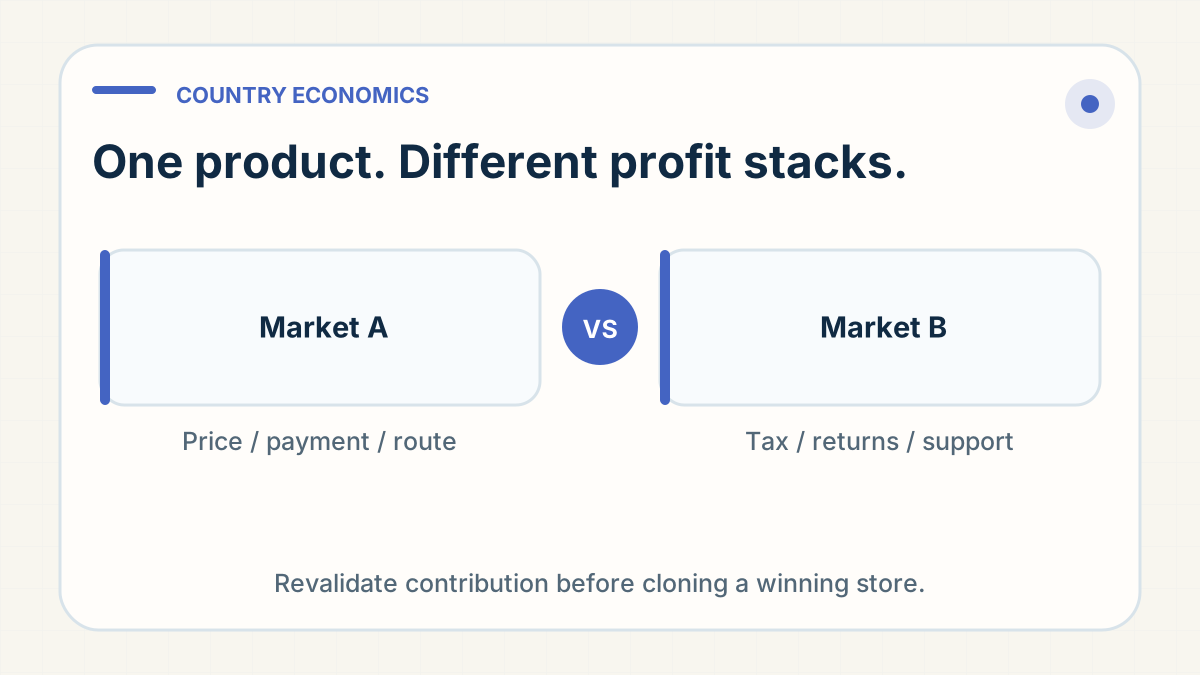
Work out the profit again for every country
Do not open a new country by translating the product page and keeping the old price. Treat every product, country and traffic source as a new business. Check local demand again. Check the price, the payment methods, the tax and duty, your delivered product cost, the delivery window, refunds, chargebacks and support. Scale only when you are still keeping money per visit after that group of orders has finished settling.
Use the landed-cost model to work out what one customer-ready order costs you. This guide goes one step wider. It asks whether the whole country still leaves you money once local checkout, delivery and what happens afterwards are counted.
The country is part of the product economics
The item in the box can stay the same while everything around it changes. Currency, payment methods, the tax shown at checkout, who collects duty, the delivery promise, what customers expect when they return something, the language your support answers in and what a customer costs you in ads all sit between your product and the money you keep. A result from one country is evidence about that setup, not a forecast for the next one.
Shopify Markets shows how real this is. Its current documentation lets you set the currency for a market, set duty and tax behaviour per market, and match the storefront language and country. Shopify also says automatic currency conversion can carry a conversion fee, and that a refund in a foreign currency uses the exchange rate on the day of the refund, so the original conversion fee does not come back to you. Those are platform mechanics, not proof that going local will make you money. They are why a copied gross-margin sum is never the whole answer.
Global-e reported that the value of everything sold through it in the second quarter of 2026 was USD 2.089 billion, up 44 per cent on the year, with revenue of USD 299.0 million, up 39 per cent. Adyen reported first-half 2026 net revenue of EUR 1.303 billion and processed volume of EUR 803.8 billion, and said customers using specific optimisation products saw an average 0.9-percentage-point lift in conversion. Those are company-level numbers from a cross-border platform and a payment company. They tell you this plumbing matters. They do not tell you what you will convert or keep in any country.
A privacy-safe review of our own portfolio from May to August 2026 covered 145,005 orders. Europe was 57.3 per cent of that reviewed set, North America 28.0 per cent and Japan 9.5 per cent. That describes the mix of one operation over one period. It is not market size, category demand or a target for you. The narrow point is that where the parcels go is different enough to decide product, route and problem-handling country by country.
Build one country profit stack for every expansion test
Keep the stack at product version, country and traffic source. One blended dashboard lets a strong country pay for a weak one, and lets a warm retargeting audience cover for a cold launch that is not working. Compare in one currency, but keep the original currency and the exchange rate you used in your evidence.
- Demand and traffic: visits you could have sold to, traffic source, audience, creative, landing-page version and season.
- Local price and offer: the price shown, discounts, bundles, free-shipping threshold and any promise you make only in that country.
- Payment: which methods you show, how many payments are approved or declined, fraud controls, payment fees and chargebacks.
- Currency: how you price, the conversion fee, the rate when you take the money and when you refund it, and who carries the swing.
- Tax and duty: what you show, where it is collected, what you classify the product as, where it is made, what you assume about the de minimis limit, and what the customer gets when your estimate is wrong.
- The exact product version: the approved spec, the parts, the claims, the supplier and the version number.
- Customer-ready product cost: product, moving it in, inspection, packaging, inserts, labels and pick and pack.
- Route to that country: whether it is allowed, freight, last mile, tracking, dispatch cut-off and an honest delivery window.
- What happens to the parcel: delivered, late, returned, lost, damaged, refused and address problems.
- Refunds and replacements: the reason given, what a replacement costs, reshipping, partial refunds and what revenue you still hold once the window closes.
- Support and rules: languages you cover, how often customers contact you, how long each one takes, what proof you need, product rules and any fixed work that country creates.
- Ads and profit: ad spend, agency or creative cost, what you keep after everything, and what you keep per visit.
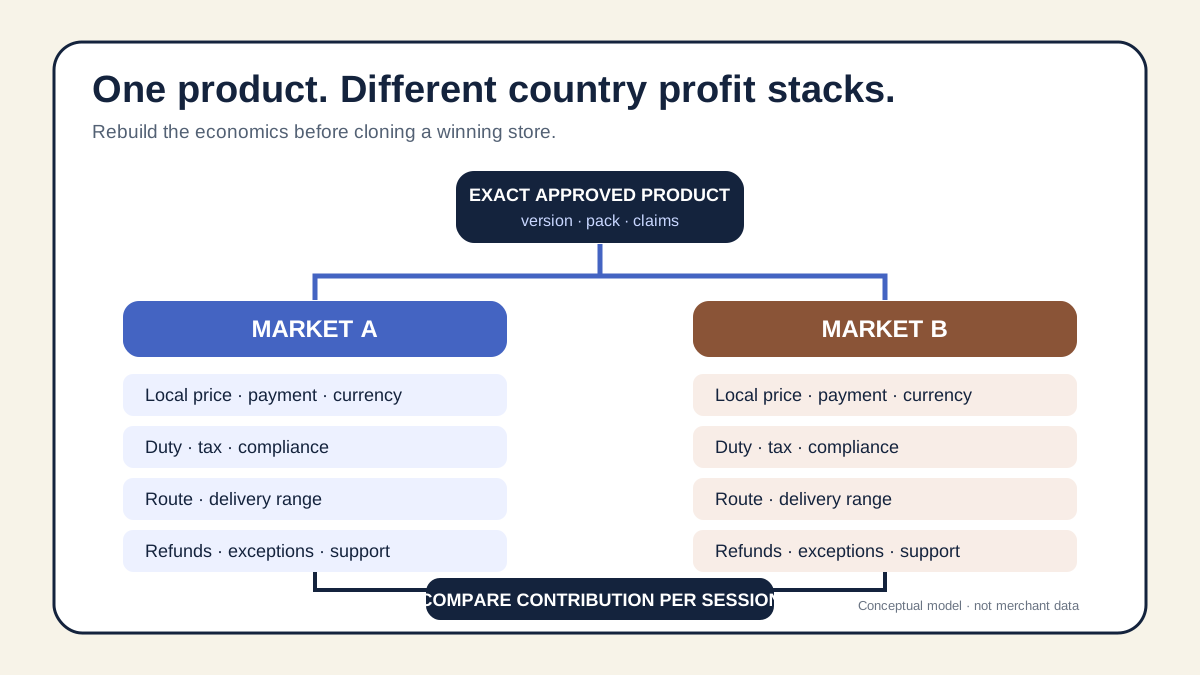
Compare countries on what you keep per visit
Start with the revenue you still hold after discounts and after refunds have settled. Take off the exact product and packing cost, freight and last mile, any duty or tax you absorbed, payment and currency cost, ad spend, replacements, returns, support and any fixed work that country creates. Divide what is left by the visits you could have sold to, for the same product, country and traffic source.
That one number keeps conversion and order size in the same view. A country that converts worse can still be the better one if you keep more of each order, sell a bigger order or have fewer things go wrong. A country with cheap clicks can still be the worse one if failed payments, late parcels, refunds and support eat the difference.
Here is a worked example. Market A gets 1,000 visits, 30 paid orders and 27 kept orders at GBP 60, so GBP 1,620 of kept revenue. Product and packing cost GBP 864, freight GBP 49, ads GBP 600, and payment plus settled problems GBP 108. You are left with minus GBP 1, or about minus GBP 0.001 per visit. Market B gets the same 1,000 visits, 24 paid orders and 23 kept orders at GBP 70. Its GBP 1,610 of kept revenue, less GBP 736 of product and packing, GBP 56 of freight, GBP 480 of ads and GBP 69 of payment and settled problems, leaves GBP 269, or GBP 0.269 per visit.
Those numbers are made up. They are not our rates and not a target. They show why the country that converts better can be the one losing you money. Put your own current numbers in, and give both countries the same amount of time to settle before you compare them.
Download the blank country-economics comparison worksheet. It has two empty country rows, with no provider rates or universal thresholds. Fill both rows with the current economics for your own store.
Check how far the new country really is before you spend
Score the distance between the country that works and the one you want, before you order stock or copy the campaigns. Use current evidence about your exact product, not what you think a country is like. Score each line 0, 1 or 2: 0 means something is genuinely different or unresolved, 1 means partly similar with gaps, 2 means close and backed by current evidence.
- The job: is the use, the urgency and the reason for buying really the same?
- Room on price: does the local competition leave you anything after realistic discounts and costs?
- Payment: can the customer you want pay the way they trust, and what does that do to approvals and fraud?
- Product and rules: do the spec, labels, claims, plugs, sizes, materials or restrictions change?
- Route: is there a tracked route for the exact packed product to that country, with a delivery window you can say out loud?
- What happens after: what do you know about delivery, returns, replacements, support and chargebacks on comparable orders?
The score is a to-do list, not a probability. A low score on rules or route can stop the test whatever the total says. "We do not know" is a proper answer. Missing evidence should buy you a small test or a hold, never an optimistic guess.
Run the expansion in six controlled states
- Screen: write down the customer job, the reference price, product restrictions, payment methods, route options and your biggest unknowns. Reject the country when a hard product, rules or route problem cannot be fixed.
- Quote: lock the exact version and the customer-ready pack, then get current route and handling numbers. Model a bad, a likely and a good case, and keep tax, refunds and ad spend visible in all three.
- Test: show it to a limited audience with one named product version, price, set of payment methods, delivery promise and traffic source. Write down the main number, how long you will wait and what makes you stop, before you launch.
- Hold: stop committing while orders settle or while you work out a pattern of problems. Keep serving the orders already open and keep the evidence.
- Scale: spend more only inside the product, country, route and traffic setup that actually left you money after everything settled. Check again when any part of that setup changes.
- Stop or redesign: stop showing it when profit, payment, delivery, refunds, rules or support cross the line you wrote down. Fix the named layer before you try again.
Do not put stock in the country because early ads look good. Bulk freight, storage and local fulfilment can improve a route you have already proved, but they also make a guess much harder to undo. Wait for a stable product version, demand in one place, a repeatable customer-ready cost, enough delivery evidence, settled problems and a written plan for getting rid of stock that does not sell.
When those start to hold, use the pre-stock decision guide. For a country where you have little route evidence, run a controlled shipping-route test before you make the delivery promise public.
Give each country price an audit trail
API 2026-10 trail lists each adjustment in order with its type and value. It helps investigate mismatches but does not name a market or audit orders.
Read Shopify's 17 September notes on the pricing audit trail and market relationships. If Shopify returns an empty trail, treat it as a reason to check whether the calculation finished; do not assume that no rule exists.
Test 20 variants across three markets (60 pairs). Compare API, storefront and checkout prices; log mismatches before spending.
Test the offer in the actual checkout
A translated email, a buyer's country or a country market alone does not prove a payment option will work. Run a declared test profile through your storefront. Record the market, currency, product URL, price, shipping charge, payment methods shown and the resulting payment state. Your merchant eligibility and account settings are part of the result.
Australia provides a current caution. Affirm and Shopify announced Shop Pay Installments for Australian Shopify merchants on 27 August 2026. Shopify's general FAQ, checked on 7 September 2026, still lists only eligible stores in the US, Canada and UK. These sources conflict. Neither proves that your Australian store is eligible, nor that US or UK limits, fees or refund terms apply there. Check your exact account before building the offer around it.
Use the Klaviyo and Shopify Markets checklist to follow the product from message to checkout. Sources: Affirm and Shopify's Australia announcement and Shopify's instalments FAQ. Recheck them when the available account terms change.
Keep instalments only if extra orders pay for the buyers who switched
A rising instalment share shows how customers paid. It does not show more people bought: some would have paid by card, and on their orders you carry any extra fee.
The option pays only when this stays above zero: money kept from the genuinely extra orders, minus the extra fees on orders you would have had anyway, minus any change in refunds or disputes, minus setup cost. Use settled orders from your own store, not a provider's network-wide averages. A card payment can also keep its fee after a refund, so count only the change.
Illustrative, made-up numbers, not a quoted fee: 30 buyers who would have paid by card switch, and each switch adds USD 2, so USD 60. If each extra order leaves you USD 18, four extra orders only just cover that. Ten leave USD 120 before refunds, disputes and setup.
Check each country with a random split: show the option to a random share of checkout visitors and hide it from the rest, with the same product, price and traffic over dates you fix in advance. On a review date you also fix in advance, late enough for refunds and disputes on those orders to settle, compare kept orders and what you keep per visit. Split only where your platform and the provider's terms allow it.
Without a split, compare equal periods before and after switching it on, with product, price and ads unchanged. That cannot prove instalments brought the extra orders, because season or a promotion can move orders too. Comparing instalment buyers with card buyers cannot show extra orders at all, because those buyers chose the method themselves.
Tell a real country effect from a noisy launch
Write at least one other explanation next to every conclusion. Conversion may differ because the traffic or the creative changed, not because the country is better. Refunds may look low because the orders are too young. Delivery may look fast because your sample only covers easy postcodes. A big order value may come from a bundle you ran for a week, or from the exchange rate.
If your volume allows it, hold the product version, the offer, the creative family and the traffic source steady and change only the country. If you cannot, write down every difference and trust the answer less. Read paid orders, kept orders, profit, delivery and problems by the week the orders came in. Never compare a two-week-old launch with a home market you have run for a year.
Here is how you would know the new country is worth it. Take a settled, comparable group of orders and find that it still leaves you money and still runs smoothly once you have measured the layer you suspected. The reason to stop is the mirror image: what you keep stays below the floor you wrote down, or customers get hurt and the rules are against you, even while gross sales climb.
Match the next action to your stage
- Testing store: pick one product version, one country and one traffic source. Check the product is allowed, know your customer-ready cost and have a tracked route before you widen the test.
- Growing store: split profit and problems by country, tighten your version control, and test whether stock or route changes improve settled results rather than only dispatch speed.
- Multi-country seller: keep a profit stack, a route owner, tax and payment assumptions, a review date and a change log for each country. Do not let a global average approve local spend.
- Own-brand seller: add packaging, labels, claims, an intellectual-property check, compliance evidence, local returns and the risk of unsold stock before you pay for tooling or bulk.
What RyanFulfil can make operational
We can turn a country plan into China-side controls: exact product and version briefs, supplier and sample checks, agreed inspection criteria, customer-ready packing cost, route options to that country, test-order preflights, stock-mode comparisons and evidence when something goes wrong. Whether a route is allowed, how long it takes and what it costs still has to be confirmed for the current product, pack and country.
You stay responsible for demand, pricing, advertising, payment setup, tax and legal advice, what you promise customers, your own money thresholds and the decision to scale. RyanFulfil cannot guarantee conversion, delivery dates, customs outcomes or profit.
A useful country brief has the exact product version, the country, the quantity and stock mode, the customer-ready pack, the payment and delivery promise you intend, the price ceiling, the swaps you will not accept, the test window and the rule you will decide by. Contact RyanFulfil when that brief needs a current China-side sourcing and shipping check.
What this doesn't prove
Sources as of 18 September 2026. The Shopify mechanics come from the current official Shopify documentation linked below. The Global-e and Adyen figures are company-reported first-half or second-quarter 2026 results and are not a benchmark for what you will keep. Our portfolio figures are aggregated operating context, not a fair sample of world demand. The 12-layer stack, the distance score, the profit-per-visit comparison and the six states are ours, not anyone else's standard.
Read this again after a change in platform fees, tax or duty rules, payment methods, exchange-rate policy, product spec, supplier, packing, route, carrier, customer promise or your own settled country results. Drop any model the moment your current product and country evidence says otherwise.
Need a product checked before you spend on ads?
Send us the product link and destination on WhatsApp (+86 178 4666 9989). We'll check sourcing, packing and shipping with you before you commit.
Get Sourcing Quote on WhatsApp →