Field note
What was happening
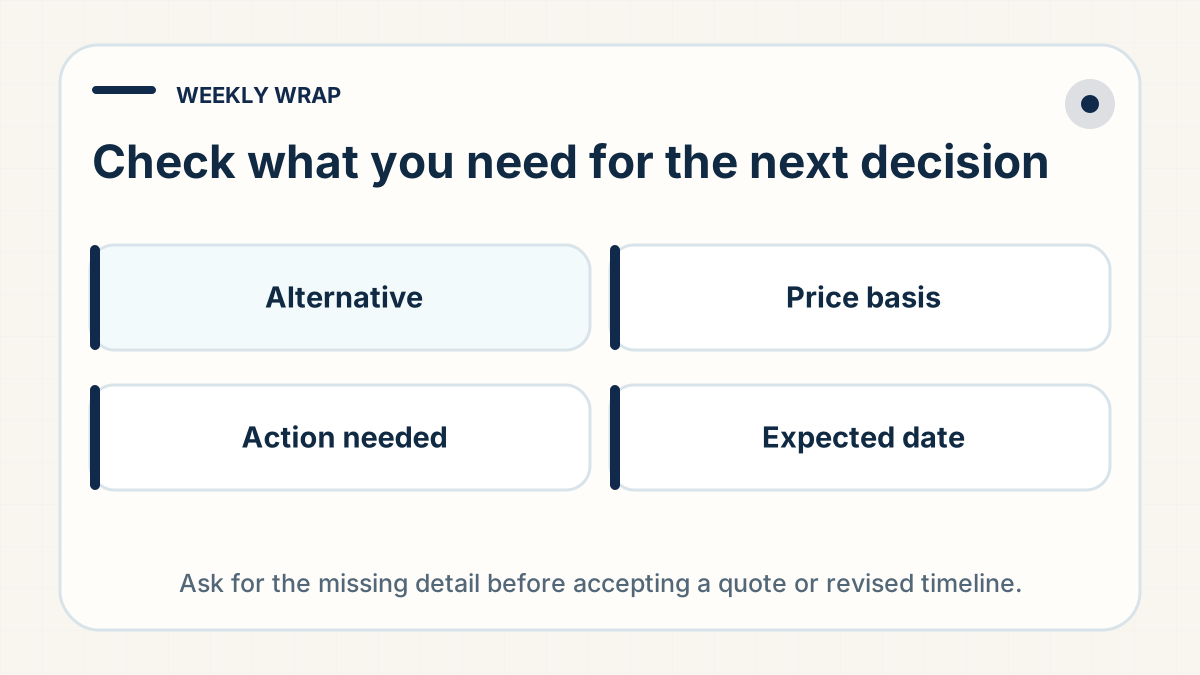
An answer is finished only when it carries its own next move. That means the alternative beside the no, the basis beside the price, the action line beside the data, the named day beside the deferral and the artifact beside the assurance. The pattern held across six complete days, from a quiet Sunday to a heavy Friday. Expectation and sourcing questions led, with quote, pricing and communication traffic close behind. Sunday ran light and prospect-heavy at a few hundred messages, with the front desk open and the factories closed. Each weekday ran several times that, peaking early in the week and again on Thursday.
The flow split close to evenly between prospects still deciding and active fulfilment groups. France, the United States, Germany, the United Kingdom and the wider EU led the destinations; home-and-lifestyle goods led the product mix, ahead of apparel, electronics accessories and beauty. Volumes, prices and minimums appear here as bands, and every story is blended across several accounts. These are pooled patterns, not the story of one identifiable account.
The theme of the week
All week, the threads that closed in one message were the ones where the answer travelled with its next move; the ones that dragged left the reader to come back and ask what to do with what they had been sent.
A no is finished when the alternative rides with it
The week opened on that discipline and never dropped it. A product that could not be sourced was declared unsourceable after a stated multi-supplier search, with interim updates along the way, rather than drifting as a maybe. A declined buyback was relayed honestly instead of being stalled. A customisation minimum that ruled out a small test run arrived together with a lower-minimum hunt and a ready-made alternative in the same message. Later in the week the same shape returned with numbers attached: personalisation a supplier could not do came back priced as private production with a minimum band and a lead time, and branded requests were refused with unbranded equivalents in the same breath.
A buyer whose request could not be fulfilled had to ask again for an alternative, while another could not decide how long to wait on an open-ended supplier search. Ask for the sourcing limit, available alternatives and the next update together, so you can decide whether to change the specification, wait or look elsewhere.
A cheaper price is a different shipment until proven otherwise
Price objections arrived all week and met the same move: ask for the comparison artifact — the link or screenshot, the exact spec, the quantity, the shipping method — and requote on the same basis before deciding whether the total differs. One apparent several-fold gap closed to near parity once both prices sat at the same quantity. A domestic marketplace price that looked unbeatable turned out to be local retail stock, compared against a cross-border quote already carrying international shipping and customs. One comparison remained unresolved because the alternative reference was not supplied.
The rule that survives is match the basis before you match the price: confirm any volume condition attached to a discount before comparing it with your current order.
The verdict travels first; the documents ride underneath
Carrier contact cards, lookalike quotes and certificate stacks all failed the same way this week: correct data, no meaning attached. A held-parcel notice that had circulated as phone numbers and opening hours started working the day one line rode ahead of it — this is self-collection; have your customer collect with this tracking number. A near-match quote landed cleanly when labelled as a similar product only, while an unlabelled lookalike read as a trick and ended the conversation. An eligibility question has exactly three honest answers — yes, no, or unknown together with whose determination it is — and the verdict belongs in the first line, the paperwork underneath.
Sent raw, the data is not the answer; it is the reader's homework.
Whether it can ship decides more than what it costs
A product a supplier will happily sell is not yet a product that can leave China for your market. The screen that kept the week honest ran material, dimensions, battery, brand and certificates before route and price — and where it was skipped, two contradictory answers about one oversized item inside an hour cost more credibility than a plain no ever would. The same check, applied to lanes, ended one market plan before a single ad ran: the quote came back at roughly three times an established lane's rate for the same bulky item, and the seller cancelled with nothing lost but a question.
A sourceable product still needs an eligible route, and a price without its label is half a quote: what it includes, which lane it belongs to and that lane's window belong in the same message as the number.
A delivery time is a sum, and a status is an artifact
Every workable answer to how long will it take decomposed the promise into legs: a procurement leg to the warehouse measured in working days, then a transit leg that belongs to a named lane — Standard or Express — with the quoted transit clock starting at dispatch; the customer's total wait also includes preparation after checkout. Sellers who had glued the legs into one number spent the week un-gluing them. The same discipline settled contested statuses: an origin scan with its timestamp answered a chargeback, an invoice history check prevented a double shipment, and raw tracking events read back with their dates dissolved a customs panic that was only ever a display problem.
When a status is contested, trade evidence, not adjectives — a delivery time is a sum, not a number, and a status is whatever the artifact says it is.
On a Friday, tomorrow means Monday
The last evening of the working week filled the deferral queue, and the honest deferrals named their day. A late-night enquiry answered with a named next-morning owner was accepted happily; an evening lead got an it-is-late acknowledgement with a concrete next-day commitment. The ones that hurt were the questions that visibly fell into the weekend — a "we will follow up tomorrow" sent on a Friday evening China time is, in practice, a Monday answer, and saying so costs one clause. Clients accept latency they can see; what they do not accept is silence with no clock on it.
When your agent defers on a Friday, ask for the day, not for "tomorrow" — because tomorrow means Monday. The same goes for the deferrals you send your own customers.
Where the week's questions actually sat
Pooled across the six days, the desk worked roughly four hundred distinct conversations, on the order of nine hundred noteworthy events, and more than seven hundred direct client questions. Price, quote and minimum-order questions were the largest single block by a wide margin, present every day of the window; branding, packaging and customisation came next, then shipping time and route, then tracking. Around half the conversations were prospects still deciding; the rest were active fulfilment groups mid-order.
What to carry into next week
Ask for the next action in the same reply: the alternative after a refusal, the inclusions and lane beside a price, the conclusion attached to a document, and a named day for a deferred check.
To see what a price should cover, read how we build a fulfilment quote.