Field note
On Friday evening, "tomorrow" is a Monday word
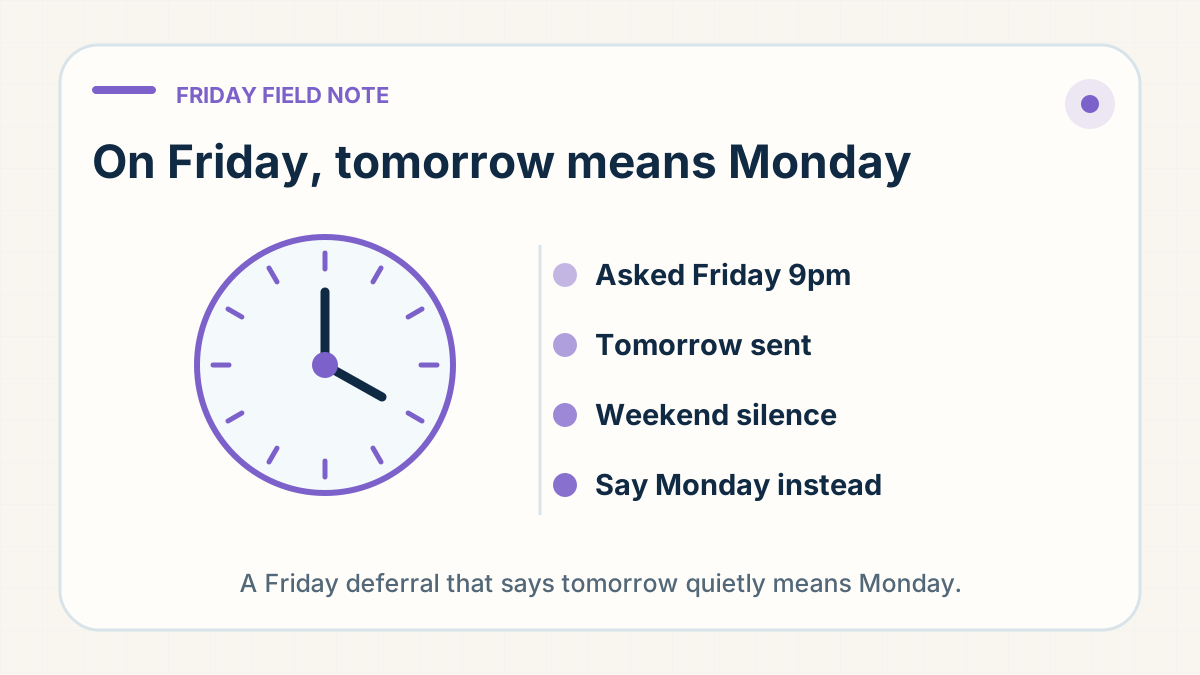
Give every deferred question a real day; on a Friday evening that day is Monday, so say Monday. The last working evening of the week has a specific failure mode. A question arrives at 9pm China time, the honest answer is "we will follow up tomorrow" — and on a Friday, tomorrow is not tomorrow. Unless somebody works the weekend, it is Monday. This Friday the desk ran both versions of that sentence: deferrals that named the real day and kept their clients calm, and deferrals that said "tomorrow" and let a question fall silently into the weekend. The same evening produced two other kinds of closed answer worth copying — destination maths delivered before a seller spent on ads, and a product ceiling stated plainly instead of an open-ended search.
Our FAQ answers whether we work at weekends and why a quote can wait until Monday.
A deferral needs a visible clock
The stalled cases shared one shape. An artwork check on a homeware order stopped because the supplier had gone off duty; the "following up tomorrow" note was honest but never said the realistic next update was Monday. A marketplace seller in Western Europe asked for barcode numbers on a handful of product variants late in the evening and got silence instead of a one-line "will check Monday". A buyer working against a two-day purchase deadline asked about adding her brand to a bulk order, and the deferral named no response time at all. None of these answers was wrong. Each one simply left the client to discover the weekend on their own.
The fix is structural, not heroic: every deferral goes onto a written register with a named owner and a named day, so nothing depends on memory across a weekend. An open action register for fulfilment exceptions is exactly that clock — the question, who holds it, and the date the next update is due.
Clients accept latency they can see
The counter-examples came from the same evening. A late-night enquiry about a kids' product got an immediate "we will check tomorrow morning" with a named owner, and the prospect accepted happily. An inbound business lead was acknowledged at 8pm with an honest note that it was 8pm, plus a concrete next-day commitment. Neither answer moved any faster than the failures above. The difference is that the waiting had a shape. A client who can see the clock will wait; a client staring at silence starts pricing in the worst case.
The lane decides before the ad does
Friday also settled several market-entry questions, and it settled the cheapest ones earliest. A pet-product seller asked about opening South Africa; the quote came back at roughly three times the Australia rate for the same bulky item, with recipient tax-ID and phone requirements and a possible inspection fee on top. Shipping alone exceeded his retail price, so he closed the market before spending anything on ads. That is the system working.
The expensive version ran in parallel: a Spanish-speaking prospect went through sourcing, quotes and a translated video call before anyone checked whether a lane to his South American market existed at all — it did not — and a Gulf-destination buyer planned around parcel sizes the lane's weight cap had never allowed.
The template for doing this well already exists: a North-African quote went out within a day carrying every hard truth — customs clearance excluded, transit on that lane declared unstable rather than dressed in a number, sample order first. Before committing spend to a new country, check the addresses standard shipping can't always reach — coverage, address type and service rules decide feasibility before any ad does.
A stated ceiling beats an endless search
The third pattern was the closed no. A UK textile seller wanted an extra-long size; after a wide supplier check the answer was that the size does not exist, together with the actual maximum available — a ceiling the seller could plan against. A German footwear seller pushed several rounds of "please look again" on larger sizes; the line held — the model tops out, and larger means custom production with a minimum order — and the seller converged on an informed compromise. A US bag seller asking for a mini version heard that none of the factories contacted makes one, with official dimensions and a stated tolerance. And a third colour one seller believed existed was confirmed out of stock at every supplier, restock uncertain, before she listed it.
An open-ended "we'll keep looking" feels kinder in the moment, but it freezes the client's decision and it expires badly. The ceiling, stated alongside what is available, is the answer a seller can plan against — the same discipline behind getting sizing charts right when you don't hold stock.
Name the day before you close the week
Before Friday ends, read back every question you have deferred and give each one a real day — and on the last working day of the week, that day is Monday, said out loud. Ask your agent for the day, not just "tomorrow", and pass the named day straight to your own customers. Close any market whose lane maths fail before the first ad, and stop any search that has already found its ceiling. A closed answer on Friday is worth two hopeful ones on Monday.