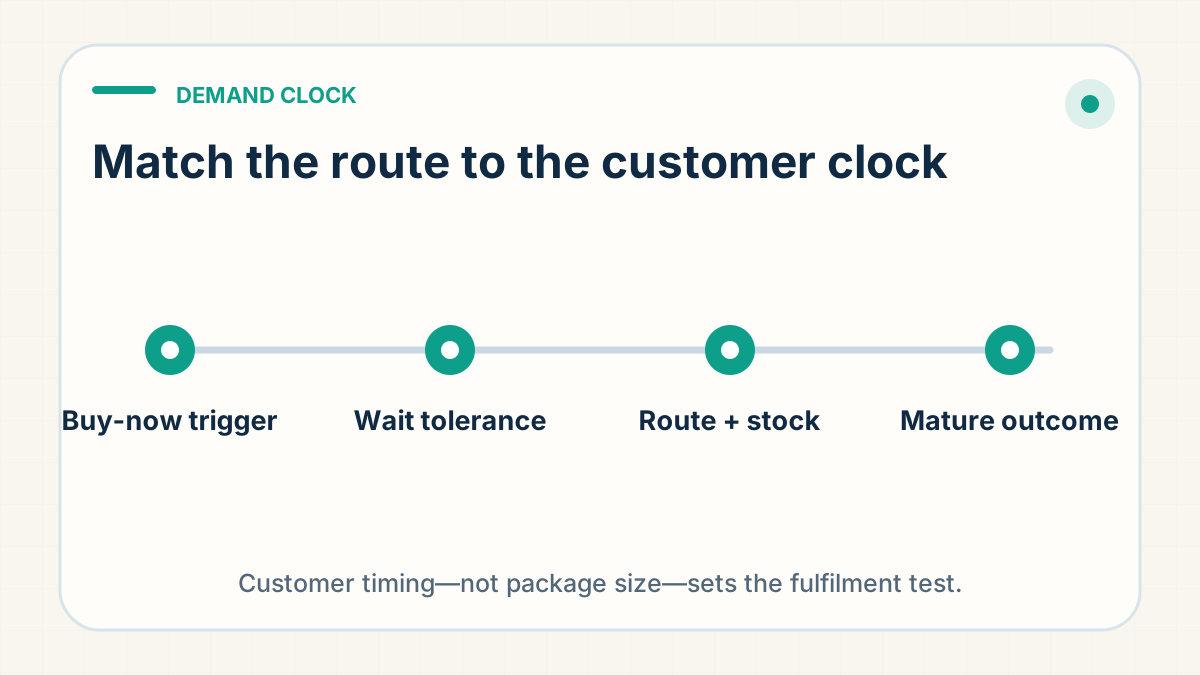
Match the route to how long your customer will wait
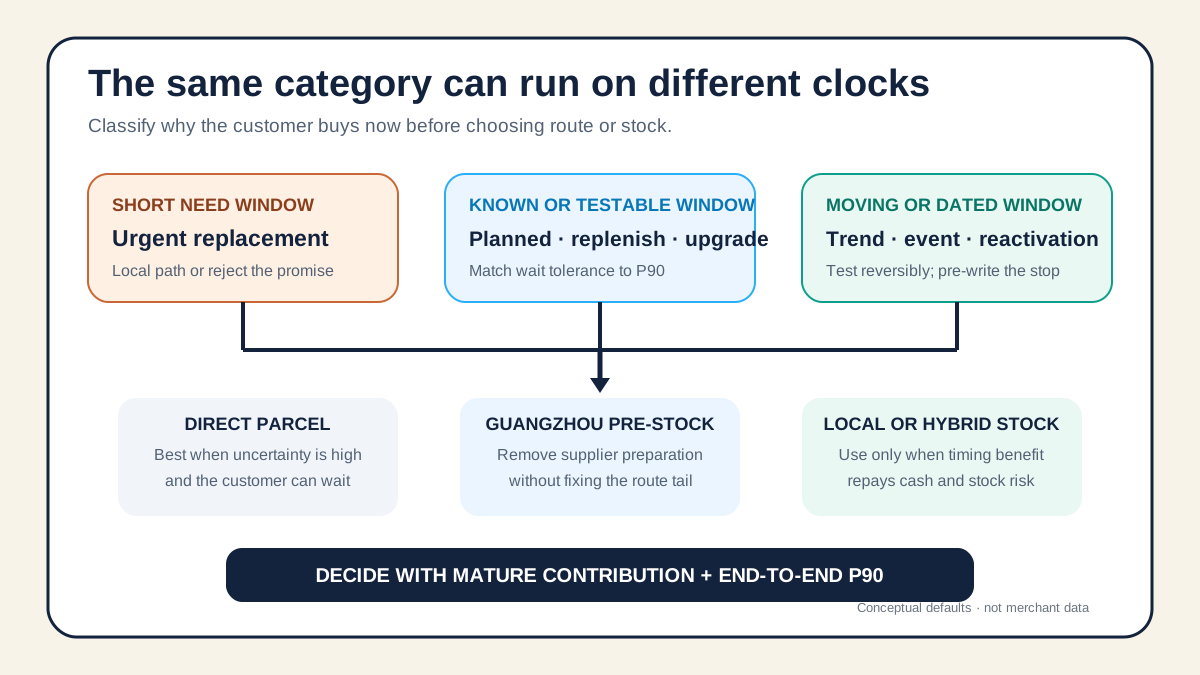
The product category does not tell you how long your customer will wait. Work out why the customer is buying now, before you pick a route. Something broke and they need it today. Something is wearing out. They are running low. They want a better one. They saw it and want to try it. There is a date they need it by. Or the price finally suits them. Then compare that wait with your real door-to-door time, not your best one. Use direct parcel, Guangzhou pre-stock or stock in the customer's country only when the timing fits and the money still works.
This is a different question from the four-clock winning-product diagnostic. That guide tells you whether the product, the creative, the audience or your own operation is what slowed down. This one asks why your customer buys now, and when their need is simply too late to serve.
One category can hold several different waits
Best Buy gave a useful contrast in its second quarter of FY2027. Management said big appliances are mostly bought to replace something, and that speed, stock, delivery and installation matter when an essential appliance dies on you. In the same electronics business it talked about a possible wave of television replacements from the people who bought heavily in 2020, new technology pulling upgrades, emerging products growing, and gaming looking weak against a big launch a year earlier. That is one retailer explaining its own numbers, not a benchmark for your store. What it is good for is showing that one category label can hide several very different waits.
The same warning turns up elsewhere. Gap reported second-quarter comparable sales ranging from up 10 per cent at Gap to down 12 per cent at Athleta, inside one clothing owner. Ulta's second-quarter mix moved in opposite directions by subcategory: haircare and fragrance each gained one percentage point of the mix while cosmetics and skincare and wellness each lost one. Neither of those tells you what to sell. Both tell you that "clothing demand" or "beauty demand" is far too rough to set your stock or your delivery promise.
So put the wait on the exact approved product version, the country and the job the customer is doing. A spare part can be an emergency in one use and a planned job in another. A fragrance can be a refill, a try-it or a gift with a date on it. Treat your answer as a bet you can lose, one that gets stronger or weaker as real orders come in, not as a permanent label on the category.
The seven reasons someone buys now
- It broke and they need it now: waiting costs them something real. If a local shop can supply it, your slow parcel is beaten before you start, even on a small item.
- It is wearing out: age, wear, a service interval or a renewal date opens a wider window. They can buy before it fails, if the reminder is honest.
- They are running low: use empties the product or the refill. Work backwards from the day they run out and your real delivery time.
- They want a better one: what they have still works. Your new version has to be better in a way they can see, feel or measure.
- They just saw it: a creator, a trend or a new use gets their attention. That attention can move faster than your supplier approval, your QC and your route.
- There is a date: a launch, a season, a holiday or a day they need it for. The last safe order date matters far more than when your campaign ends.
- The price finally suits them: a lower entry price, a smaller pack, a payment plan or a well-timed nudge. It may pull a purchase forward rather than create a new one.
Say how sure you are before you turn it into policy
Say you are sure only when that exact product and country shows the same reason and the same timing across orders that have already settled. Be half sure when the product logic and some real customer behaviour agree. Say you are guessing when the reason comes from a category label, a supplier's claim, a big company's commentary or one short launch window.
Write the strongest rival explanation next to your answer. A product that looks like a refill may be bought once as a gift. A spike may just be a good ad. A wave of replacements may only be a discount. Your answer is worth something when another observation could prove it wrong.
Compare how long they will wait with your slow parcels
Parcel size is not the thing that decides your route. The longest your customer will wait is. Measure the whole gap from paid order to delivered parcel: supplier handling, the move to the warehouse, receiving and release, handover to the carrier, the flight or the sailing, customs and the last mile.
Then use the day by which 9 in 10 of your parcels have arrived. Call it your 9-in-10 day. The rough rule we use in-house is: how long your customer will wait, divided by your 9-in-10 day, door to door. Above 1 and the slow tail fits inside the wait. Below 1 and at least 1 order in 10 misses it, if the last few months repeat. Do not publish a comfortable band as if it were universal. Sample size, season, country, whether the product is accepted on that route, and how badly a late parcel hurts all move the answer.
Keep your middle day next to your 9-in-10 day. The middle day, the one half your parcels beat, is what most customers feel. The 9-in-10 day is where the cancellations, the where-is-my-order messages, the missed birthdays, the refunds and the one-star reviews come from. Split it by exact product version, country and route. A blended world average can make a fragile lane look safe.
If the route has no steady pattern yet, run a controlled shipping-route test before you change what you promise. Measure order to dispatch on its own, so a quick carrier does not hide a slow supplier or a stock wait.
Pick direct parcel, China pre-stock or local stock by the wait
- Direct parcel keeps you able to walk away when demand is unproven, the product is unusual, the customer can wait and dead stock would hurt you more than a slow parcel.
- Guangzhou pre-stock takes out the repeated supplier prep and the domestic move once demand is proven but you still do not know which country and which variant will win. It does not shorten the international leg.
- Stock in the customer's country can fix a timing problem when demand is concentrated and steady enough to pay for bulk freight in, local fulfilment, storage, returns and whatever you fail to sell.
An emergency product usually pushes you to a local path, or to rejecting it. Wearing out, running low and upgrading can all work on a direct parcel when the customer buys early enough. Trend products usually belong in small direct-parcel tests first. A product with a date on it needs a cut-off before you commit to any stock. These are starting points for you to check, not routing rules.
Use the existing dropship, Guangzhou pre-stock or overseas-warehouse comparison for the cost and control trade-offs. The customer wait is the timing input; that guide tests whether holding stock earns the commitment.
Work backwards for refills and for dated products
For a refill: send the reminder on the day they are likely to run out, minus your 9-in-10 delivery days, minus a few days for them to think about it. A reminder that lands after they have run out is not marketing, it is an apology. Hold the message back when the exact version, the sellable stock, the route or the customer's eligibility is not ready.
For a dated product: last safe order date = the day the customer needs it, minus your 9-in-10 packing days, minus your 9-in-10 delivery days, minus a few days of slack. Your campaign should stop on that date. A paid order after the useful day is not saved by a good conversion rate.
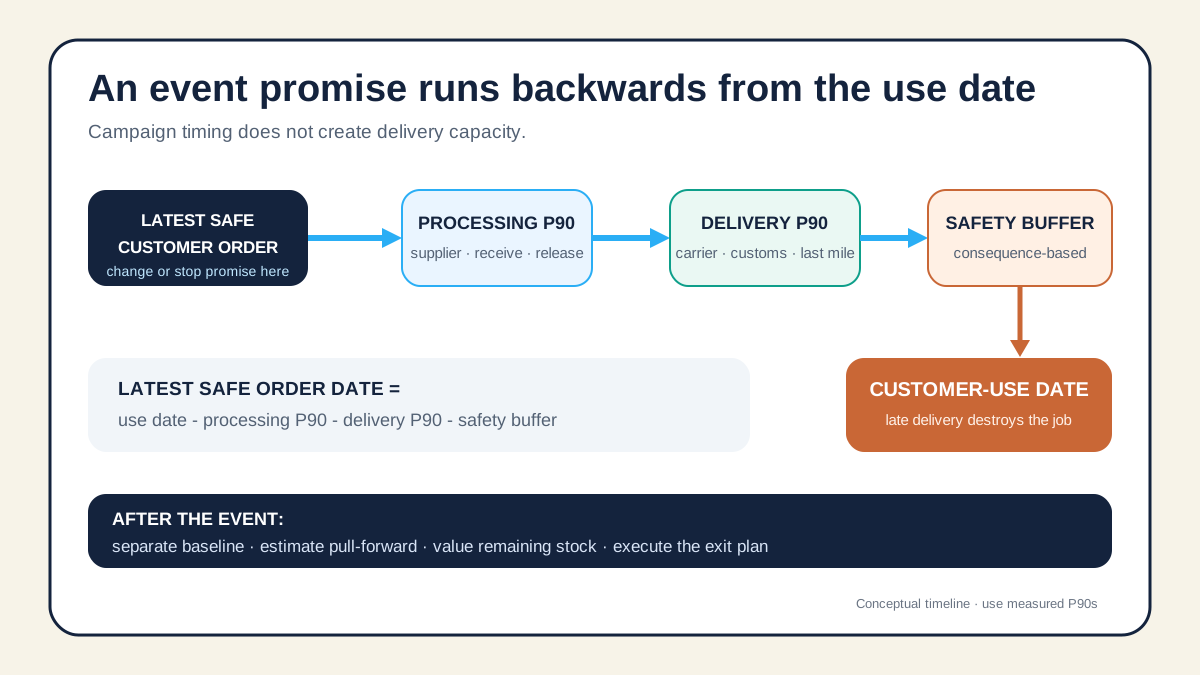
Keep the money from a dated push separate from your normal weeks. Work out how much demand you simply pulled forward, what stock is left after the useful day, and whether the product has an honest use afterwards. A launch peak can seed real repeat orders, but you have to see those orders, not assume them.
Once stock is showing steady repeat demand, the reorder-point calculator turns your full restock time, the stock you hold and a deliberate buffer into a trigger to reorder. Do not feed it a one-off spike.
A message needs the product to be ready, not just the calendar
A calendar can schedule a message. It cannot prove that the product is ready. Hold your back-in-stock alert until the approved version, the parts, the sellable quantity, the inspection, the route and the delivery promise are all released. Suppress a refill reminder after a recent reorder, a refund, a product change or a closed route.
Where your volume allows it, compare a message triggered by the real state of the product with a group you deliberately leave alone, and judge it on the money you keep, not on the revenue the platform claims. A message can take credit for an order you would have had anyway. It can also pull an order forward without giving the customer anything.
Financing and discounting can move the clock without creating demand
A payment plan, a lower entry price or a smaller pack can solve a real budget problem for your customer. It can also just swap the payment method, pull them down from a better-paying version, or bring next month's order into this month. Measure approvals, what you keep after everything settles, refunds, chargebacks, repeat orders and how much of it looks genuinely new. Financed sales are not proof that the product fits the market.
Run a 30/60/90-day timing test
- Days 1 to 30: pick one product and one country, write down why you think they buy now and how sure you are, map the exact version and what you promise, work out your middle day and your 9-in-10 day end to end, and name the strongest other explanation.
- Days 31 to 60: test one timing change. That might be an earlier refill reminder, a tighter cut-off for a dated product, a batch pre-stocked in Guangzhou, a faster route, or a group you leave alone to compare against.
- Days 61 to 90: read kept orders, what you keep, your slow parcels, support messages, refunds and leftover stock once those orders have settled. Keep it, narrow it, change route, pre-stock, go local, redesign it or stop, using the rule you wrote before you started.
Download the blank demand-clock audit worksheet. It has one row per product version and country, with no preset rates, answers or universal thresholds. Fill it with the current facts for your own store.
What to watch and what not to assume
- Watch: a big company talks about replacement, category growth or automation. Let it give you a question, never a forecast for your store.
- Watch: a trend looks durable during one creative or one launch window. Wait for a normal week and for orders that have settled.
- Reject: an emergency product with a good local substitute and no real advantage, pushed into a long-route promise.
- Reject: stock bought because the category is hot while the exact version, route, rights, safety, margin or exit plan is still open.
- Measure your own customer wait limit, replacement interval, genuinely new financed volume and demand pulled forward by a date. A supplier listing or large-company result cannot supply those values for your store.
Here is how you would know we are wrong. Take settled groups of orders with clearly different reasons for buying, and find that they show no real difference in how long people wait, how the routes perform, what stock costs you or when a message works. If that is what you see, use the simpler rule your own data supports.
Match the action to your stage
- Tester: keep your answer provisional. Prove one product, one promise, one country and one route before you add stock.
- Early scaler: split timing and results by exact version, route and country. Use Guangzhou pre-stock only when it removes a delay you have measured.
- Stocked or own-brand seller: add dated exposure, variant concentration, restock times, release gates, honest post-date uses and a cash-safe way out of stock that did not sell.
- Multi-store operator: move the question, not the answer. The same physical product carries a different wait in another country, another offer, another job or another traffic source.
Where RyanFulfil fits
We can make the China-side timing inputs something you can inspect: exact product and version records, supplier lead-time checks, samples, receiving and inspection states, customer-ready packing, route options, proof of dispatch, China stock and local stock comparisons, and what happened when something went wrong. Every route, product and country still needs a current check.
You stay responsible for demand, pricing, advertising, what you send customers, payment plans, legal and compliance decisions, your stock thresholds and the decision to scale. RyanFulfil cannot guarantee how long your customer will wait, sales, route acceptance, delivery dates, customs outcomes or profit.
Bring the exact product version, the countries you sell to, the date the customer needs it, your expected volume, your current route evidence and the decision you have to make. Contact RyanFulfil when those need a current sourcing, packing, route or stock check from the China side.
What this doesn't prove
Sources as of 28 August 2026. The Best Buy, Gap and Ulta facts come from their official second-quarter releases and transcript linked below. Those companies have shops, known brands, local stock, service networks and business models that do not carry across to an independent store shipping from China. Their results are examples of timing and of variation inside a category, nothing more.
The seven reasons, the confidence labels, the wait rule of thumb, the route starting points, the refill and dated-order sums, the release gate and the 30/60/90 test are ours. Check the decision again when the exact product, supplier, version, promise, country, route, packing or delivery times, stock position, event date, price, payment terms or your settled results change.
Need a product checked before you spend on ads?
Send us the product link and destination on WhatsApp (+86 178 4666 9989). We'll check sourcing, packing and shipping with you before you commit.
Get Sourcing Quote on WhatsApp →