Test a route, not a carrier logo
A carrier can offer multiple services with different product rules, handoffs and destination performance. A useful test therefore records the exact service, origin process, packed parcel, destination type and final-mile arrangement. Otherwise, a good result cannot be repeated and a bad result cannot be diagnosed.
Define the question first
Choose one primary question: reduce cost without damaging the customer experience, improve tracking, serve a difficult destination, ship a special-goods category, or create a backup route. A test that tries to prove everything with a few parcels usually proves very little.
Build a representative test group
- Use the actual packed product or a faithful equivalent, not only its catalogue weight.
- Include common destinations plus one or two known edge cases such as a rural postcode.
- Avoid changing packaging, fulfilment cut-off and carrier at the same time.
- Keep enough parcels on the current route to create a fair comparison where practical.
The sample does not need to be huge to reveal process failures, but it must be broad enough to encounter the handoffs you care about. A single successful delivery is evidence of possibility, not a reliable service benchmark.
Record the timeline as events
- Order released to fulfilment.
- Parcel packed and physically handed to the origin carrier.
- First customer-visible tracking event.
- Export, destination-country and final-mile handoff events.
- Delivery attempt and completed delivery.
Measure both elapsed time and silence between meaningful events. Shopify notes that customer tracking depends on the tracking number, selected carrier and tracking URL being handled correctly. A fast parcel with unusable tracking may still produce support tickets and payment disputes.
Use a balanced scorecard
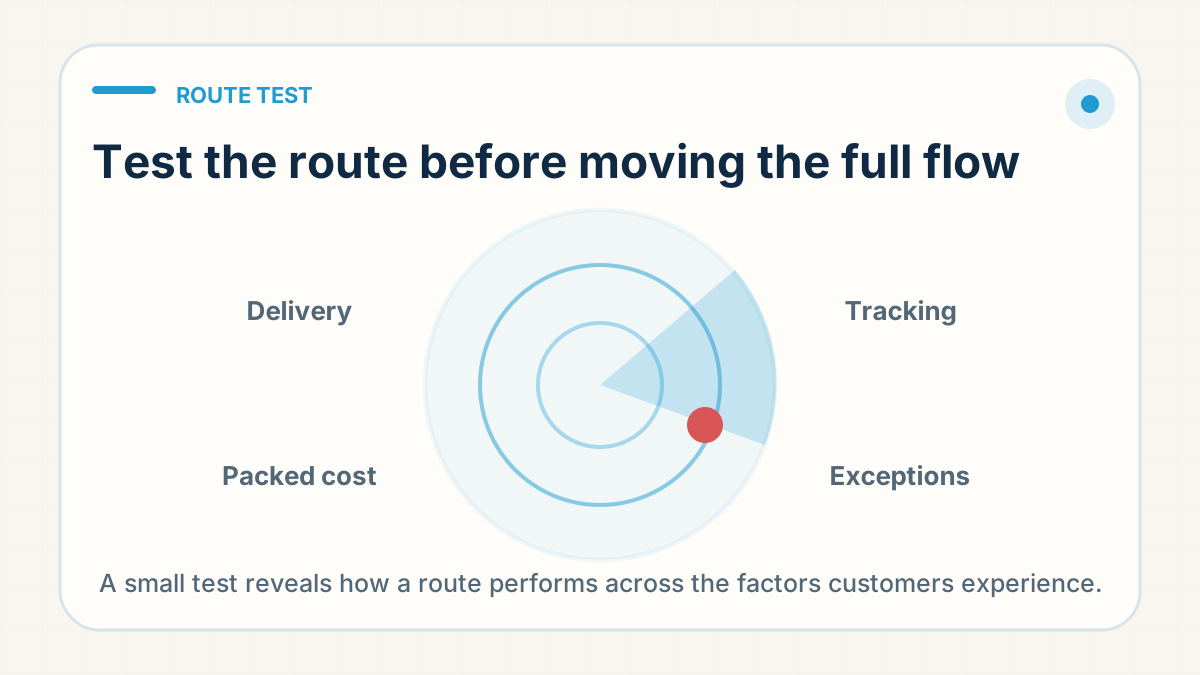
- Packed cost: chargeable weight, surcharges and what is included.
- Delivery: median, range and late-tail behaviour—not only the fastest parcel.
- Tracking: first visibility, carrier recognition, handoff clarity and delivery proof.
- Exceptions: address, customs, failed delivery, damage, loss and return process.
- Support: response quality, evidence provided and time to a usable next action.
Set pass, hold and fail rules before results arrive
For example, pass may require acceptable cost, no eligibility failures, usable tracking and no material increase in the late tail. Hold may mean the route needs another batch after a packaging or data correction. Fail may mean a product restriction, poor tracking integration or exception process makes the service unsuitable despite attractive pricing.
Check the packaging at the same time
Packed dimensions influence both protection and chargeable weight. Carrier and ISTA guidance consistently treats the shipped product and its packaging as a system. Test the parcel that will actually travel, especially when the item is fragile, unusually shaped or bundled.
If the commercial question is whether the faster route changes sales, use the separate shipping-speed test framework to connect this route evidence to the displayed promise, conversion and delivered contribution.
Move volume only after the route proves itself
Move volume only after the test answers the original question and the result can be reproduced. The winning route is the one whose cost, eligibility, tracking and exception handling work together for that order profile.
The rule: Test one defined service with a small, representative parcel set and a fixed review window. Record acceptance, usable tracking, delivery range and exception handling before expanding; changing the carrier, product and destination at once produces activity, not evidence.
Need one order or route checked?
Worried about an order's tracking? Send us the order number on WhatsApp (wa.link/dropship) and we'll check what's going on.
Check Order on WhatsApp →