Your parcel reaches the carrier a median of 1.6 days after payment: that is across 197,000+ paid orders in our order-management records for orders paid 1 May – 3 October 2026 (how we count it). The shipping table lists RyanFulfil's lane ranges by destination.
On RyanFulfil's lanes, Express typically takes 2–9 working days from dispatch on major routes: United States 5–8, United Kingdom 3–5, Germany 4–6, Australia 4–7, Hong Kong 2–5. Standard/Economy typically takes 5–12: United States 6–12, United Kingdom 5–8, Germany 6–10. The carrier on your order depends on the lane we quote, and the quote states the route and ETA before you commit.
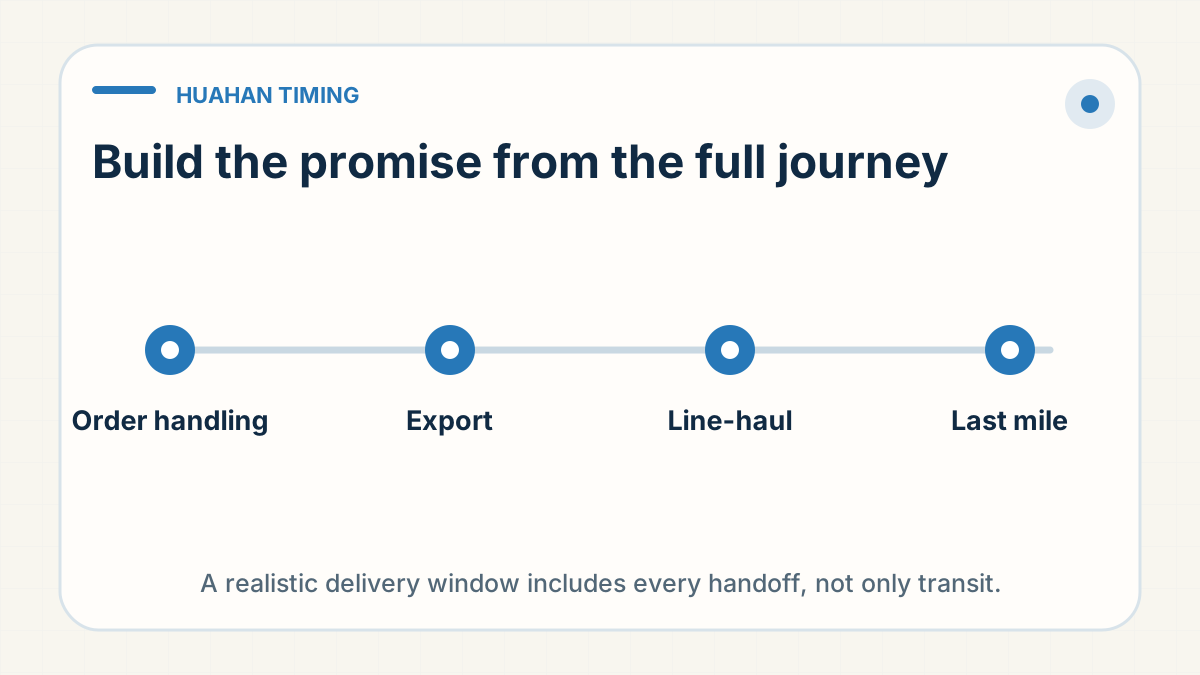
A Huahan shipment should be assessed by its actual service and destination, not by an old timing figure attached to the carrier name. Preparation, carrier acceptance, export, clearance and local delivery are separate stages with different sources of delay.
What should you ask about a Huahan route?
Confirm the exact service, destination, item eligibility, dispatch readiness and the event from which the quoted transit window begins. If the item needs special handling or the destination is remote, make that part of the decision before promising delivery.
What delivery range should you give customers on Huahan?
Use the current quote for the relevant lane and allow for the work needed before carrier acceptance. Review the delivery range whenever the route or operating conditions change. A general article should never be treated as a promise for a particular parcel.
What should you do when a Huahan scan goes quiet?
Use the latest meaningful tracking event and carrier guidance to decide whether a follow-up is appropriate. A pause alone does not establish loss, compensation or a remedy.
When does the Huahan clock start?
A seller serving UK and European customers may receive a transit range for a Huahan service and assume that the same range belongs on the product page. The order, however, may still need to be purchased from a domestic supplier, checked, packed and accepted into the export network. The customer experiences all of that as delivery time, even if only the middle portion appears in a carrier quotation.
This is where an otherwise accurate number becomes misleading. Sales wants the shortest credible promise because conversion matters. Operations needs enough room for normal preparation and handoffs. Customer support inherits the gap if the storefront silently starts the clock several days later than the buyer does.
How do you build the range from milestones?
Use three clocks rather than one. The first is release time: product availability, quality checks and packing before carrier acceptance. The second is route time: export, line-haul, clearance and the handoff to a local network. The third is exception time: the sensible buffer for ordinary variation in the current lane and season. Write down where each estimate begins and what evidence will show that the parcel has moved into the next stage.
For pre-stocked goods, the first clock may be short. For per-order sourcing, a custom finish or a restricted item, it may drive a significant part of the wait. That is why another seller's Huahan result—even to the same country—cannot safely be copied without knowing the service and release conditions.
How do you use the range after dispatch?
When tracking goes quiet, locate the parcel against those same milestones. A label with no carrier acceptance points to a different owner than a parcel already awaiting local delivery. Escalate from the last physical event and the service's current trace process; do not reset the customer's expectation with a fresh optimistic date at every handoff.
Good timing guidance gives the seller a promise that can survive a normal delay and gives support a clear moment to investigate. It does not claim to predict the arrival day of an individual parcel.
The minimum decision record is therefore small but specific: product readiness, named service, destination, quote date, point where transit begins, customer-facing range and escalation owner. Recheck it when any one of those inputs changes instead of letting an old successful delivery become an unwritten guarantee.
The rule: Build the customer window from warehouse release, the selected Huahan service and a realistic exception buffer. State when the clock begins, monitor the milestone that ends each stage and change the promise when lane evidence changes rather than quoting one universal transit number.
Waiting for a parcel you bought? Contact the store you ordered from: it holds your order details.
Need one order or route checked?
Worried about an order's tracking? Send us the order number on WhatsApp (wa.link/dropship) and we'll check what's going on.
Check Order on WhatsApp →