From the operations archive
Several “stuck” parcels were not stuck in the same place
A support queue held deliveries across Europe and Japan with similar customer complaints: tracking had not produced the expected arrival. Underneath, the events differed. One parcel had a failed delivery, another was waiting for collection, another lacked a complete address, and another appeared quiet between export and local handoff. Calling all of them delayed concealed the action each needed.
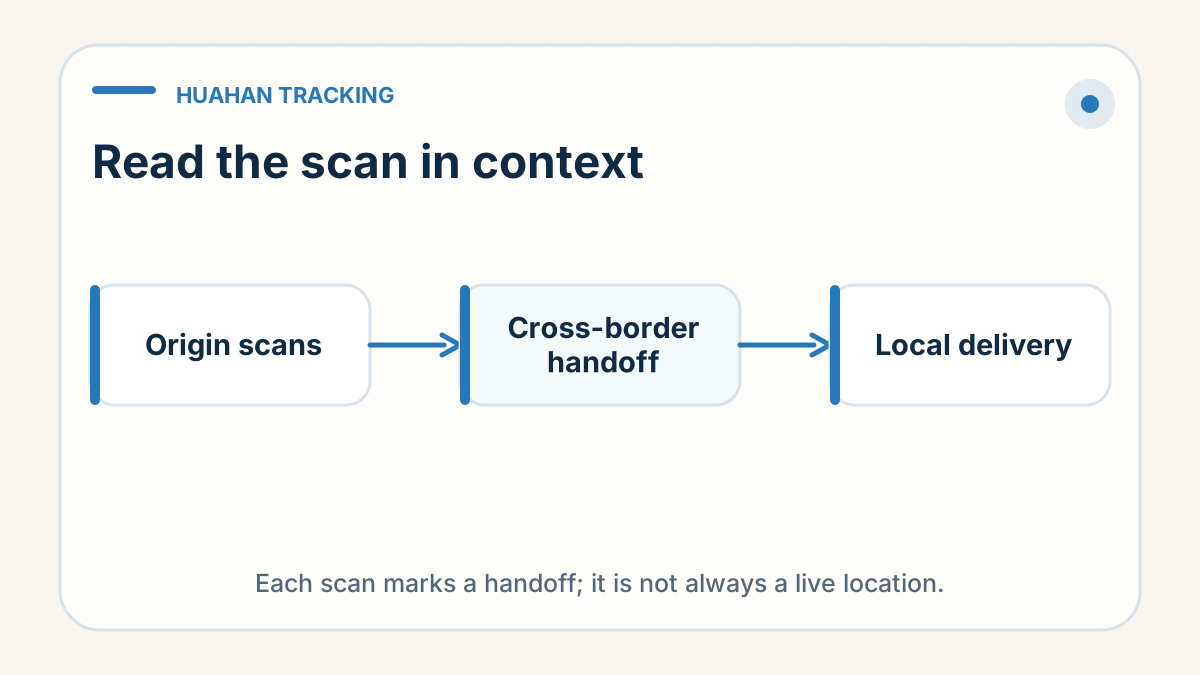
The seller needed a customer-facing answer quickly, but a tracking line is evidence of a stage—not a full diagnosis. An electronic label event did not prove physical acceptance. A handoff event did not guarantee that the destination carrier had completed its first public scan. A pickup status could expire while everyone waited for a new movement event that would never come.
The team translated each Huahan event into three things: last confirmed physical stage, next expected milestone and next actor. That allowed one customer to receive collection instructions while another case went to a carrier trace. Tracking became useful when read as an event chain with gaps and ownership, not as a traffic-light label that declares every quiet parcel lost.
About this story: it is an anonymised composite of client situations. It broadens markets and product families and leaves out identifying details. Read the dated field note: A first sale — and a day of untangling stuck deliveries.
Huahan is recognized by major shipment-tracking aggregators, which is a useful signal that tracking data flows through standard channels, but it doesn't mean every Huahan shipment gets identical visibility. How much you actually see depends on the specific service used and what happens once the parcel is handed to a local carrier for final delivery.
Why tracking detail isn't uniform
Cross-border shipping typically involves a handover partway through the journey. The international carrier moves the parcel across borders, and a local postal or courier service takes over for the last leg to your customer's door. When that handover happens, tracking can shift to the local carrier's system, sometimes under a new tracking number, and the level of detail you see, scan frequency, proof of delivery, signature capture, depends on what that local carrier provides, not just what the international leg supports.
What "delivered" can actually mean
Depending on the local carrier and destination, a "delivered" status can mean the parcel was handed to the recipient directly, left in a designated safe place, dropped at a pickup point or locker, or accepted by a neighbor. None of these are wrong, but they're different experiences, and knowing which one applies matters if a customer says they never received something marked delivered.
What we actually watch for
Whether a first scan happens within the expected window after we hand a parcel to the carrier, if not, we check for a handover issue before assuming the worst; gaps during international transit or customs that are longer than normal for that specific route; the point where a parcel changes to local-carrier tracking, so we know which system to check next; and "delivered" statuses that a customer disputes, so we can pull whatever proof of delivery is actually available for that shipment type.
What we show you, not just a raw tracking link
A useful escalation record contains the order reference in the private support channel, the last confirmed physical stage, the next expected milestone, the party able to act and a review time. Repeatedly refreshing an unexplained scan is not an escalation plan.
If the scan has stayed quiet beyond the review point for that stage, open one trace with the evidence already assembled and give the customer the next update time. Do not upgrade a quiet page into a loss claim without a custody review.
The rule: Translate each Huahan event into a physical stage and next actor. A pickup deadline needs customer action, a missing acceptance scan needs warehouse or carrier evidence, and a quiet export handoff needs a review point; calling all three delayed hides the decision.
Waiting for a parcel you bought? Contact the store you ordered from: it holds your order details.
Need one order or route checked?
Worried about an order's tracking? Send us the order number on WhatsApp (wa.link/dropship) and we'll check what's going on.
Check Order on WhatsApp →