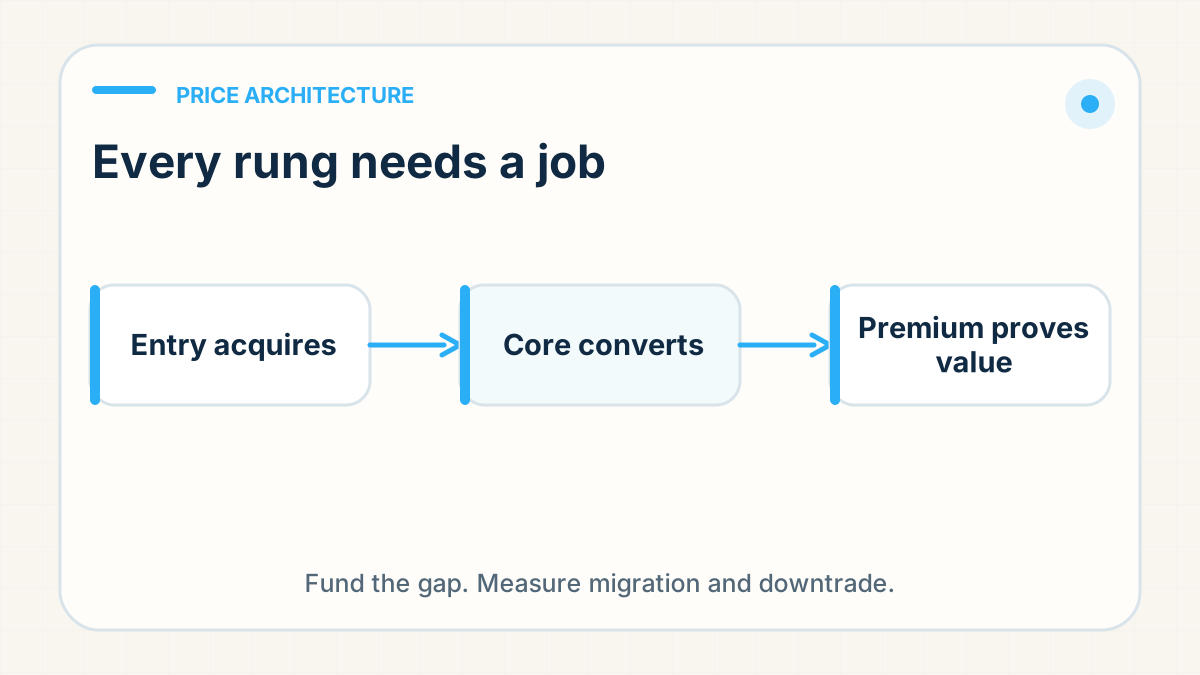
Give every price rung a customer job
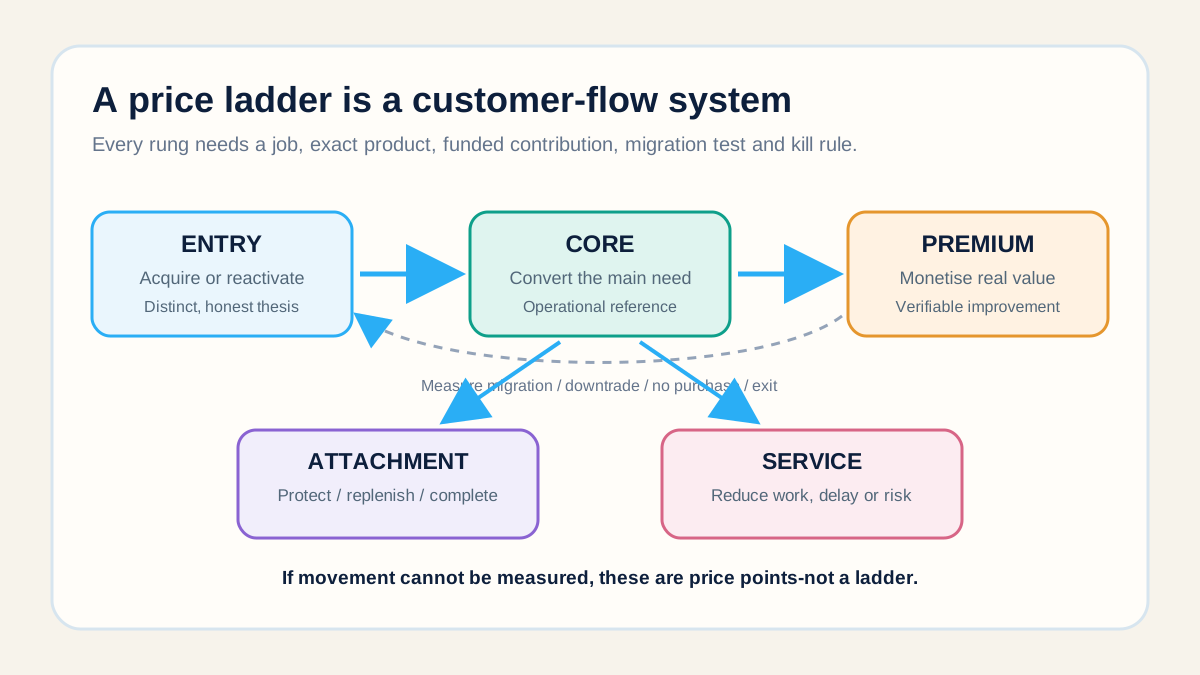
Your entry, core and premium prices are not three numbers on a page. They are three jobs. Entry brings the right buyer in, or brings an old one back. Core solves the main problem. Premium charges for a better version the customer can see and check. An add-on solves the next job. A paid service takes work or worry off the customer. Give each price one job, one exact product version, one honest delivered cost, one thing that pays for it, one guess about where the buyer goes next, one stock rule and one date you stop. If you cannot see customers moving between your prices, you have a price list.
Start with the cart-quality audit if all you have noticed is that your average order value moved. That guide asks whether the finished basket got better. This one asks which price brought the customer in, where that customer went next, and whether the whole path paid for itself after you had shipped it.
A bigger basket can hide a smaller customer list
Mene is a small, clean example. In its second quarter of 2026 the jewellery company said average order value rose 30 per cent while orders fell 12 per cent and new customers fell 16 per cent. Returning customers were 72 per cent of revenue. Those are the company's own reported movements. They do not prove that price caused the fall in new buyers. They do show that a fatter basket and a healthy flow of new customers are two different questions, and your dashboard can answer one while you assume it answered both.
The 46-percentage-point gap between those two numbers is simple subtraction on two reported figures. It is not a study. For you it is a prompt. Split new buyers from returning ones, then look at units, add-ons, discount, what you keep after shipping and refunds, and what a new customer costs you, before you celebrate the headline.
Mene also launched a fixed-price silver range, and said plainly that it is a different thing from its 24-karat gold and platinum investment jewellery. The lesson is not to go and sell silver. It is that your cheap tier should be an honest product you can describe out loud, not your main product with something quietly taken out of it.
Give every price one job
- Entry: make the first decision easy, or bring back a customer you already know. Use a different, honest spec. Do not hide thinner material, missing parts or a slower route.
- Core: solve the main job with your most stable product, packing, stock, route and margin. Everything else is judged against this one.
- Premium: charge for something the customer can check. Better material, more capacity, a finish, a custom option, proof, a longer warranty or real help. A higher number on its own is not premium.
- Add-on: protect, refill, complete or extend the first job. It has to earn extra money after packing, without turning into a second parcel or a support ticket.
- Service: take away waiting, work or risk, and say exactly what it covers. You need the people, the cut-off time and an answer for the customer when you miss it.
One owner, three price cuts, three different results
Wesfarmers reported its full year for 2026 with three value programmes under one owner. Kmart cut prices on more than 2,500 items while keeping its "one-up" and "two-up" tiers; revenue rose 2.8 per cent and earnings before tax rose 6.0 per cent. Bunnings reported revenue up 4.1 per cent and earnings before tax up 5.1 per cent, and management said productivity and cost discipline paid for the investment in customer value.
Officeworks cut prices on about 2,000 essential products and said transactions, units and margin dollars all grew. Revenue rose 3.7 per cent, but earnings before tax fell 22.2 per cent. Management put much of that down to about A$40 million of transformation costs, and also named clearance activity. The 28.2-percentage-point gap between the Kmart and Officeworks earnings numbers is our subtraction, not a controlled test.
Different ranges, different customers, different starting margins and different one-off costs mean you cannot read a cause into it. The narrower point is the useful one for you. A price cut needs something visible that pays for it. More transactions is not that thing on its own, and a weak profit line does not prove the cut failed when large one-off costs sit in the same number.
Write down what pays for the discount before you change the price
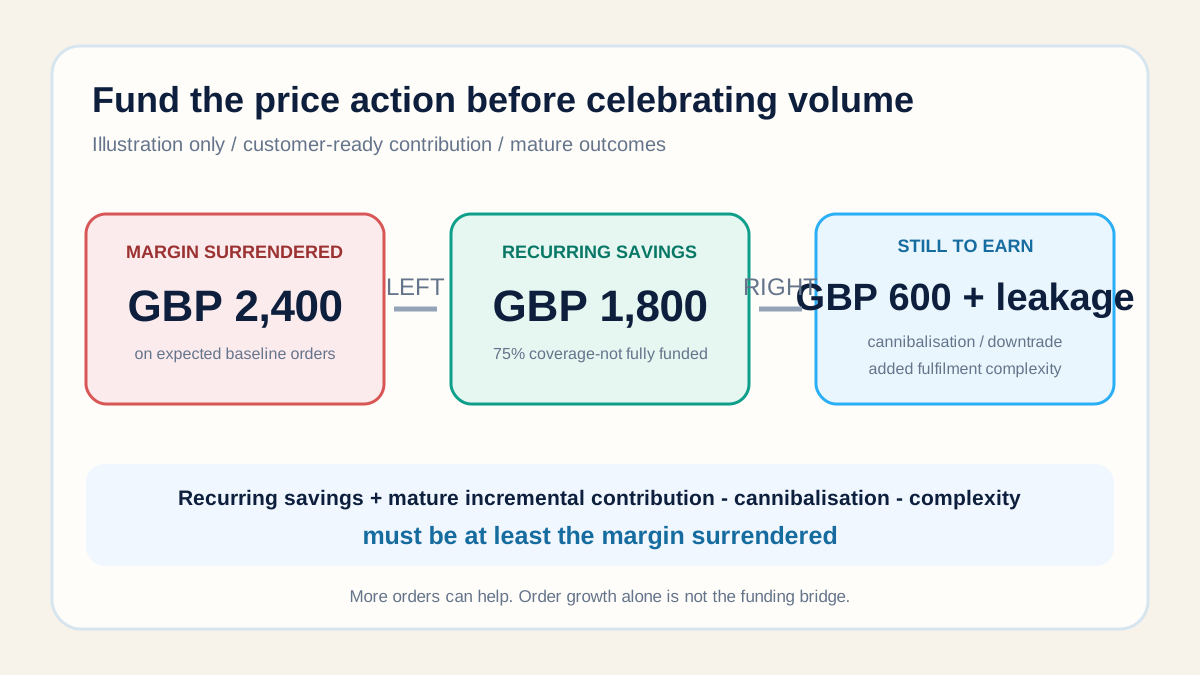
Take the orders the cut will touch. Work out the margin you are giving up on the volume you already had. Then name the savings that keep coming back: a lower factory price on the exact version you approved, better packing, a cheaper route, fewer problems, lower payment or handling fees, faster stock turns, less fiddly work. Add the extra profit from genuinely new demand and from customers who move up. Subtract the sales you would have made anyway at the old price, the buyers who slide down to the cheap version, and the extra work.
The gate is simple. Repeating savings plus real new profit, less the sales you took from yourself and the extra work, must at least cover the margin you gave up. Keep your ad spend on the page. Do not bury it inside one blended monthly profit number, because that is where a bad cut hides for three months.
An example, with made-up numbers. Your price action gives up GBP 2,400 of profit on the orders you expected anyway. You can point to GBP 1,800 of savings that keep coming back. That covers 75 per cent of it. The other GBP 600, plus anything you take from your own core sales and any extra shipping cost, still has to be earned by new orders. A bigger order count does not close that gap by itself.
Watch where customers move, and where they slide back
Your prices are working only when you can see what a customer does once another price becomes relevant to them. Group buyers by who could have moved, not only by who bought. Hold the market, the traffic source, the exact product version and the delivery promise as steady as you can.
- Entry buyers: new delivered customers from the entry offer, divided by the visitors who saw it, counted after ad cost and after problems have settled.
- Entry to core: entry buyers who later buy core inside the window you named, divided by the entry buyers who had time to do it.
- Core to premium: core buyers who later buy premium, kept separate from people who bought premium first.
- Add-on rate and profit: attached delivered orders divided by the orders that could have carried one, with the extra packing cost and extra risk counted in.
- Sliding down: buyers who used to take core or premium and now take entry while core and premium are still in stock.
- Sales you take from yourself: the core or premium profit you lost because of the new price, measured against a control group or a baseline you wrote down first.
Do not switch the whole store over and compare it with a different season. If your volume allows it, keep a clean control group. If it does not, roll out by country, by group or by traffic share, and write down the main number you are watching, how long you will wait and what makes you stop, before you launch.
The product and the stock are part of the price
A smaller number is not an honest entry price if the customer only finds out what is missing when the parcel lands. Write down the exact material, size, parts, finish, claims, customer-ready packing, inspection rule, route and remedy for every price you sell. Judge the premium version against that same written spec, not against a feeling.
Use SKU and product-version control so your ad, your storefront, your supplier, the warehouse and whoever answers your email all mean the same unit. Then check that the finished order still works with the landed-cost model.
Stock changes your prices even when the numbers on the site do not. If entry is out of stock, more people look like they chose to trade up. If core is unavailable, premium looks strong because there was nothing else. If an add-on ships separately, its revenue can hide a worse order. Record stock state, swaps, split parcels, cancellations and route changes next to every result you read.
A service is only a rung if you can deliver it
Intuit reported full-year 2026 TurboTax revenue up 7 per cent while total TurboTax units fell 2 per cent. TurboTax Live revenue grew 37 per cent and was 53 per cent of total TurboTax revenue. That is company-reported evidence that a service tier can grow inside a bigger product business. It does not show that the service caused the whole result, and it does not mean the same money is there for you.
If you sell physical products, your service might be faster handling, a setup step, personalisation, replacement cover, or sourcing help. Price it only after you know who does the work, what the cut-off is, what proof you keep, who is responsible and what the customer gets when you cannot finish it.
Run the 12-point price-ladder audit
Score each line from 0 to 5 on the evidence you have today, not on how confident you feel. Zero means you do not have it. Five means it is specific, current, yours and strong enough for your next commitment. Multiply the 60-point total by 100/60. The score points you at the next job, but a safety, rights, version or route problem can stop everything no matter what the total says.
- PL01 - job: every live offer has one customer job and one person who owns it.
- PL02 - who is buying: you know whether they are new, returning or coming back after a break, and what they will use it for.
- PL03 - product truth: the exact approved differences between entry, core, premium and add-on are written down.
- PL04 - the gap between prices: the gap follows real value, real cost or a real substitute, not a round number that looked nice.
- PL05 - what pays for the discount: repeating savings and real new profit cover the margin you gave up, the core sales you took from yourself and the extra work.
- PL06 - buying and keeping: the buyers you wanted still look good after delivery and after refunds settle, not just at checkout.
- PL07 - the money per order: your bad, likely and good cases all include product, packing, route, ad cost and things going wrong.
- PL08 - where customers move: entry to core, core to premium, add-ons, sliding down and staying put are all things you can measure.
- PL09 - stock and version: every price you approved was actually sellable, and shipped without an unapproved swap.
- PL10 - packing and route: packed cost, delivery window and the risk of problems match what you promised, country by country.
- PL11 - stock and complexity: MOQ, variants, data, QC, packing, support and compliance work fit how much you actually know.
- PL12 - knowing when to stop: the review date, the stop rule, the owner and the action are written before you buy more stock or commit to your own brand.
Use four bands. At 85 to 100, scale, but only inside the product, route, stock and customer paths you have already proved. At 70 to 84, fix your weakest price before you add anything. At 55 to 69, keep it in small tests and hold off on stock or own-brand commitments. Below 55, simplify it, redesign it or drop it.
Download the blank 12-point audit worksheet, customer-migration tracker and discount-funding bridge. They hold no RyanFulfil rates and no universal thresholds. You put in your own buyers, costs, evidence and floors.
A 30/60/90-day plan
- Days 1 to 30, look: put every live offer against entry, core, premium, add-on, service or "no clear job". Lock the exact versions and stock states. Work out what you keep per order at each price, and split new buyers from returning ones.
- Days 31 to 60, design: pick one customer path. Write down what pays for the change, where you think buyers will move, your control group, how long you will wait and what makes you stop. Approve the sample, packing, route and support answer before you touch the storefront.
- Days 61 to 90, test: show it to a limited group, follow those orders through delivery and problems, then read profit per visitor, new customers, who moved up, who slid down, what you took from your own core, and how much work it created. Scale, change or stop using the rule you already wrote.
Watch it, stop it, or admit you cannot tell
- Watch: the main number looks good, but the orders have not settled or the sample is too small. Keep the test small and name the date you look again.
- Stop: what you keep after shipping, the product truth, the stock, the customer outcome or the workload crosses the line you wrote. Stop showing it and protect the orders already open.
- Cannot tell: your data cannot identify the buyers, the exact SKU, the stock state, who saw what, or where customers moved. Missing evidence is not a pass.
Carry another explanation next to every conclusion. Premium may look strong because entry ran out. New customers may have fallen because your traffic changed. Repeat share may look better because fewer new people came in. Profit may look healthy because the refunds have not landed yet. Say what else could explain the movement, and say what would tell the two apart.
What RyanFulfil can make operational
We can turn your prices into product and shipping controls on the China side: a sourcing brief for each price, approved-version labels, sample and QC criteria, customer-ready cost comparisons, packing and route checks, stock rules, bundle mapping, test-order preflights and evidence when something goes wrong. You keep pricing, advertising, how you run the test, your own money thresholds, your legal claims and the decision to scale or stop.
A good first brief is not "find me a cheaper version". It is the customer job, the exact approved spec, the country, the quantity and stock mode, the packing, the route, the delivery promise and the price ceiling for each rung. Contact RyanFulfil when those need a China-side product and shipping check.
What this doesn't prove
Sources as of 27 August 2026. The company figures are reported by Mene, Wesfarmers and Intuit in the primary sources linked below. They come from other industries and other business models, and they are there to show how something works, not to give you a benchmark or a controlled experiment. The percentage-point gaps and the discount example are plain arithmetic we did ourselves. The five rungs, the discount test, the movement measures, the 30/60/90 plan and the stop rules are ours. None of them guarantees new customers, conversion, repeat orders, margin or profit.
Read this again after a company restates its numbers, after a change in your product spec, supplier, packing, route or customer promise, or when your own settled results say the opposite. Here is how you would know we are wrong. Run a controlled test and find that your new rung adds nothing you keep, once ad cost, the core sales you took from yourself and the extra work are counted, or that it makes customers worse off while the headline number improves.
Need a product checked before you spend on ads?
Send us the product link and destination on WhatsApp (+86 178 4666 9989). We'll check sourcing, packing and shipping with you before you commit.
Get Sourcing Quote on WhatsApp →