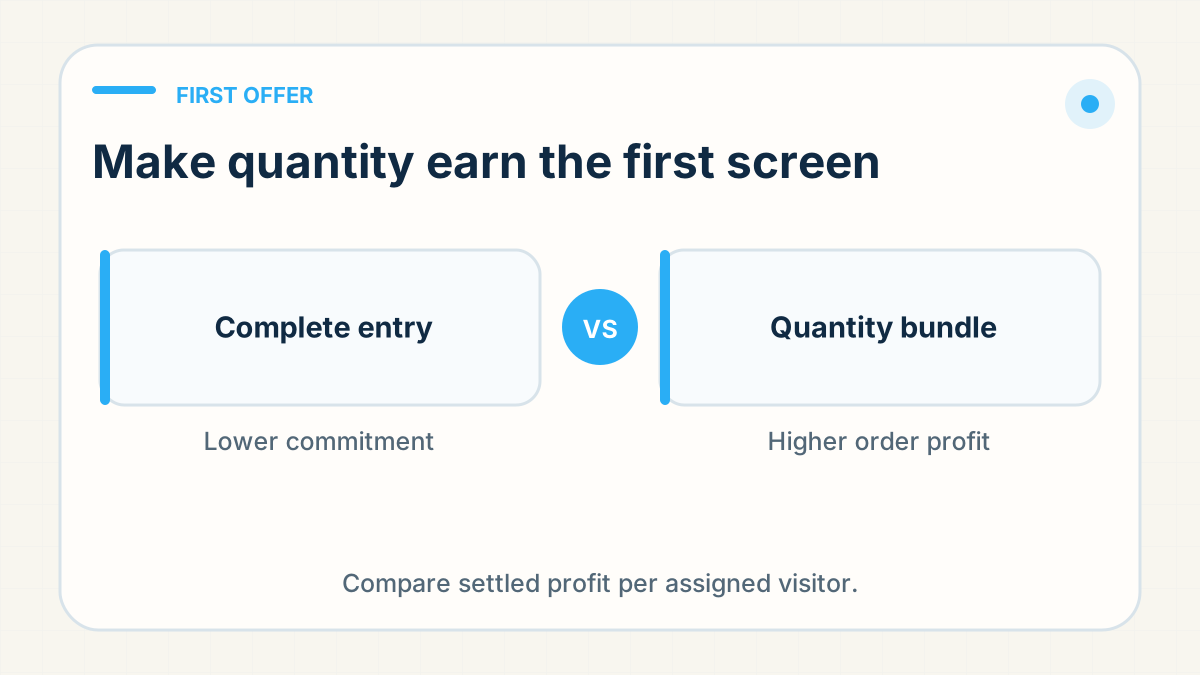
Start with the smallest complete order, then make the bundle earn its place
If cold visitors keep looking but do not buy, your first offer may be asking them to commit to too much quantity. Keep the product, country, page, promise and traffic as stable as you can. Compare the smallest complete order with the larger bundle. Then judge the result on profit after variable order costs per person assigned to each version, after refunds have had time to arrive.
The smaller offer is not a damaged sample, a hidden subscription or a cheap item that cannot solve the advertised job. It is the least a first-time customer can buy and still receive the complete outcome. The bundle is allowed to win. It just has to win with the people who saw it, not only with the few who reached checkout.
This is a different decision from calculating what a bundle costs to pack and ship. That guide protects the cost side. This one asks whether bundle quantity belongs in the first offer at all.
A lower basket can be the result of more new customers
Boozt's official second-quarter 2026 result reported net revenue of SEK 2,061 million, up 13 per cent from SEK 1,823 million a year earlier. On the company's earnings call, management said Boozt.com's average order value dipped slightly because a larger share of revenue came from new customers, who initially bought fewer items per basket. Management expected those customers to expand into more categories and items later.
That does not prove a smaller bundle will improve your store. Boozt sells a broad department-store range, not one China-direct product, and the call did not report a controlled offer test. It gives you a useful rival explanation for a falling basket: the store may be acquiring more first-time buyers, not losing pricing power.
Read your own store before changing the offer. Split average order value into first-time and returning customers. Then split each group into item count and price per item. If first-time customers buy fewer items while returning customers add more, pushing the larger bundle at everybody may tax the exact group you are paying to acquire.
Define the smallest complete offer before you test
Write the customer job in one sentence. Then list every part needed to finish it on day one. That is the complete offer. Quantity above that line belongs in the bundle; anything below it is an incomplete promise.
- A refillable dispenser may need one dispenser and one refill to work. A three-refill pack is quantity, not completeness.
- A paired product may need two units by design. Selling one shoe, one curtain panel from a required pair or half a mounting kit is not an entry offer.
- A device may need the correct cable, plug or mounting piece. Removing a required part to make the price look lower moves cost and frustration to the buyer.
- A consumable may need enough quantity to show the claimed use. If one sachet cannot produce the stated result, it is a sample, not the complete first offer.
Now make the two versions easy to compare. Use the same exact product version, creative promise, page quality, destination country, delivery wording, refund terms and traffic source. If the entry page gets a new video while the bundle keeps the old one, you tested a page and an offer together.
The number that decides is profit per assigned visitor
A bundle usually makes more before advertising on each order. That is not enough. A first offer also decides how many visitors become buyers. The useful comparison keeps every visitor in the group they were assigned to, whether they bought or not.
For each offer you test, calculate: conversion rate × profit after variable order costs, then subtract advertising cost per assigned visitor. Your variable order costs include the product, checking and packing, packaging, payment cost, the route, discounts, refunds, reships, chargebacks and support you can tie to the settled cohort. If a cost is missing, call the figure profit after the costs included as of the review date, not final profit.
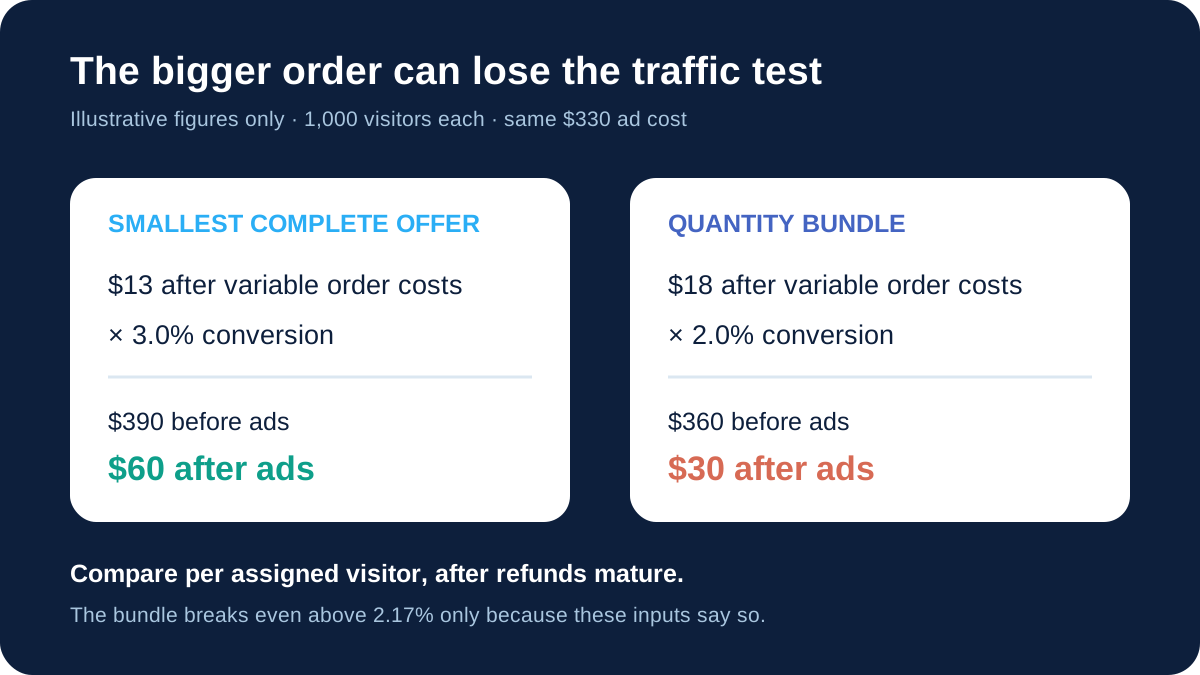
Here is an illustration with made-up figures. The entry offer sells for 29 dollars. Product, checking and packing cost 7.80 dollars; the route costs 5.50; payment costs 1.20; and the settled refund, reship and support allowance is 1.50. That leaves 13 dollars before advertising. It converts 3 per cent of assigned visitors.
The bundle sells for 45 dollars. Its product and packing cost 15 dollars; the route costs 7.50; payment costs 1.70; and settled losses and support are 2.80. That leaves 18 dollars before advertising. It converts 2 per cent. With 1,000 assigned visitors and the same 330-dollar traffic cost, the entry makes 390 dollars before ads and 60 dollars after. The bundle makes 360 dollars before ads and 30 dollars after.
In that example, the bundle needs to convert above about 2.17 per cent to beat the entry offer: 390 dollars divided by 18 dollars, then divided by 1,000 visitors. The answer changes as soon as any input changes. It is not a target conversion rate and it is not a RyanFulfil forecast.
Do not declare a winner from ten orders
Choose your decision rule before you launch. Name the smallest profit difference worth acting on, the maximum affordable downside, and the date when refunds and reships are mature enough to count. Then use your normal conversion rate and that minimum useful difference to set the visitor count. A statistically competent analyst or experiment calculator can size it; there is no universal number that fits every store.
Ten orders against twelve is not enough to rename a winner. If the required visitor count is larger than your budget, call the run a pilot. Use it to find broken checkout steps, unexpected freight, support questions and obvious offer rejection. Do not turn a noisy pilot into a conversion claim.
Keep your test per assigned visitor. If you divide only by buyers, the high-converting offer loses the value of the extra customers it created. If you divide only by people who clicked the buy button, you have removed the visitors whose hesitation the offer was meant to change.
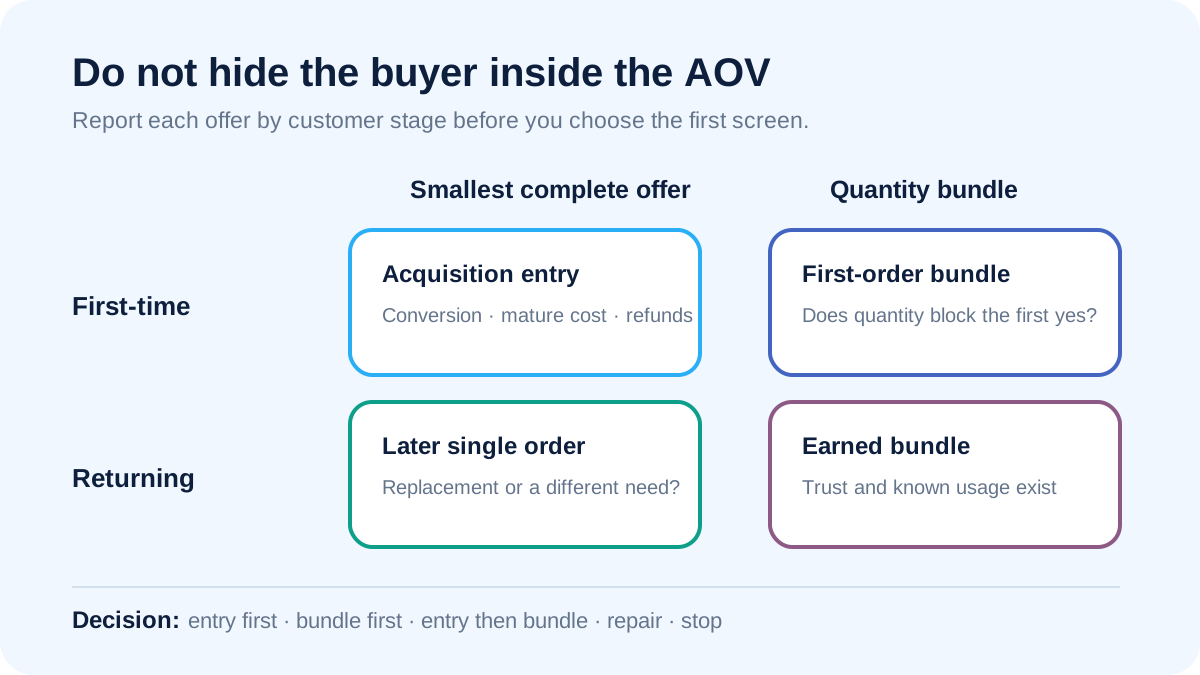
Use a four-cell report so acquisition and repeat do not blur
Once your test settles, report four cells: first-time buyers on the entry offer, first-time buyers on the bundle, returning buyers on the entry offer and returning buyers on the bundle. Show your assigned visitors, orders, conversion, units, revenue, every included variable cost, refunds and profit after those costs in each cell.
- If the entry wins with first-time buyers and the bundle wins with returning buyers, keep the entry at acquisition and offer the bundle after delivery or on a later visit.
- If the bundle wins both groups after costs, keep it. The test did not exist to force a smaller offer.
- If the entry converts better but loses after refunds or support, the easier purchase may be attracting the wrong expectation. Fix the promise or stop.
- If neither version makes money after mature costs, offer size is not the rescue. Revisit product, price, page, route or acquisition cost.
Keep this report beside the guide on why AOV can rise while the order gets worse. AOV is a description of baskets. It is not the decision rule for an offer test.
When the bundle should stay first
Some products in your store have a natural quantity. Keep the bundle first when the advertised job requires a matched set, the product is normally replaced in pairs, shipping one unit creates a false economy, or the customer is replenishing a known consumable. You may also lead with a bundle when your repeat buyers already have the trust and usage experience to choose it.
The countercase matters. A smaller first offer can increase order count while making the operation worse: more parcels, more payment fees, more support contacts, lower shipping efficiency and no later purchase. That is why the test must wait for mature costs and why the smaller version must be commercially complete.
If the smaller version wins but each order becomes too fragile, use the first-order margin and realised-LTV guide before assuming a later purchase will repair it. Forecast repeat is not money you have received.
Run one clean test
- Write the customer job and mark the smallest quantity that completes it.
- Quote both customer-ready packs to the same country and named route. Record packed weight, dimensions and every part in each version.
- Randomly assign eligible visitors to entry or bundle. Hold product version, market, promise, traffic and page treatment stable.
- Record first-time and returning status before reading the result.
- Wait through delivery and the refund window. Rejoin refunds, reships, chargebacks and support cost to the original group.
- Compare profit after included variable costs per assigned visitor, with counts beside rates.
- Choose: entry first, bundle first, entry then bundle, repair and retest, or stop.
Download the blank first-offer test worksheet. It keeps both offer versions, assigned visitors, buyer type, included costs, maturity date and the decision in one row.
What RyanFulfil can help hold still
RyanFulfil can quote the two customer-ready packs, confirm the exact parts and quantity, record packed weight and dimensions, check the approved version, apply the agreed packing rule, and return route and exception evidence. That helps you know whether both test groups received the offer you intended.
We do not choose your audience, guarantee conversion, set your statistical threshold or promise the smaller offer will win. The store owns assignment, measurement, consent, pricing, claims and the commercial decision.
If you want to compare two complete packs, send the exact product, both quantities and the destination country. We can quote the physical difference before you pay to test the commercial one.
Make quantity earn the first screen
Do not ask a stranger to prove loyalty on the first click. Give the smallest complete offer and the bundle the same traffic, then let settled profit per assigned visitor decide. If the entry wins acquisition and the bundle wins later, that is not a compromise. It is an offer sequence.
Here is how you would prove this guide wrong. If the bundle keeps more settled profit per assigned visitor under the same product, market, page treatment, promise and traffic—and does so without worse refunds or support—keep the bundle first. The test is there to preserve the winner, not to manufacture a preferred answer.
Where the figures come from
Sources as of 5 September 2026. Boozt's official release reports Q2 2026 net revenue of SEK 2,061 million versus SEK 1,823 million and 13 per cent growth. The selected management explanation about new customers and basket items comes from a third-party transcript of the 14 August 2026 earnings call. It is used as a possible mechanism, not as proof that a smaller offer caused Boozt's result or will transfer to a dropshipping store.
Every dollar, cost and conversion figure in the worked example is illustrative. The 2.17 per cent break-even follows only from those inputs. Use the complete-offer definition, four-cell report, test sequence and worksheet to test your own offer. Recheck the method when your cost definition, refund window, route, product version or acquisition setup changes.
Need a product checked before you spend on ads?
Send us the product link and destination on WhatsApp (+86 178 4666 9989). We'll check sourcing, packing and shipping with you before you commit.
Get Sourcing Quote on WhatsApp →