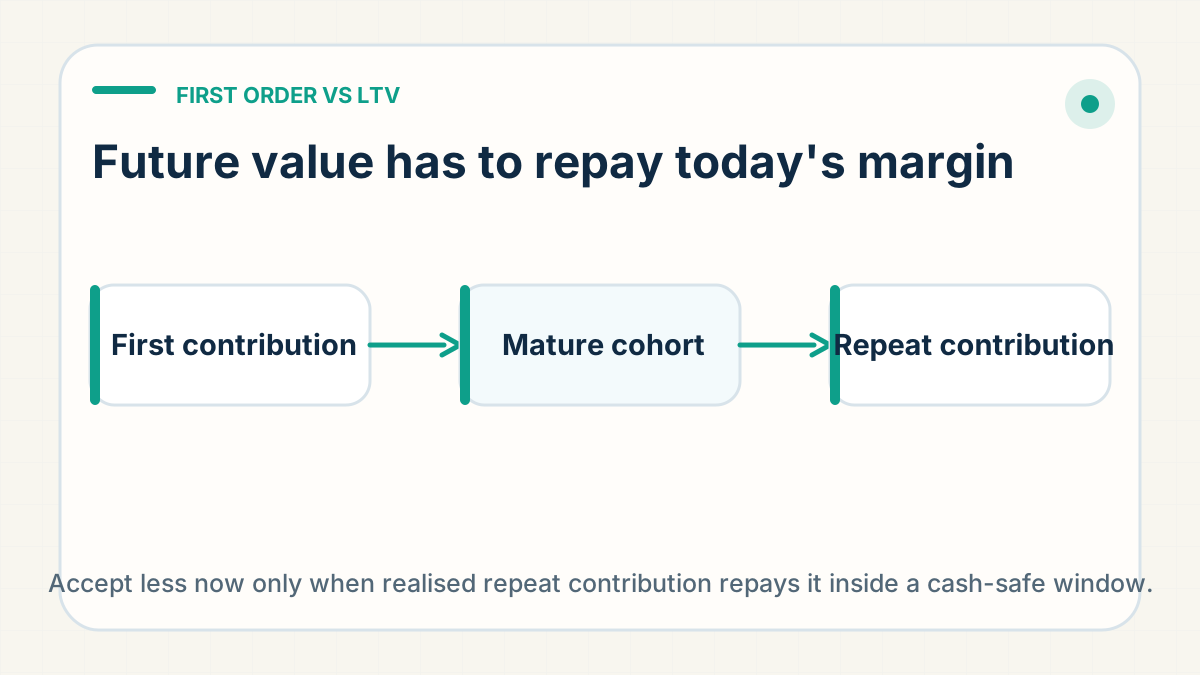
LTV is future cash with a probability attached
Product, freight, refunds and customer acquisition consume cash now. LTV arrives later, if the customer returns, the next order contributes and the store can finance the wait. A lower first-order margin can make sense when a store has a real, measurable repeat-purchase mechanism and enough cash to wait for it. It should be a controlled acquisition decision, not a belief that future orders will eventually repair an unprofitable product.
The default for an unproven dropshipping offer should remain positive contribution on the first delivered order. Relax that rule only when mature customer cohorts show that repeat contribution reliably repays the amount sacrificed, inside a pre-defined window, after refunds, reships, support, discounts, payment fees and fulfilment costs. Revenue called lifetime value is not enough. The decision needs cash contribution that has actually arrived.
Treat forecast LTV like stock that has not reached the warehouse: useful for planning, unavailable for paying today's invoice. The further away the repeat event, the smaller and less certain the cohort, and the more fragile the fulfilment path, the harder the forecast must be discounted before any first-order sacrifice is approved.
What the Life360 example actually shows
Life360 provides a useful illustration because its hardware and recurring-revenue lines are visible separately. In its Q2 2026 filing, the company reported $159.0 million of total revenue. Subscription revenue was $115.6 million, up 31% year over year, while hardware revenue was $9.8 million, down 20%. The same filing said Life360 continues to prioritise hardware as a driver of subscription growth by optimising pricing and bundling for subscription attachment rather than standalone hardware margin.
The margin detail prevents an easy slogan. Q2 hardware gross margin was 43%, but Life360 said the improvement was primarily due to tariff refunds and lower tariff costs. Across the first six months of 2026, hardware gross margin was only 1%. In Q1, the company had reported negative hardware gross margin while it tested Pet GPS pricing and exited brick-and-mortar retail, and said it was deliberately pricing Pet GPS for adoption over near-term device margin.
That is evidence of one company managing a connected-device, membership and advertising system. It is not evidence that a dropshipper should lose money on a physical product. Life360 has an installed app, paid memberships, product telemetry, multiple revenue lines, substantial capital and its own retention data. A small store usually has none of those advantages. The transferable lesson is to evaluate linked customer economics; the non-transferable shortcut is to copy the loss leader without the recurring system behind it.
Define first-order contribution before discussing LTV
Gross margin is too early in the calculation. First-order contribution should begin with the amount collected from the customer and subtract every variable cost created by that order: product, domestic movement, checking, pick and pack, packaging, payment fees, international freight, discounts, duties or taxes borne by the seller, expected refunds, reships, chargebacks and variable support. Customer acquisition cost should then be shown separately or deducted consistently across every comparison.
AOV can move in the opposite direction from order quality. The AOV and cart-quality guide shows how price, units per transaction, attachment and delivered contribution can tell different stories.
Use the free fulfilment cost calculator to place your own product, packing, shipping, fee and expected exception inputs into the same delivered-order model before setting a CAC ceiling.
- Customer cash collected, excluding tax the store merely passes through.
- Product and customer-ready packing cost for the exact approved configuration.
- Domestic receiving or supplier movement, warehouse handling and international freight.
- Payment, currency conversion, selling-channel and affiliate fees.
- Expected refund, reship, chargeback and variable support cost based on delivered cohorts.
- Discount, gift, free-shipping or introductory hardware subsidy used to acquire the order.
Do not hide acquisition spend inside a blended monthly profit figure. A cohort can show positive product contribution and still destroy cash after advertising. Conversely, an offer with lower first-order product contribution can be rational if it acquires materially more qualified customers and the incremental repeat contribution is proven. Keep the two questions visible.
Name the repeat mechanism
A repeat-purchase forecast needs a physical or service reason to exist. The strongest mechanisms are an item that is genuinely consumed, a part that wears out on a predictable cycle, an optional complementary product that solves the next customer job, or an ongoing service with continuing value. A vague hope that customers will browse the catalogue again is not a mechanism.
- Replenishment: the customer uses up the item and the next purchase interval can be observed.
- Replacement: a component has a normal service life and can be reordered without making the original product feel defective.
- Expansion: the same customer has a credible second use, size, room, device or recipient.
- Add-on: a separately useful accessory improves use of the first product without being required to make the original promise true.
- Membership or service: the seller provides continuing value rather than attaching a recurring charge to an ordinary one-off item.
Forced subscriptions, deliberately undersized refills and accessories required to fix an incomplete base product may create repeat billing, but they also create cancellation, refund and trust risk. The mechanism has to be valuable to the customer, not merely convenient for the spreadsheet.
Calculate the break-even repeat rate before saying LTV
Group customers by the date and offer through which they first bought, then follow the same people through a fixed window. For each cohort, record first-order contribution, the share that places a second and third delivered order, contribution from those orders, refund and chargeback losses, retention discounts, support cost and the time at which cumulative contribution becomes positive.
A compact model is: first-order contribution plus the repeat rate multiplied by contribution from each repeat order, minus the incremental retention cost. The break-even repeat rate is the first-order loss divided by contribution from the expected repeat order, before adding retention cost and a margin for uncertainty. Use delivered, non-refunded orders in the numerator. Keep the customer count beside every rate, separate subscription renewals from product reorders, and report median time to repeat rather than only an average that a few late buyers can distort.
Suppose the first delivered order contributes negative $4 and a later delivered order contributes $10. Before retention spend, refunds or uncertainty, at least 40% of the cohort must place that repeat order merely to recover the first-order shortfall. If mature cohorts repeat at 18%, the strategy does not become viable because the product has a high theoretical LTV. The observed payback is missing.
Set a payback window the cash can survive
Lifetime is an unhelpfully long deadline for a small store. Set a specific payback window that matches the natural buying cycle and the business's working capital. A product replenished every month can be judged sooner than one normally replaced every year. Neither should be forced into a seven-day result because the ad dashboard updates quickly.
Cash leaves before a cohort matures. Advertising is charged, the supplier and fulfilment partner must be paid, inventory may need replenishing, and refunds can arrive before repeat contribution. Model the lowest cash balance during the test, not only the eventual profit in the optimistic case. A strategy that is profitable after six months can still fail if the store cannot finance month two.
- Choose the maximum first-order contribution sacrifice per acquired customer.
- Choose the natural observation window and the latest acceptable payback date.
- Cap total customers or cash exposed before the first mature review.
- Reserve money for paid orders, refunds, chargebacks and hero-SKU reorders.
- Stop automatically if the cash floor, service level or quality guardrail is breached.
Compare the offer with a real control
Do not reduce margin across the whole store and compare the result with a different season. Keep an honest control wherever volume permits. Randomly expose eligible visitors or customers to the standard offer and the lower-first-order-margin offer, while holding product version, market, traffic source, creative and delivery promise as stable as practical.
A lower introductory price, starter bundle or free-shipping threshold can change conversion and customer mix as well as margin. The treatment may acquire bargain-seeking buyers who repeat less often. Measure qualified acquisition, delivered contribution and payback by cohort; do not declare a winner because first-order conversion rose.
- Primary outcome: cumulative contribution per acquired customer at the chosen payback date.
- Acquisition outcome: customer acquisition cost and delivered first orders per eligible visit.
- Retention outcome: second-order rate, time to repeat and repeat contribution without hiding retention discounts.
- Service guardrails: cancellation, on-time delivery, refund, reship, chargeback and support-contact rates.
- Operational guardrails: stockouts, split parcels, wrong variants, packing errors and replenishment delays.
Wait until the repeat and delivery windows mature. A cohort acquired last week cannot prove a 60-day replenishment hypothesis, and a second order that is still in transit has not yet produced final contribution.
Price the physical operation behind the repeat order
Repeat economics can fail even when customer behaviour is strong. A refill from a second supplier may have a different preparation time. An accessory may push a bundle into a higher chargeable-weight tier. A replacement part may be too cheap to ship alone, or a combined parcel may cross a product or customs restriction. Every repeat configuration needs its own landed and delivered economics.
Keep separate SKUs and stock records for the base item, refill, accessory and bundle. Approve each customer-ready pack, document which combinations can travel together, and define what happens when one component is unavailable. If the subscription or reorder promise exists on the storefront but the warehouse has no repeatable pick rule, the business has created retention demand it cannot fulfil cleanly.
Use the adjacent-SKU framework to prove that the next item solves a real customer job, and the bundle-cost guide to price the combined parcel before promising a starter set or replenishment bundle.
Ask the fulfilment team before launching the test
- Can the exact refill, replacement or accessory be tied to a stable SKU and approved product version?
- What is its standalone packed cost and route, and what changes when it ships with the original item?
- Does the combined parcel change chargeable weight, declaration, eligibility or damage protection?
- What minimum, supplier lead time and reorder point protect the promised repeat interval?
- Can the order data distinguish introductory, standard, refill, replacement and bundle configurations?
- Who owns a partial stockout, substituted component, split shipment, failed renewal or repeat-order refund?
These questions are not finance administration. They decide whether the repeat event in the LTV model can become the correct physical order at the promised cost.
When lower first-order margin is usually the wrong move
- The hero product is new and has no mature repeat cohorts.
- The only repeat mechanism is a broad catalogue and an email sequence.
- Product version, quality, supplier lead time or route eligibility is unstable.
- Refunds, chargebacks or support cost are not assigned back to the acquisition cohort.
- The test depends on a subscription customers may not understand or can only cancel with friction.
- The store needs first-order cash to fund already-paid orders or proven inventory.
- The team cannot identify which offer, customer and repeat order belong to the same cohort.
In those situations, protect first-order contribution and fix the evidence gap first. A lower margin is an advanced acquisition choice, not a repair for weak product economics.
Write the decision before the campaign starts
- Keep the offer when cumulative delivered contribution per acquired customer beats the control by the payback date and every service guardrail holds.
- Narrow it when only certain products, markets, traffic sources or existing-customer segments repay the sacrifice.
- Return to positive first-order contribution when repeat rate, repeat margin or payback misses the pre-written threshold.
- Stop immediately when cash exposure, refunds, chargebacks, stockouts or product quality crosses its cap.
- Call the result inconclusive when seasonality, creative, price, product version, traffic or fulfilment changed enough to explain the difference.
Archive the cohort dates, offer, product version, customer count, acquisition cost, first and repeat contribution, payback curve, refund maturity and operating exceptions. That record makes the next test better and prevents a promising early percentage from becoming permanent unmeasured discounting.
Fund today before forecasting tomorrow
Life360 shows why a physical product can be evaluated as part of a larger customer relationship. Its filings also show how much context disappears when that strategy is reduced to "lose money on the device": different revenue lines, changing hardware margins, tariff refunds, pricing tests and company-specific subscription attachment all matter.
For a dropshipping store, positive first-order contribution remains the safer default. Accept less only after naming the repeat mechanism, measuring delivered cohort contribution, pricing every repeat configuration, setting a cash-safe payback window and writing a stop rule. Customer lifetime value is useful when it is realised, attributable and collectible. Until then, it is an unsecured promise from a customer who has no obligation to return.
What these figures can and cannot show
Life360 financial figures and statements about hardware pricing, margin and subscription attachment are company-reported results from its Q1 release and Q2 2026 Form 10-Q. Q2 hardware margin included a material tariff-refund benefit, and the company's subscription, advertising, app and capital structure are not comparable to a typical dropshipping store. Use the cohort model, fulfilment checks and decision rules above on your own settled orders; they do not guarantee repeat purchase, payback or profit.
Need a product checked before you spend on ads?
Send us the product link and destination on WhatsApp (+86 178 4666 9989). We'll check sourcing, packing and shipping with you before you commit.
Get Sourcing Quote on WhatsApp →