The first winner makes the second product harder, not easier
Once one SKU sells repeatedly, the next-product question changes. The store no longer needs another random trend. It has customer language, order patterns, support questions, delivery data and a known reason people buy. That evidence can narrow the search for an adjacent product, but it does not guarantee the same buyers want anything else from the brand.
The useful candidate strengthens the same customer relationship without weakening the hero product operation. It may complete the same job, solve the next problem, replace a consumable part or improve use of the original item. Supplier convenience and visual similarity are weak reasons on their own.
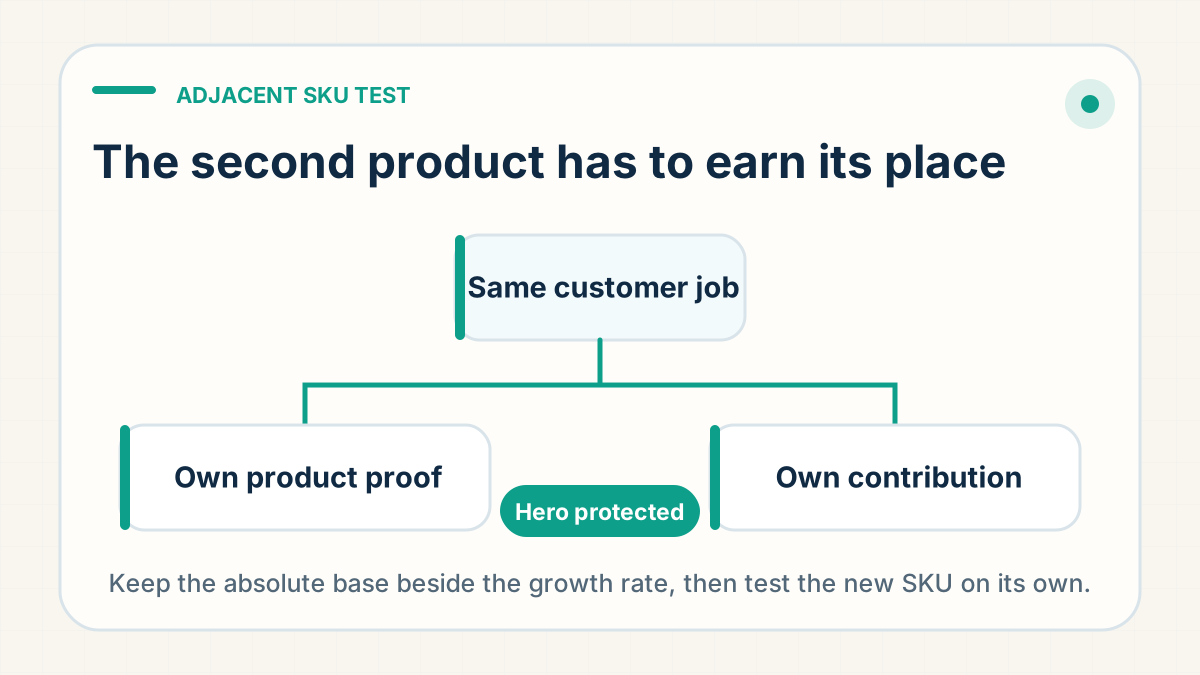
"The same audience might buy it" is not adjacency. That describes almost any catalogue expansion. A real adjacent SKU should reuse hard-won customer understanding while earning its own demand, contribution and operational right to exist.
Why fast growth in a small category can mislead
On reported Q2 2026 constant-currency growth of 18.9% in shoes, 56.2% in apparel and 102.2% in accessories. The percentages look like a story about expansion beyond the core. The absolute figures add the necessary scale: quarterly shoe sales were CHF 781.6 million, compared with CHF 54.2 million in apparel and CHF 14.5 million in accessories.
Accessories therefore grew fastest from a much smaller base. This is a company-reported example from one premium sportswear brand, not evidence that accessories are automatically the best second category for a dropshipper. Its value is methodological: examine both growth rate and absolute contribution, then ask whether the adjacent category reinforces the customer proposition or merely produces an exciting percentage.
Start with the original customer job
Write down why the hero SKU is bought in practical terms. Separate the job from the product name. A buyer may be trying to organise a specific space, protect an item during travel, create a repeatable grooming routine or solve a fit problem. The next product should have a clear relationship to that job.
- Complete the job: a component the buyer otherwise has to source separately.
- Continue the job: a refill, replacement or maintenance item needed after use.
- Extend the job: a related use case for the same customer and environment.
- Protect the result: storage, care or transport that keeps the original item useful.
If the relationship takes several paragraphs to explain, it is probably a separate product test rather than a natural adjacency. Treat it as such.
Look for evidence inside the current operation
The best adjacent-product clues often sit in ordinary records. Search pre-purchase questions for missing components. Review returns to find situations where a complementary item might help without hiding a defect. Read support tickets for repeat setup or care problems. Inspect multi-item orders and search terms. Ask whether customers already mention another product by name.
Do not turn every complaint into an upsell. If the hero SKU needs an add-on simply to work as advertised, include it or correct the offer. An adjacent item should add genuine value, not charge the customer to repair an incomplete promise.
- Customer language: repeated request or workaround, not an invented persona.
- Order evidence: repeat purchase, natural co-purchase or a clear next-use moment.
- Support evidence: a real secondary problem that is not caused by poor quality.
- Commercial evidence: enough potential contribution after its own fulfilment costs.
Score strategic fit and operational fit separately
A candidate can fit the audience while failing the operation. Score both sides before ordering stock.
- Strategic fit: same buyer, same job, credible brand relationship and an offer that can stand on its own.
- Product fit: observable specification, defensible claims, stable version and a sample that meets the requirement.
- Pack fit: can it travel with the hero SKU without damaging either item or crossing a route limit?
- Inventory fit: manageable minimum, replenishment time and no forced stock commitment based on forecast alone.
- Service fit: support, warranty and returns do not introduce disproportionate complexity.
A low-cost add-on can still be expensive operationally. It may create a second supplier, a second preparation time, a split parcel, a new customs classification or a fragile packing step. Price the customer-ready configuration and actual route rather than assuming it shares the hero SKU economics.
Test it as its own SKU before building the bundle
A bundle can hide weak demand because the hero product carries the purchase. Start by defining the adjacent item as its own SKU, with its own specification, sample, landed cost, fulfilment rule and return reason. Then test three offer positions: standalone, optional add-on and clearly priced bundle.
Keep the learning separable. Record attachment rate when it is shown beside the hero product, conversion when sold alone, contribution after any bundle discount, and whether the combined parcel changes chargeable weight or route eligibility. A higher average order value can still reduce contribution if the new pack crosses a freight tier or increases damage.
Use the cart-quality audit to separate price, units, attachment and delivered contribution instead of treating a higher AOV as proof that the adjacent SKU worked.
Avoid silently inserting the product into every order before it is proven. Free gifts and compulsory bundles change pick instructions, stock reconciliation, declaration values and the experience of customers who did not ask for the item.
Use absolute contribution, not just an attachment percentage
An adjacent SKU attached to 20% of orders may look strong, but the useful number is its incremental contribution after product, packing, payment, freight, expected support and returns. Compare that with the extra complexity it creates.
Track units and money as well as percentages. A category can double from ten orders to twenty and remain immaterial. Another can grow slowly while contributing meaningful repeat profit and strengthening retention. The On example is a reminder to keep the base beside the rate, not a benchmark for what the split should be.
Protect the hero SKU while you test
Do not let the new item consume attention or cash needed to keep the proven product in stock. Ring-fence reorder money, inspection capacity and packing instructions for the hero SKU. If the adjacent product shares a factory, confirm that its production will not delay the original. If it shares a parcel, approve the combined pack and route before promoting the bundle.
- Keep separate SKUs and stock counts even when products are usually sold together.
- Approve the standalone and combined customer-ready packs.
- Set a small test quantity or per-order purchase rule before a larger commitment.
- Define a stop rule for low attachment, weak contribution, quality failure or fulfilment disruption.
The second product has to earn scale. It should not inherit the first product's status merely because the catalogue needs to look larger.
A practical decision record
For each candidate, keep one page with the customer job, evidence source, exact product specification, sample result, standalone landed cost, combined landed cost, route, minimum, replenishment time, test offer, success threshold and stop conditions. End with one decision: reject, investigate, test or scale.
If the test passes, add the product gradually and preserve the evidence that made it work. If the supplier changes a material, size or included component, reopen the approval. Adjacency does not make version control less important; it creates another way a mismatch can affect the customer's whole order.
Use the winner as evidence, not permission
Choose the next SKU from evidence around the proven customer job, then make it pass its own product, margin and fulfilment tests. Check the absolute base behind every attractive growth rate. Test standalone, add-on and bundle positions without letting the hero product hide the result.
A coherent catalogue is not built by adding whatever the current supplier can also sell. It is built by solving the next credible problem for the same customer while keeping the original promise stable. The hero SKU gives the next product an interview, not the job.
What these figures can and cannot show
On's product-category, channel and margin figures are company-reported Q2 2026 results for its global premium sportswear business. They are not a dropshipping study, a product recommendation or evidence that another store will reproduce its category growth. Use the adjacent-SKU framework and operating checks to test your own sourcing, stock, packing and fulfilment evidence; On makes none of those claims.
Need a product checked before you spend on ads?
Send us the product link and destination on WhatsApp (+86 178 4666 9989). We'll check sourcing, packing and shipping with you before you commit.
Get Sourcing Quote on WhatsApp →