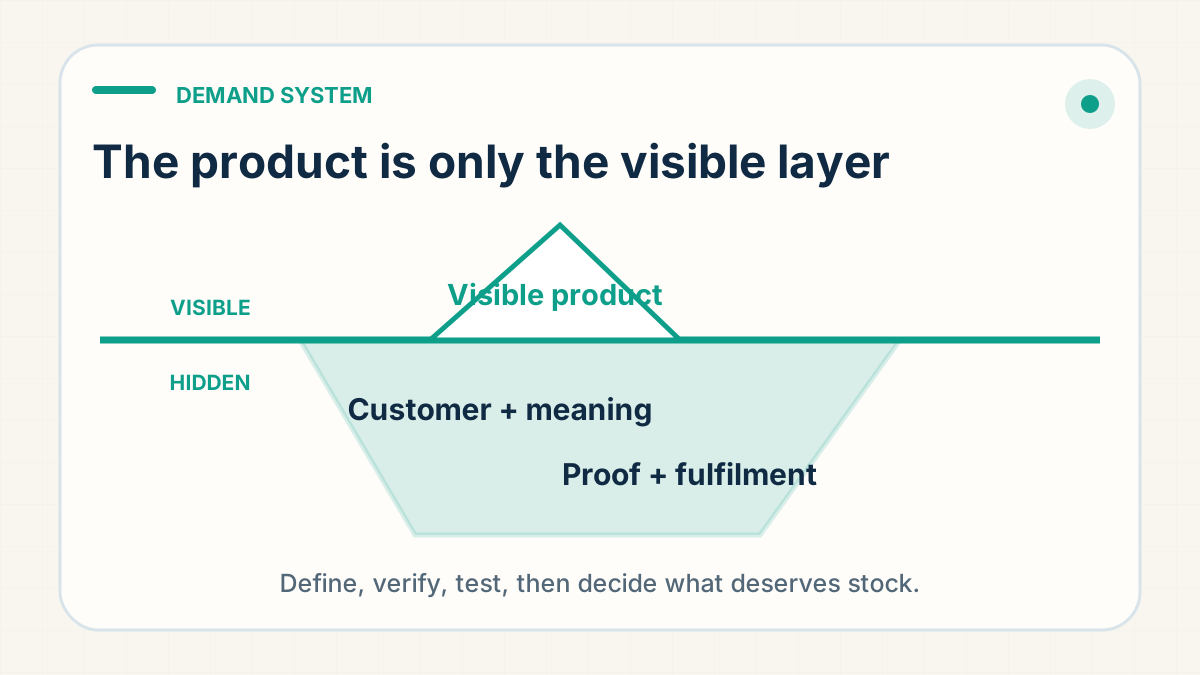
Answer in brief
Copying a visible product does not copy the reason it sells, the customer relationship behind it, the exact version buyers accept, or the operation that keeps it available. A useful product test therefore has two layers. First, prove one exact customer-ready product for one use case, market, channel, price and route. Then prove that the demand can become an asset: repeat purchase, a credible adjacent-SKU path, referral, owned audience, durable organic discovery or enough first-order contribution to fund reacquisition. If those layers are missing, the "winner" may be rented attention attached to inventory.
The practical rule is simple: do not source a category. Write the demand atom, verify the exact product and route, run a controlled live-order test, and decide in advance what evidence would make you stop. Only then should a forecast become reserved stock, a test become a larger buy, or one successful SKU become a catalogue.
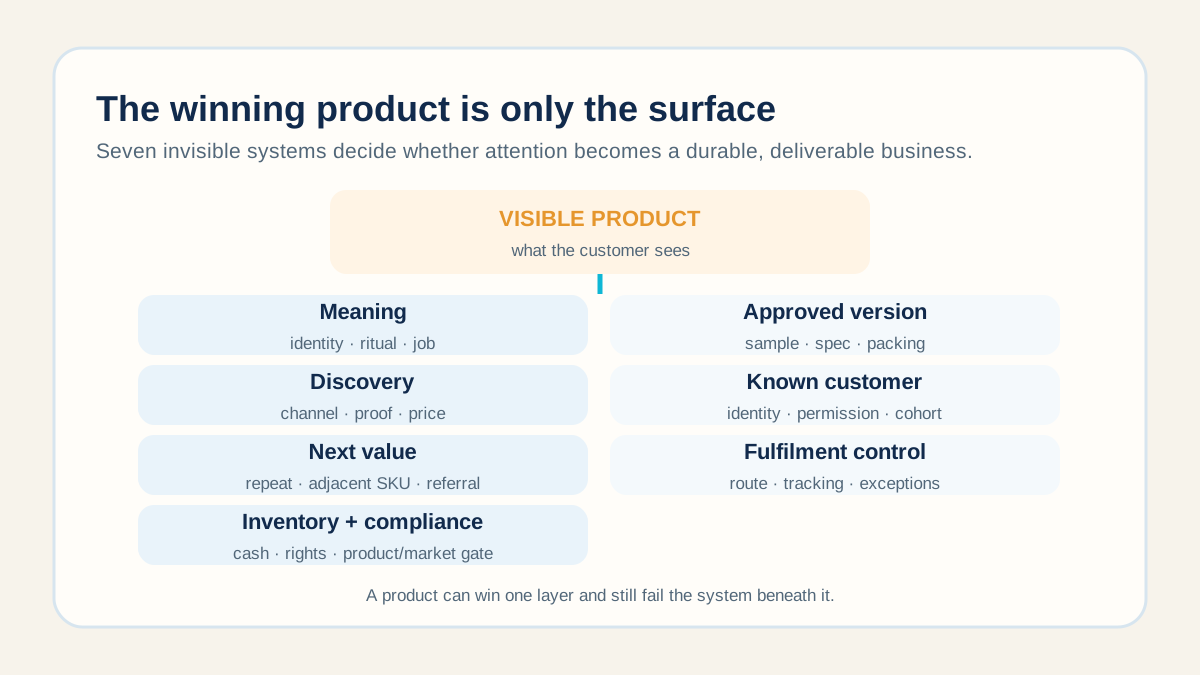
Why category growth is a weak sourcing signal
"Collectibles are growing" and "beauty is growing" sound useful because they are short. They are also too broad to tell a dropshipper what to source. A category can rise while one format, market or sales channel falls. A company can report growth while the exact demand available to a new store becomes more expensive to acquire. A product family can be popular while the version a supplier offers has different rights, materials, claims, packing or route eligibility.
DICK'S Sporting Goods' second-quarter 2026 result gives a stronger same-owner contrast. DICK'S core comparable sales rose 4.9%, while Foot Locker pro forma comparable sales fell 3.6% in the same 13-week period: an 8.5-percentage-point spread inside one reporting group and an overlapping sports-and-footwear arena. Calculated from the reported segment tables, DICK'S core segment profit was about 12.6% of sales while Foot Locker's was about negative 1.8%.
That is a natural contrast, not a controlled experiment. The banners differ in customer mission, store base, geography, assortment, launch exposure and integration stage. It still defeats the lazy conclusion that a broad category explains the outcome. Management described broad category strength, differentiated assortment and FIFA World Cup engagement at DICK'S, while describing Foot Locker as exposed to a promotional market, legacy silhouettes and fewer or weaker launches. Those explanations are management's interpretation; the disclosed divergence is the fact. For a dropshipper, the useful next question is which part of the offer system—not which category label—actually earned the order.
The latest company results make the split unusually visible. POP MART reported H1 2026 revenue growth of 23.8%. Inside that number, plush revenue grew 60.0%, figurines were almost flat at 0.3%, and derivatives and other products declined 15.8%. The result does not say generic plush is a winning-product category. It says the company's growth was concentrated in an exact format, inside an owned IP and distribution system.
Estée Lauder reported 3% organic sales growth for fiscal 2026, but its organic category results ranged from fragrance growth of 10% to makeup at 0% and hair care down 1%. Coty's full-year revenue declined 2% as reported and 5% like for like. Those are different companies with different economics, and their margins should not be compared as though they run the same model. Read together, however, they establish a narrow point: even within a familiar category, the exact product family, channel, currency effect and customer context can move in opposite directions.
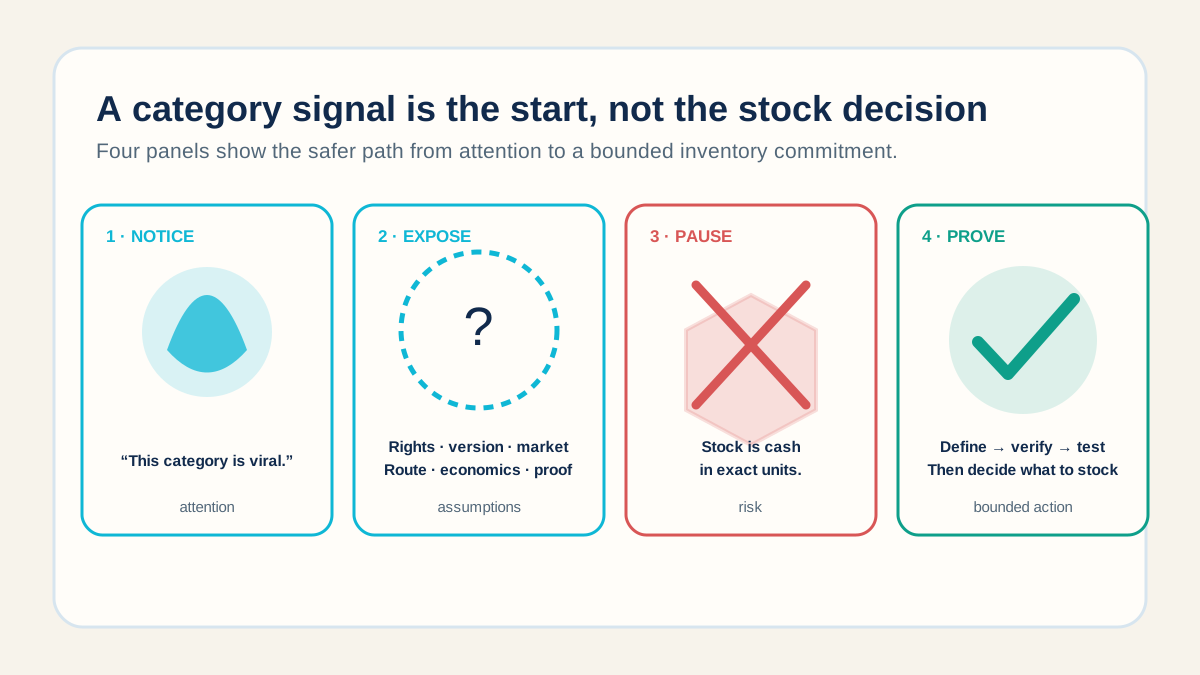
That is why trend data should create a question, not a purchase order. A broad signal can tell you where to investigate. It cannot tell you that a supplier's visually similar unit carries the same meaning, converts with the same proof, reaches the same customer or survives the same delivered cost.
Define the demand atom before requesting a quote
A demand atom is the smallest useful statement of what you believe someone will buy. It is deliberately narrower than a category, an audience or a product link. The point is not to make research sound scientific. The point is to expose the assumptions that otherwise hide inside "this is trending."
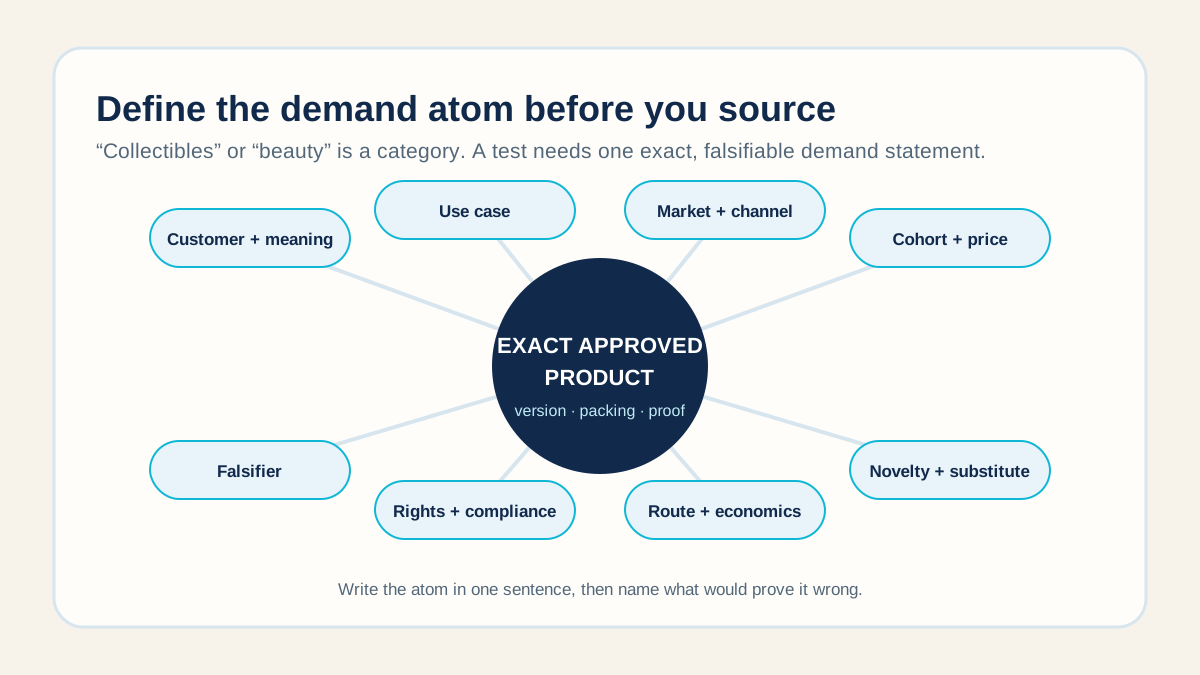
- Identity or meaning: what does ownership, use or gifting say or do for the buyer?
- Exact format: model, material, dimensions, components, finish, variant and customer-ready packing.
- Use case: the specific job, ritual, problem, collection behaviour or occasion.
- Geography and channel: the market, platform, creative environment and promise that produced the signal.
- Cohort and price: which buyer group acted, at what price, offer and acquisition cost.
- Novelty and substitute: why the product earns attention now, and what local or familiar alternative the customer can choose.
- Route and economics: packed cost, chargeable weight, processing time, delivery range, refund and reship exposure.
- Rights and compliance: who owns the design or mark, which claims are made, and which product/market requirements have to be satisfied.
A useful hypothesis fits in one sentence: "We believe [customer] in [market] will buy [exact approved version] for [use case] at [price] after seeing [proof/channel], despite [substitute and delivery gap], provided [route, rights and compliance gate] passes." Then add the falsifier: the observation that makes you reject or redesign the test.
Download the blank demand-atom worksheet to keep one row per product idea: the eight parts above, the one-sentence belief, the observation that would make you reject or redesign the test, the evidence so far and the next test. It holds no RyanFulfil prices, thresholds or example products.
If the sentence cannot name the exact customer-ready unit, begin with a product sourcing brief suppliers can actually quote. If the evidence begins with AI discovery or a trend tool, use the specific-intent product-research test to turn broad popularity into constraints someone can verify.
A view can prove attention, not the whole system
Viral content can be excellent evidence for one part of the demand atom: people stopped, watched, shared or clicked. It does not prove that the unit in the clip matches the unit a factory will ship. It does not prove a demonstration is defensible, that a buyer will keep the order, or that the parcel can arrive inside the promise without destroying contribution.
Treat the test as three separate proofs. Product proof asks whether the exact sample supports the claim. Creative proof asks whether the value is understandable without hidden explanation. Operational proof asks whether the correct version can move from paid order to usable tracking and delivery under the real packed economics. The lowest proof sets the scale decision. An average score lets a spectacular hook conceal a product or fulfilment failure.
The full procedure is in Short-Form Product Testing: A View Is Not Proof. Before spend increases, run one controlled storefront and fulfilment preflight so the same version, variant mapping, address flow, release rule and tracking return are tested together.
Virality without a customer file is rented demand
POP MART's mainland result shows what the visible toy does not. The company said members contributed 92.9% of mainland China revenue and reported a 51.6% H1 repeat-purchase rate under its own definition: members who bought at least twice during the period divided by members who purchased during the period. That is not an annual retention rate, not a causal claim and not a benchmark for a Shopify store. It demonstrates that the company can identify a large share of purchasing customers and observe repeat behaviour inside its system.
A one-product store buying each next customer again from the same auction has a different asset. It may have profitable demand, but the demand remains rented unless something durable accumulates: permission to contact the customer, a second purchase, cross-SKU migration, direct or branded search, organic content, referral, a useful community, or enough delivered first-order contribution to pay for reacquisition without wishful lifetime value.
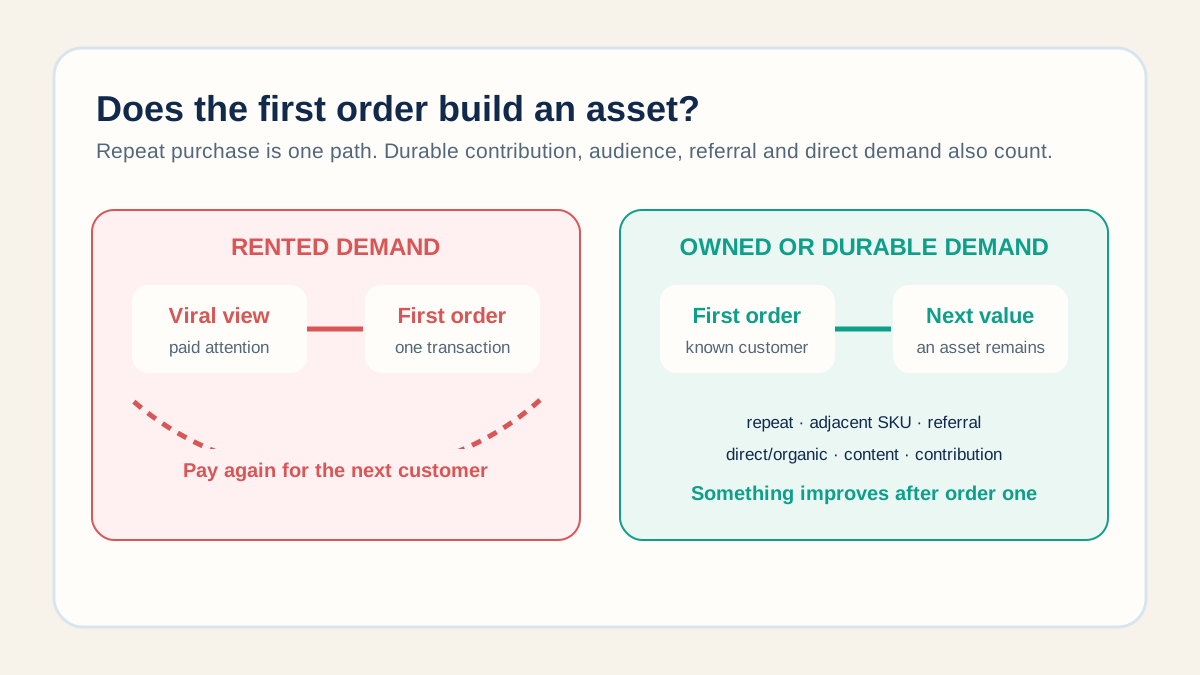
Measure identified-customer rate, second purchase by a defined window, repeat contribution after fulfilment, migration between exact SKUs, direct and organic share, and referral where it is genuinely observable. Do not report projected revenue as lifetime value, and do not assume every durable product must be replenishable. A long-lived product can still create a valuable referral, accessory, service or content relationship. The test is whether something improves after the first order rather than resetting to zero.
If a lower first-order margin is being justified by future value, use the realised-LTV and payback framework. Positive first-order contribution remains the safer default until repeat behaviour is delivered, measured and cash-safe.
Newness should deepen a hero, not multiply inventory
Once a SKU works, the next temptation is to extend the range. The winning SKU is useful evidence, but it is not permission. It tells you which customer language, use case, complaint pattern, variant and fulfilment path have survived contact with reality. A candidate next product should reuse some of that knowledge while earning its own demand and operational right to exist.
The company examples point in both directions. Estée Lauder said 23% of fiscal-year sales came from company-defined innovation and linked innovation with hero renewal, customer acquisition and halo. That share does not mean 23% was incremental or more profitable. Coty, facing a different result, said it would simplify its colour-cosmetics innovation calendar and SKU base and shift resources toward fewer, higher-impact launches and proven hero products. That is management's plan, not proof of future success. Together they show why launch count is a poor operating goal.
Test an adjacent SKU on a fixed budget. Define the job it performs beside the hero, whether it increases delivered contribution per eligible visit, whether customers of the hero actually buy it, and what it adds to samples, minimums, variant mapping, storage, packing, parcel size, support and reordering. A product that adds revenue but absorbs more cash, creates a split parcel and cannibalises the hero may be a weaker system even while the catalogue looks bigger.
Use the adjacent-SKU interview framework, then give every accepted version a stable record through SKU and product-version control. A supplier or factory change reopens approval; the listing promise does not change because the source changed.
Inventory is the final demand claim
Buying stock converts a belief into cash committed to exact units. That makes inventory the most expensive demand statement a seller writes. It should therefore require stronger evidence than a viral clip, a supplier assurance or a one-week sales spike.
Separate forecast, paid orders and physical stock. A forecast prepares capacity. Paid orders create allocation decisions. Stock needs states—sellable, reserved, held, inbound and unavailable—by exact SKU. A total unit number can look healthy while the selling variant is unavailable or a new batch no longer matches the approved reference.
Build the bridge in Forecasts, Paid Orders and Stock. Pre-stock only when paid demand is stable and concentrated enough, the exact source is reliable, replenishment is known, and the service or cost benefit can recover the cash and handling risk. The dropship, China pre-stock or overseas-warehouse comparison explains what each position solves; the reorder-point calculator turns demand and full lead time into a visible trigger.
Prepare for a surge without pretending it is guaranteed. Lock the approved version, current sellable stock, confirmed inbound units, release capacity, fallback customer message and factory-update owner. A large forecast can justify a capacity discussion. It does not make unreserved factory output available stock.
Four stages, four different decisions
- Tester: prove one demand atom. Use one exact sample, one customer promise, one route and one controlled live order. Reject if the product, claim, rights, route or contribution gate fails.
- Early scaler: prove repeatability. Watch version drift, refund and reship reasons, delivery distribution, variant concentration and delivered contribution. Increase commitment in steps, not in one emotional order.
- Stocked winner: prove cash recovery. Use paid-demand history, weeks of cover, full replenishment time, sell-through by SKU, stock states and explicit stop rules. Keep long-tail variants on a lighter model where practical.
- Private-label or hybrid brand: prove control. Approve rights, artwork, product and packaging references, exact-version documents, first-production evidence and market requirements before production. Newness must strengthen the hero system rather than merely add SKUs.
Watch and reject before sourcing
- Reject copied characters, logos, artwork or lookalikes without verified rights. Strong demand for owned IP is evidence that the rights are valuable, not permission to imitate the object.
- Hold children's toys and plush until the exact product, age grading, testing, labels, traceability and destination requirements are established. Adult collectible positioning does not automatically decide legal classification.
- Hold cosmetics and skincare until the formula, claims, responsible party, product file, notifications and market documentation are established for the exact version.
- Treat alcohol perfume as both a cosmetics and dangerous-goods problem. Do not assume an ordinary direct-parcel route accepts it because the bottle is small.
- Reject viral pre-stock when demand depends on another party's IP, one creator, one week, one market or an unverified supplier version. The risk is concentrated twice: in acquisition and inventory.
For lawful private label, use the private-label release checklist. For any source or version change, reopen the supplier and factory change-control process. Product and market requirements remain the seller or importer's responsibility; RyanFulfil can help coordinate exact-version checks and approved documents without turning operational help into legal advice.
Score the 12-part offer system before you scale
Score each dimension from 0 to 5: zero means absent or contradicted; one means claimed without useful evidence; two means early evidence with unresolved economics; three means verified in one meaningful cohort; four means repeated across cohorts with controlled operations; and five means durable, measured and documented inside a stated boundary. Add the scores, then multiply by 100/60. The number is a triage tool, not a prediction.
- Customer mission: name the specific job, identity, event or use case. Check conversion and objections by product, market and creative—not a broad category trend.
- Demand durability: separate launch or event contribution from the non-launch baseline. A useful launch-dependence ratio is mature contribution during launch windows divided by total mature contribution.
- Differentiation: identify a meaningful specification, configuration, bundle, design or proof that survives comparison with a credible local substitute.
- Value architecture: separate delivered price from specification value, risk reduction, convenience, identity and continuity. Measure discount dependency instead of calling every coupon "value".
- Proof and trust: map every material claim to the exact approved sample, version and evidence. Supplier images are not an approval record.
- Customer ownership: measure identified customers, second purchase, direct return, referral or another durable asset. Do not confuse basket depth with customer depth.
- Attachment and adjacency: name the relevant second transaction and measure incremental contribution and cross-SKU migration. Random catalogue growth scores poorly.
- Geographic fit: treat product × country × route as a separate case. Compare local substitutes, payment approval, delivery tails, compliance and contribution per session.
- Operations truth: control the exact version, supplier, QC criteria, bundle contents, packed dimensions and route. Track substitutions, pass rate and P90 delivery.
- Mature economics: reconcile sessions, kept units, net price, mix, contribution, refunds, reships and cash timing. AOV, ROAS or revenue alone does not pass.
- Inventory and lifecycle: tie stock state and cover to concentrated, mature demand. Record event-stock and obsolescence exposure instead of using an arbitrary order threshold.
- Exit discipline: define the observation that makes the team hold, redesign, change route, harvest, archive or kill the offer. Hope and deeper discounting are not an exit plan.
Use four decision bands. At 85–100, scale only inside the product, stock, quality and geography gates already proven. At 70–84, repair the weakest dimensions before adding capital. At 55–69, keep the product in bounded tests and hold large stock or private-label commitments. Below 55, the offer is usually advertisement-led or locally substitutable: reject or redesign it.
Do not average away a fatal zero. A product with attractive demand but unresolved rights, safety, exact-version, route or contribution evidence remains on hold regardless of its total. Also resist false precision: a two-point change is useful only when new evidence changed the decision, not when the team changed its mood.
What these results prove—and what they do not
The official results support three observations: outcomes can split sharply inside one owner and broad category; known-customer and repeat systems can sit behind visible product demand; and innovation, inventory breadth and obsolescence are economic decisions rather than a count of new launches. They do not prove that the DICK'S/Foot Locker divergence has one cause, that membership caused POP MART's growth, that generic plush or fragrance is a winning dropshipping category, that Estée Lauder's innovation share is incremental profit, that Coty's announced simplification will work, or that one universal offer score, repeat rate, SKU count or pre-stock threshold exists.
Use the demand system and demand atom to turn a broad product idea into assumptions, evidence, a bounded commitment and a decision you can reverse before inventory becomes the lesson. They are not predictive formulas.
Test the demand system behind the SKU
On the China side, the useful work is making the invisible layers inspectable: matching the exact product rather than a similar listing, obtaining and comparing samples, keeping an approved version reference, checking customer-ready packing, pricing the real route, running a controlled order, and separating forecast demand from sellable and incoming stock. Those controls cannot manufacture demand. They can stop a weak demand assumption from being multiplied by the wrong product, parcel or inventory decision.
Use Pricing to see what belongs in the customer-ready cost and Services for the sourcing, checking, packing, route and stock work behind the test. Send the exact product reference, target countries, variants, expected order stage and the decision you are trying to make. A useful first answer is often not "yes, we can source it." It is the smallest test that can prove whether the demand system is real.
Need a product checked before you spend on ads?
Send us the product link and destination on WhatsApp (+86 178 4666 9989). We'll check sourcing, packing and shipping with you before you commit.
Get Sourcing Quote on WhatsApp →