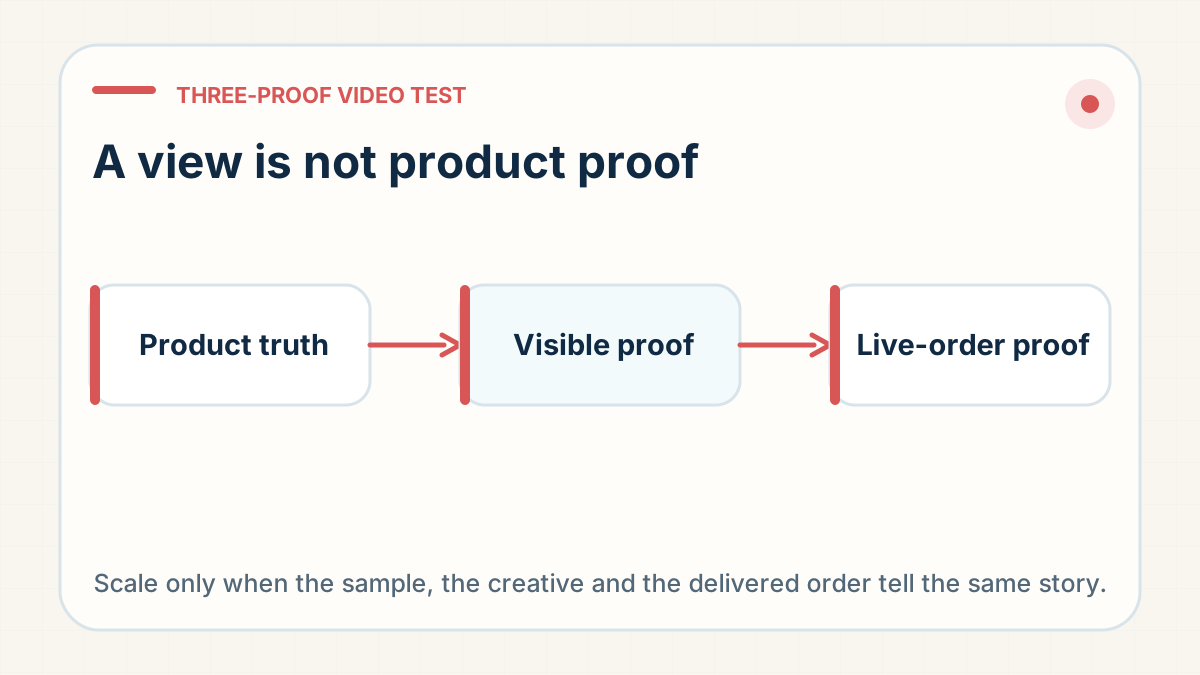
A view is not product proof
A viral clip can prove that people stopped scrolling. It cannot prove the exact unit survives inspection, the demonstrated claim is true or the live order path can deliver the same version profitably. Sea reported that orders attributed to livestreaming and short-form video grew by more than 50% year over year on Shopee in Southeast Asia during Q2 2026 and represented more than 25% of physical-goods orders. It also said Shopee affiliate orders linked from Facebook creators grew by more than 85% quarter over quarter. Those are meaningful marketplace signals that video can sit close to purchase, but they are not evidence that the same product, creative or conversion rate will transfer to an independent Shopify store.
The useful lesson is narrower: some products can make their value visible quickly enough for a buyer to act. Testing that possibility requires three separate proofs. The physical product must support the claim. The creative must make the claim understandable. The live order path must deliver the same version under workable economics. A product is not ready to scale when only one of the three passes.
Treat the scale decision as the lowest of those three proofs, not their average. A spectacular hook cannot average away a false demonstration. A perfect sample cannot average away a broken variant mapping. A profitable spreadsheet cannot average away a supplier version that changes after the first hundred orders.
Proof one: the exact product survives inspection
Start with the customer-ready unit, not a supplier listing or a viral clip. Record the exact model, variant, material, dimensions, included parts and packed condition. If the creative depends on a hinge, texture, fit, capacity or before-and-after result, test that feature on the sample that would actually be shipped.
- Write the central promise in observable language: what should a viewer be able to see happen?
- Identify the product feature responsible for that result and check it on the exact sample.
- Record limitations and normal variation so the demonstration does not imply a result every unit cannot produce.
- Confirm that the supplier can replenish the approved version instead of silently substituting a lookalike.
Reject the candidate when the product needs camera tricks, an unapproved accessory or an unusual setup to look useful. The gap will eventually reappear as a return, a complaint or an advertising claim the store cannot defend.
Proof two: one claim is visible without explanation
A short-form test should make one verified attribute legible in a short sequence: the problem, the action and the result. That sequence is a RyanFulfil testing method, not a duration rule from Sea or Shopee. The right length is whatever makes the evidence clear without hiding setup or limitations.
Build several creative angles around the same approved fact rather than several unsupported promises. A storage product might show fit in the intended space, access during normal use and the packed result. A compatibility product might show the exact device model, connection and completed function. The visual evidence and product-page specification should agree.
- Hook: show the recognisable problem or constraint, not a generic lifestyle scene.
- Proof: demonstrate the exact feature on the exact version being sold.
- Boundary: show or state the important limitation before it becomes a return reason.
- Offer: make the variant, included quantity and delivery promise unambiguous.
Measure more than views. Hold rate can tell you whether the opening earns attention; clicks can test whether the problem and offer create intent; add-to-cart and purchase behaviour can expose price or trust friction. None of those signals alone verifies the delivered product.
Proof three: the real order path works
Sea also reported that listings moved into Shopee fulfilment saw an average order uplift of more than 20% in their first month in Southeast Asia, while fulfilment volumes grew 20% quarter over quarter. That comparison is company-reported and non-random: sellers or products entering fulfilment may differ from those that did not. It does not establish that faster fulfilment will cause the same uplift on Shopify.
It does reinforce the operational question behind a video test. If demand arrives, can the seller release the correct order, ship the approved variant, return usable tracking and meet the displayed delivery range? Place a controlled order through the actual storefront and integration. Check variant mapping, stock handling, address transfer, cancellation timing, warehouse release, packed unit, tracking handoff and customer notifications.
Use the packed item to calculate landed cost. Include product, domestic movement, pick and pack, packaging, chargeable international weight, payment cost, expected reships and refunds. A creative winner with no contribution after fulfilment is not a commercial winner.
Use a three-proof test card
Keep one record for each product and creative combination. The purpose is to prevent a strong number in one stage from erasing an unresolved failure elsewhere.
- Product proof: approved sample, observable claim, evidence, limitation and version identifier.
- Creative proof: audience problem, hook, demonstration, result, offer and the metric each variation is testing.
- Order proof: selling price, landed cost, contribution target, route, preparation time, delivery range and controlled-order result.
- Decision: reject, revise, continue testing or scale within a stated stock and service limit.
Treat each creative as a test of a defined claim. If one angle earns attention but another does not, do not rewrite the product conclusion too quickly. The failed opening, audience, offer or proof sequence may be the variable. Conversely, do not call a product validated because one video performed while purchases, cancellations or delivery outcomes remain unknown.
Set scale gates before the test begins
A useful test has pre-written thresholds. Decide what minimum evidence would justify the next spend band and which failures stop the test regardless of views. The exact numbers depend on price, margin, channel and market; the discipline is to set them before the results create a temptation to rationalise.
- Do not raise spend while the supplier version, packed cost or eligible route remains unresolved.
- Do not accept a creative claim that the product sample failed to reproduce.
- Do not treat an add-to-cart signal as a purchase or a purchase as a successful delivery.
- Do not commit to a large stock position solely because a creator or ad produced a short burst.
Before a larger push, ask the supplier and fulfilment team about current stock, daily preparation capacity, replenishment lead time, weekend or holiday coverage and the last safe order-change point. Scale should be a controlled increase in a proven system, not a promise that every spike can be absorbed.
Marketplace evidence does not transfer automatically
Shopee combines marketplace discovery, creator tools, checkout, trust signals and fulfilment services inside one network. A Shopify store typically has to earn the click, establish trust, present the product, complete checkout and coordinate fulfilment across separate systems. The marketplace figures therefore support testing video-led discovery; they do not provide a forecast for store traffic, conversion or revenue.
They are also regional aggregate results rather than a product-category study. They do not identify which categories drove the orders, the base behind every growth rate or the incremental effect of one feature. Use them as a reason to test a mechanism, not as permission to copy a product or enter a country.
Demand three proofs before scaling the clip
A short-form product test is complete only when product truth, visible proof and live-order proof agree. Inspect the exact unit, demonstrate one defensible claim, measure the funnel in stages and send a controlled order through the real route. Scale only inside the stock, margin and service capacity you have actually checked.
That standard may reject a product with impressive views. It may also preserve a quieter product whose first creative needs work but whose customer fit and operation are sound. A view is evidence that attention stopped. A delivered, kept and contributing order is evidence that a business may be starting.
What these figures can and cannot show
Shopee order, creator and fulfilment figures are company-reported Q2 2026 results and prepared remarks from Sea. They are marketplace-wide observations, not an audited causal study of Shopify dropshipping or a forecast for a particular product. Use the three-proof framework, test card and scale gates to test your own product; they do not guarantee ad performance, sales or delivery outcomes.
Need a product checked before you spend on ads?
Send us the product link and destination on WhatsApp (+86 178 4666 9989). We'll check sourcing, packing and shipping with you before you commit.
Get Sourcing Quote on WhatsApp →