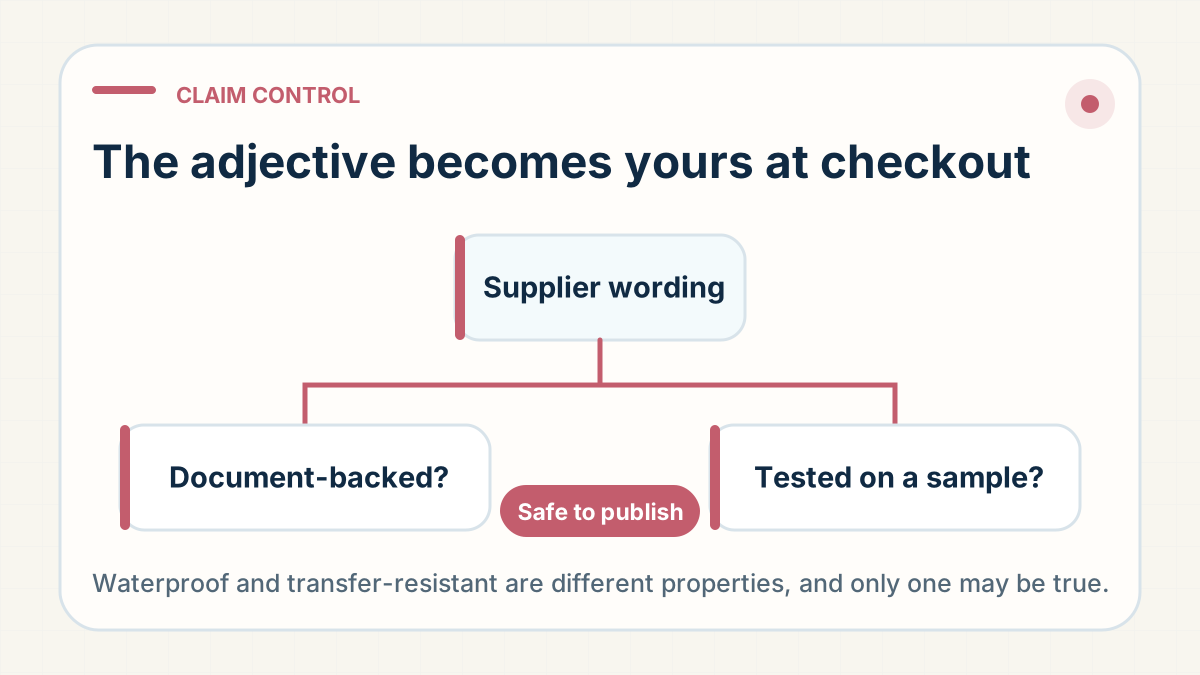
The claim moves from the factory to you
A supplier listing describes a product in order to sell it to you. Your product page describes the same item in order to sell it to a consumer — and at that point the words stop being marketing you received and become representations you made. Consumer-protection regimes in most markets hold the seller responsible for the accuracy of product claims, regardless of where the description originated. Copying an adjective forward is how a factory's optimism becomes your refund rate.
Why supplier listings overstate, without anyone lying
It helps to understand where the wording comes from, because the instinct to treat a factory as dishonest is usually wrong and always unproductive. A marketplace listing title is written to win a search. Platform conventions reward keyword density, so attributes get stacked into a title as tags rather than as claims — the words are functioning as search terms, not as a specification sheet.
On top of that sits translation. A term with a precise technical meaning in one language frequently maps onto a looser everyday word in another, and the looser word is the one that ends up in the listing. Add category norms — where an entire product class is described with the same adjective regardless of tested performance — and you get copy that is conventional in its original context and materially misleading once it is lifted onto a consumer product page in another market.
None of that changes your position. The seller needs evidence for the claim used in the listing, so the practical response is not indignation but verification.
Two words that sound the same and are not
The clearest example we see is a seller told a cosmetic product is waterproof, who then asks separately whether it is also transfer-resistant. Those are different properties. One describes behaviour in contact with water; the other describes whether the product rubs off onto skin, fabric or a glass. A product can genuinely be the first and not the second, and a customer who was promised both will notice within a day.
The same trap runs through every category. Water-resistant is not waterproof. Stainless is not tarnish-proof. Hypoallergenic, food-safe, machine-washable, scratch-resistant and lead-free are all specific statements, several of them regulated, and none of them is established by a supplier writing it in a product title.
Colour is a claim too
Colour differences can cause avoidable returns. Supplier promotional images are processed — brightened, colour-corrected, sometimes rendered rather than photographed — because they exist to make a product attractive in a marketplace grid. A swatch photograph taken under ordinary light will not match them, and neither will the product.
Treat the promotional image as advertising and the swatch or in-hand photograph as evidence. Where a shade name is going to become part of your own range, map it explicitly: your name, the supplier's name, and an in-hand reference image agreed by both sides. Do it before the listing goes live, because renaming a colour after customers have ordered it is far more expensive than agreeing it beforehand.
Build a claim register before the listing
- List every performance and material claim your copy makes, including the ones inside images and video.
- Mark each as supplier-stated, document-backed or tested-by-you. Check whether that evidence is sufficient for the specific claim and destination before using it.
- For anything document-backed, check the document names the exact model, not a related one in the same range.
- Test the rest on a physical sample the way a customer will use it — water, wear, washing, handling, a full charge cycle.
- Delete or soften anything that survives none of those checks. A quieter listing beats a contested one.
Write the limitation into the listing
Sellers worry that stating a limitation costs conversions. In practice, the alternative is paying for the same information later through refunds, replacements and reviews that state it far less kindly. A short honest line — that a plated finish should not be worn in water, that a natural material varies, that an outdoor item will patinate — converts a refund into an expectation.
This is also the cheapest form of quality control available to a seller who does not hold stock. You cannot inspect every unit, but you can make sure the promise matches the product.
When the supplier cannot confirm, that is the answer
Sometimes a factory simply will not commit to a property, and no amount of asking changes it. That is information: it tells you the claim is unverified, and the safe response is to drop it from your marketing rather than to keep it and hope. A seller who launches on an unconfirmed performance claim is choosing a risk, and it is better to choose it knowingly than to inherit it from a listing.
Publish only the claim the exact product can support
Separate what the supplier said from what has been shown, verify each claim on the exact model you will ship, agree colour against an in-hand reference rather than a promotional image, and write the limitation into the page. The claims you can defend are the ones that will still be true in the customer's hands.
The rule: Limit each listing claim to what the exact product version and relevant evidence support in the destination market. Supplier wording is a lead, not approval; change the claim, obtain the missing evidence or stop the product before advertising turns uncertainty into a customer promise.
Want a product checked before it ships?
Tell us what to check on WhatsApp (+86 178 4666 9989), and we can build those product, packaging and quantity checks into the fulfilment process.
Request Quality Check on WhatsApp →