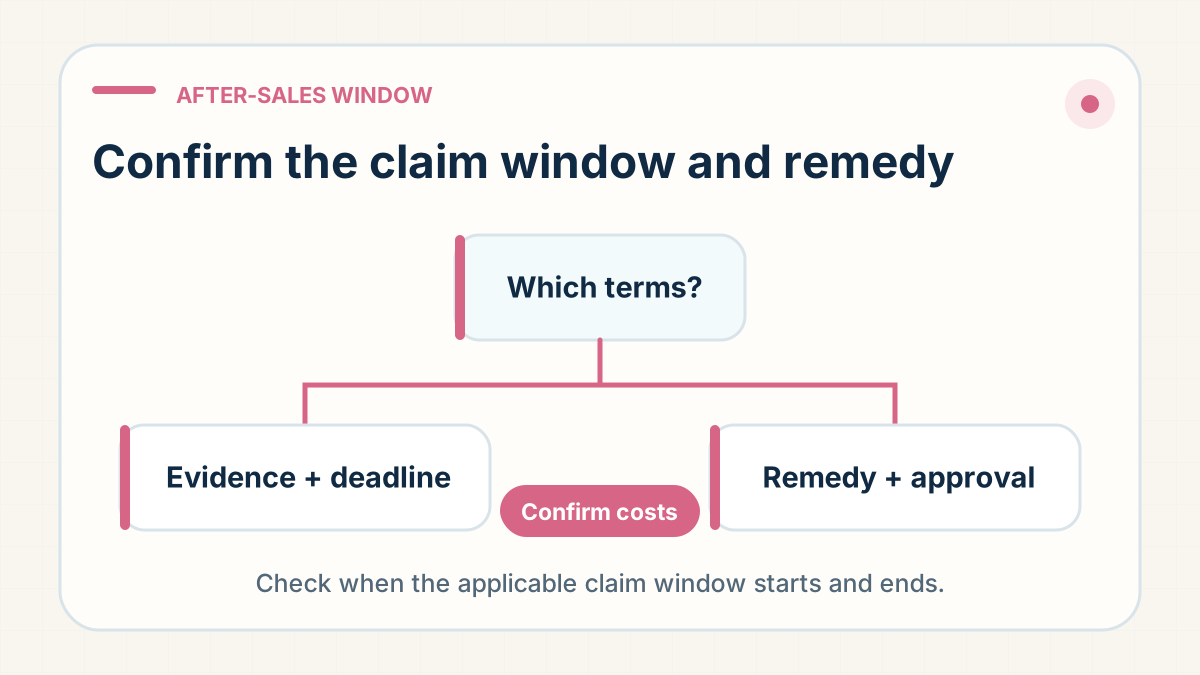
Two clocks: your warranty and the supplier's window
A replacement dispute almost always comes down to two clocks that nobody lined up. The store promises its customer thirty days or more, counted from whenever the customer complains. The factory's after-sales window is shorter and is counted from the delivery scan, not from the day the customer finally opens the box. The agent sits between the two and inherits the gap.
RyanFulfil publishes the cause-by-cause rules openly, and expects damage and malfunction evidence promptly after receipt; the rules are set out in the FAQ. What the FAQ cannot publish is the factory's own window for a given product, because it varies by supplier. That number has to be asked for at sourcing, written into the client group at onboarding, and quoted back the first time it is applied. One seller with several open cases was told that parcels delivered one, two and five months earlier had all "exceeded the period" and still could not say what the period was. A window first heard at the moment of refusal is not a policy; it is a surprise.
Who pays, by cause
The cause decides the payer. Name both in the first reply and most of the argument disappears.
- Packing error: the wrong item, a missing component or a unit that left the warehouse damaged. The agent reships free.
- Factory defect: the agent claims goods and shipping back from the factory and reships or refunds the seller. The claim is the agent's job, not the seller's.
- Transit damage reported at receipt, with arrival photos of the outer box, the inner packing and the item: the agent resends at its own cost and takes up the carrier claim itself. The same damage reported after weeks of use is a different case, and usually wear and tear.
- Address failure, non-collection or refusal: the parcel returns. Redelivery is a charged resend, with a corrected address and a reachable number supplied before anything moves.
- Change of mind: the seller's cost. Shipping paid is not refunded.
- Outside the window: a charged resend is offered, not imposed. The offer states the fee and waits for a yes.
The hard cases sit between two lines: a small electronic item that stops working is a factory matter if the fault is inside the unit and a transit matter if the casing is cracked. The defect, packing-damage or transit-damage triage guide sets out how to read the evidence before choosing the lane. Choose the lane first, then apply the window; the other way round is how a factory defect gets refused as "late" when it should have been claimed.
Evidence has a shelf life
Every lane above needs evidence that only exists at one moment. Arrival photos of the outer box prove transit damage on the day and nothing a week later. A short video of a malfunction, taken before any repair is attempted, is what the factory will accept; a description from memory is not. The scan history fixes the delivered date, which every window is counted from.
That is why evidence is asked for at receipt rather than at the first complaint: past the supplier window, a photo no longer proves when the damage happened. A store that promises thirty days still has to collect its evidence inside the shorter window. The evidence guide lists what to ask for at the first complaint, so the support assistant collects it once.
Agree the default before the first case
Most after-sales friction is not about money. It is about messages that read as a commitment on one side and an offer on the other. "We will charge and resend" went out on several cases; the seller read it as done, the desk was waiting for approval, and one replacement sat for days until the seller asked why nothing had moved. Elsewhere a run of damaged kits had been resent on sight, so when the next report was answered with a question instead of a dispatch, the order simply stopped. The desk owed both sellers a sentence that said which it was.
The fix is a standing rule agreed before the first claim, written where the support assistants work rather than said on a call with the owner. It answers four questions.
- Does a damage photo trigger an automatic resend, or does every case wait for a verdict?
- Does a charged resend go on the next invoice automatically, or wait for an explicit yes?
- What is refundable and what is not: lost parcels, missing items and pre-dispatch cancellations on one side; unreachable recipients and refused returns on the other?
- What does "neutral packaging" mean for this store, and is a repack requested or assumed?
One after-sales lead set all of that in a single message and the seller had nothing further to ask. The practice to adopt is to quote the fee, get the yes, then create the shipment; a replacement with a tracking number attached before the seller agreed to pay for it is the worst of both. Tuesday's note on writing the rule before charging under it shows what it costs when the sequence runs backwards.
When the same defect repeats, stop replacing and fix the batch
A replacement policy is built for the occasional unit. When the third report in a fortnight describes the same fault, the question is no longer who pays for one resend but whether the batch is sound. A printed product arriving with pages out of order, an appliance line already known to be failing: each new report belongs to a batch claim, not to a fresh case judged on its own date.
At that point the desk owes the seller a corrective action with the factory, including a pack-out review, a batch picture in bands so the seller can decide whether to keep selling, and a pause on the per-case window: refusing the fourth identical failure as "outside the period" on a batch the factory has already accepted as faulty is a practice to stop. The refund, reship, replace or investigate guide covers the choice between lanes; the batch rule is its investigate branch.
Map your store policy to the window
A thirty-day customer policy is a selling point, so do not copy the supplier window into it. Fund the gap deliberately rather than discovering it on an invoice.
- Promise a window you can honour, and state how a claim is opened: photos of the box and the item, a short video for anything that does not work. Collect that evidence at the first complaint even when you already intend to replace; it is what turns your cost into a factory or carrier claim.
- Price the gap: a small allowance per unit for replacements outside the factory window is cheaper than a dispute, and it lets the support assistant say yes without asking.
- Ask the agent for the factory window on each product before the first order, and revisit it when the product, factory or batch changes; the window moves with the supplier.
Write the claim rule before the first claim
Ask for the after-sales window and the who-pays rule at onboarding, write both where the support assistants can read them, and collect arrival evidence as soon as the parcel lands, whatever you promise customers. Treat a repeated defect as a batch question, quote a charged resend before creating it, and never let a seller learn the window from a refusal.
Evidence boundary
This guide is a composite drawn from reviewed operations conversations between 16 and 21 August 2026 across several client groups and destinations. Products are described by family only, volumes in bands, and no client, customer, supplier or order is identifiable. After-sales windows vary by factory and by agent and are deliberately not stated here as a policy; ask for yours in writing.
Have a specific fulfilment question?
Send us the product, destination and order context on WhatsApp (+86 178 4666 9989). A clear answer is more useful than a generic estimate.
Ask Questions on WhatsApp →