Back to blog
Shipping & Logistics

What Happens After a Failed Delivery: Collection Deadlines, the Return Hub and Resend Fees

9 min read
A failed delivery is a deadline, not a dead end. The parcel is waiting somewhere with a clock on it; the job is to tell the customer which clock.

Read the status twice before you act

A failed-delivery status is the start of a short, time-bound process, not the end of the parcel. Most of the avoidable cost sits in the first hour: someone reads a "delivery attempt failed" or "returned to sender" line, tells the customer the parcel is coming back, and opens a refund before the parcel has moved at all. Read the scan history twice first. A first-attempt failure is often stale by the time it reaches the seller; the aggregator posts it with a lag, and the second attempt has frequently succeeded within a day. Check the destination carrier's own tracking as well as the origin number before escalating.

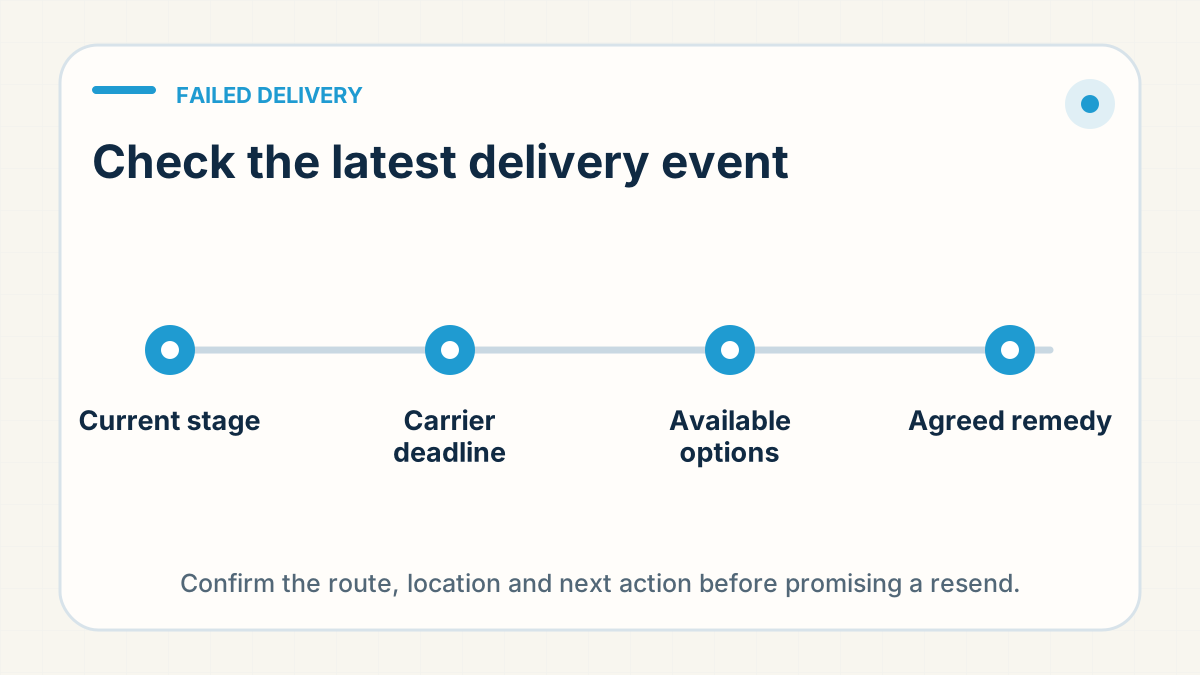
After a failed delivery: read the scan twice, the collection window, the overseas return hub, then a resend or a new parcel before the disposal deadline.

The same discipline applies on the agent's side. A return notice has to be checked against live tracking before it goes out; a templated "returned, incorrect address" message on a parcel that was delivered the day before costs far more credibility than the minute the check takes. The status families and what each one permits are set out on the tracking status page.

The collection window: who has to move, and by when

When a last-mile attempt fails, because the recipient was out, the courier could not access the building or the address could not be found, the parcel is normally held locally for a limited time. The agent posts the local carrier's contact details, service hours and the reason recorded. From that moment the recipient is the only person who can act: contact the carrier, collect from the depot or access point, or book a second attempt. An agent in China cannot negotiate with a destination carrier on the consignee's behalf, and the carrier hotline will not recognise the origin tracking number, so the local carrier reference has to travel with the alert.

The notice the seller forwards should say four things: what happened, what the customer must do, the date before which they must do it, and the carrier contact. A raw carrier block pasted on its own leaves the seller's support team guessing whether "self-pickup" means the customer has to collect the parcel themselves. It does.

Where can my customer collect the parcel?

At whichever access point the last-mile carrier assigned once the parcel entered its network — and the recipient finds out which one by putting the local reference into that carrier's own tracking page or hotline, not into the aggregator page the seller has been watching. A fulfilment desk in China does not hold pickup addresses for foreign towns and never will: the destination carrier chooses the point, after the parcel has landed, from its own network. Saying that boundary out loud, with the reference and the carrier's contact route attached, is faster than going quiet while somebody tries to find an address that was never ours to hold.

This is also where the international tracking page stops being reliable. A parcel sitting at a collection point can still read as in transit on a multi-carrier page for days, because that page is reporting the leg it can see rather than the state the parcel is actually in. Treat a long, unchanging in-transit status on a collection route as a prompt to check the destination carrier directly, not as evidence that the parcel is still moving.

Two habits follow from that. Before treating a quiet parcel as lost, check whether it is simply waiting for somebody to fetch it; on routes that end at an access point rather than a door, that is the commonest explanation, and a contact number and the carrier's opening hours resolve it faster than a claim will. And when a recipient reports that the carrier's line will not connect, suspect the hours before the fault — support windows are shorter at weekends, and a call placed outside them fails in exactly the way a broken number does.

Keep the clock in the same message as the address. An unclaimed parcel is not held indefinitely; it goes back into the overseas return network on the holding period described below. A collection notice that carries only the instruction and not the consequence gives the customer no reason to go this week rather than next.

A bad address is not a refusal

Status wording is carrier-specific and frequently wrong about cause. "Rejected by customer" and "returned, incorrect address" sometimes describe a missing house number, a postcode that does not match the town, or a building the driver could not find, and sometimes they are simply the template the carrier attaches to every return. A parcel the customer insists they would have accepted, with their name on the doorbell, can still come back wearing that label.

Before treating a return as a refusal, check the address on a map, confirm the postcode matches the town, and ask the last-mile carrier what the driver recorded. A corrected address that fails a second time is still incomplete rather than wrong, which in rural France usually means the locality or building detail. Missing house numbers are the commonest cause of French returns, and some destinations will not dispatch at all without a recipient phone number. The checkout fields that stop this before the label is printed are in the guide to checkout address data that prevents delivery failures.

The return hub is overseas, not in China

An uncollected, refused or undeliverable parcel does not come back to Guangzhou. It returns to the carrier's service hub or return warehouse in the destination region, and a parcel already travelling back cannot be intercepted and redirected mid-route. The seller has no view of the return leg, so the agent has to say where the parcel is heading, when it is expected at the hub, and what the options will be on arrival. Silence on that leg turns every return into a manual "has it arrived yet" ticket.

What a resend needs

Once the parcel is at the hub, a second attempt is possible. It needs three things: a full corrected address, a phone number the carrier can reach, and the resend fee. A second attempt on an unchanged address fails the same way as the first. The address should arrive as plain text, with name, street, house number, postcode, town and phone in one message; a screenshot invites retyping errors, and a missing field costs another round trip with the end customer.

Expect the redelivery to run on the original tracking number. Overseas exceptions are re-attempted under the existing consignment, and a new number only appears when a fresh parcel is created. Say that when the resend is arranged, rather than promising a number that will never exist.

The disposal deadline runs through the weekend

Every hub holds returned parcels for a limited time and then disposes of them under local rules. The deadline is set by the carrier and the country, not by the agent, and it can be days rather than weeks. It does not pause for a Sunday, a public holiday or a closed support inbox. Once it passes, redelivery is impossible and the only remaining option is a new parcel shipped from China at full cost.

That makes the disposal date the single most important line in any return notice. The seller needs it on the day the parcel reaches the hub, not on the day they ask whether it has come back. An agent that sees a parcel go quiet in the overseas network should warn before the window closes; a disposal notice should never be the first the seller hears of a problem.

When the same failure repeats

One failed delivery is a parcel problem. The same failure on the same store or route is a pattern, and patterns have causes. Repeated returns from one resort region in high season usually mean a seasonal carrier blackout on a correct address, and offering delivery to a pickup point solves it. Repeated "delivered" scans that customers dispute on one store are a trigger for a carrier investigation with proof of delivery, not a second copy of the generic post-office reply. Why those investigations take as long as they do is explained in why lost packages take so long to resolve.

Agree the money before the first case

Whether the shipping on a returned parcel is refundable is not a question to settle in the chat while the customer waits. Agree it with the agent before the first case. In practice, lost parcels, missing items and cancellations before dispatch are commonly refundable; parcels that come back because the recipient could not be reached, did not collect or refused them commonly are not, and a resend from the hub or from China carries a new shipping charge. Whatever the agreed rule, write it into the onboarding notes so the seller can set a matching customer policy. The choice between remedies is worked through in when to refund, reship, replace or investigate.

What to tell the customer

  • The carrier attempted delivery and is holding the parcel locally; you need to contact the carrier to collect or rebook before the date shown.
  • The parcel is on its way back to the carrier's regional hub; it cannot be redirected in transit, and we will update you when it arrives.
  • A resend needs your full address, including the house number, and a phone number you answer; it will move under the same tracking number.
  • If the hub's holding deadline passes, the parcel is disposed of and a fresh shipment from China is the only route.
  • If tracking shows delivered and nothing has arrived, check the household, neighbours and the local depot first; a carrier investigation follows if that draws a blank.
  • Your parcel is waiting at a local collection point; contact the carrier with the reference below to find out which one and to collect it before it is sent back.

Act before the collection window closes

Treat a failed delivery as a clock, not a verdict. Re-read the scan, forward the collection notice with its deadline the day it appears, verify the address before calling it a refusal, and get a corrected address and phone number to the hub before the disposal date. Agree the refund rule before the first case, and escalate a repeating failure instead of repeating the reply. The order states that sit around this one are listed on the order issues page.

Evidence boundary: this is a privacy-safe composite drawn from reviewed operations conversations in August 2026, with no single account, store or parcel described. Carrier holding periods, disposal deadlines and resend fees differ by route and by last-mile carrier, so the dates and charges on an individual notice take precedence over the general shape given here.

Need a route or order checked for a specific order?

If a specific order's tracking has you or your customer worried, send us the order number on WhatsApp (wa.link/dropship) and we'll check what's actually going on.

Check Order on WhatsApp →