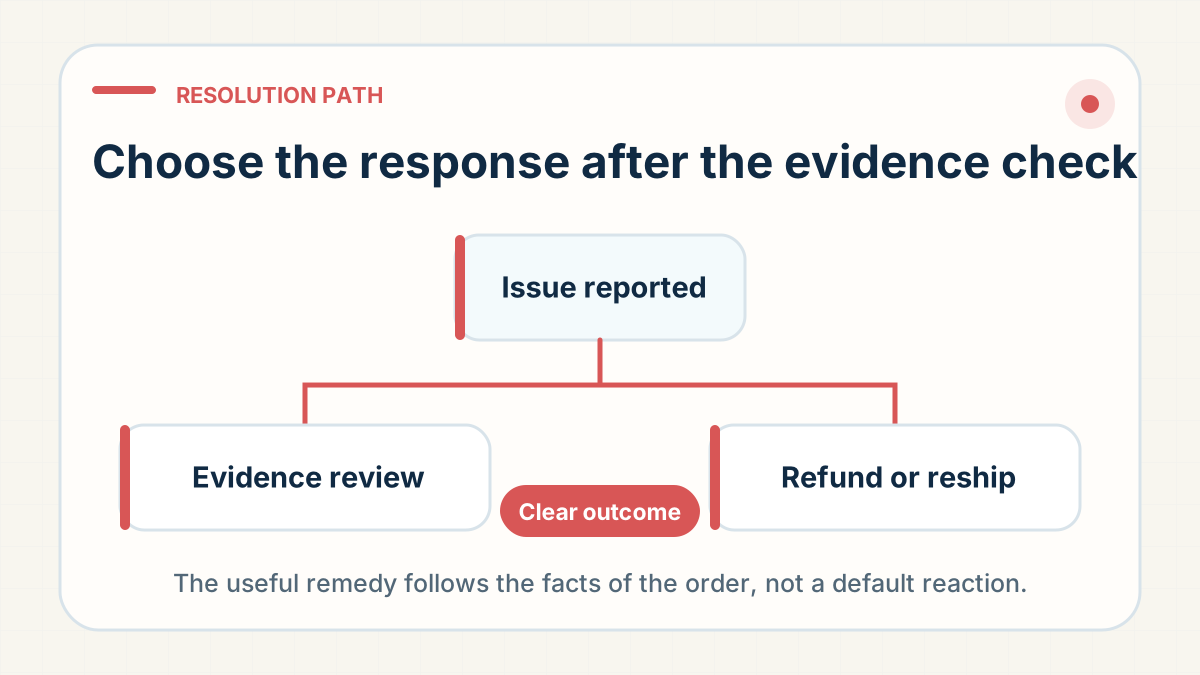
Start with urgency and reversibility
Some cases need immediate protection: a possible safety issue, a time-sensitive order, a clearly wrong item or a customer already waiting beyond a firm promise. Other cases benefit from one focused evidence request before a costly remedy is chosen. The aim is to avoid both extremes—making every customer prove too much, or reshipping repeatedly without understanding a recurring failure.
Refund when the commercial relationship should close
A refund often makes sense when the order cannot be fulfilled, the delay is no longer acceptable, the item is unsuitable and replacement adds no value, or the seller's policy and applicable consumer rules require it. For US online orders, FTC guidance requires sellers to have a reasonable basis for shipping promises and provides cancellation and refund rights when shipment is delayed; other jurisdictions differ.
Reship when a complete second parcel is the cleanest remedy
Reshipment can fit confirmed loss, an unrecoverable delivery failure, or a complete order problem where replacement parts are impractical. Before releasing it, correct the address or route issue that affected the first parcel. A reship on the same bad data or unsuitable service can repeat the failure.
When a carrier says a returned parcel is being held at an overseas warehouse, record its stated deadline for a corrected address or redelivery instruction and act before that storage window expires; the carrier's notice for that parcel controls. If the deadline or whether redelivery remains possible is unclear, keep recovery of that parcel under investigation rather than promise its redelivery; the failed-delivery guide explains the return-hub and deadline sequence.
Replace a part or unit when the failure is contained
A replacement may be better than a full reship when one component is missing or faulty, the rest of the order remains useful, and the replacement can travel safely and economically. Confirm compatibility and whether sending the part creates a confusing support burden for the customer.
Should I send a replacement, or ask the supplier first?
Ask first: the answer can be a part to buy rather than a parcel to send. Ask your partner to put the fault to the manufacturer with the photo or video and ask what the fix is and whether a part covers it. As of September 2026, on one week of fault reports here, that question changed the remedy on two of them, and on one no parcel was needed at all.
Bracket slots that looked too narrow had been tested at the factory: the screw passes with a little force, and a powered driver makes fitting much easier. A ceiling fan whose remote would not respond came back with a pairing sequence to run before anything was sent, not the new motor and remote the buyer wanted.
When a part really is needed, ask your partner to source it from the item's own factory. A module sourced elsewhere carried no compatibility guarantee; the original factory sold the same part separately, at the same quoted price, with fitting steps.
Name the failed part, not the product, and ask for the replacement to be checked against that description before it leaves: on one order a replacement described part by part still arrived with the wrong item and a blank card. Ask whether this fault has been reported on the item recently, and expect to supply a video of the fault before that question reaches the factory.
Investigate when the next fact changes the decision
- Tracking is silent but still within the normal interval for that stage.
- The cause may be product, packing, transit or setup and evidence can distinguish them.
- Several complaints may indicate a batch-level issue requiring containment.
- The requested remedy is unusually costly, irreversible or inconsistent with the evidence.
Investigation should have a deadline and owner. "Waiting for the carrier" is not a plan unless the next escalation time and fallback remedy are defined.
Use a two-loop case record
- Customer loop: issue, evidence requested, promised update, remedy and completion.
- Operations loop: SKU/version, likely cause, containment, corrective action and later effectiveness check.
CPSC guidance for regulated products highlights the value of complaint, production and quality-control records. Even for ordinary goods, structured records help reveal patterns that isolated chat messages hide.
Share case evidence securely
Send the order reference and necessary evidence through the agreed private support channel. Remove unrelated personal information and avoid posting customer addresses or tracking identifiers publicly.
Choose the remedy from cause, evidence and repeat risk
Choose the fastest fair remedy that does not hide a repeatable problem. Then close the operational loop so the next customer is less likely to need the same remedy.
The rule: Choose the customer remedy from urgency, evidence, value and the seller's stated policy, then keep the cause investigation separate. A prompt refund can be commercially right without proving fault, while a replacement should not close a repeat pattern that needs a product or packing correction.
Have a specific fulfilment question?
Send us the product, destination and order context on WhatsApp (+86 178 4666 9989), and we'll answer for that order instead of giving a generic estimate.
Ask Questions on WhatsApp →