The direct answer
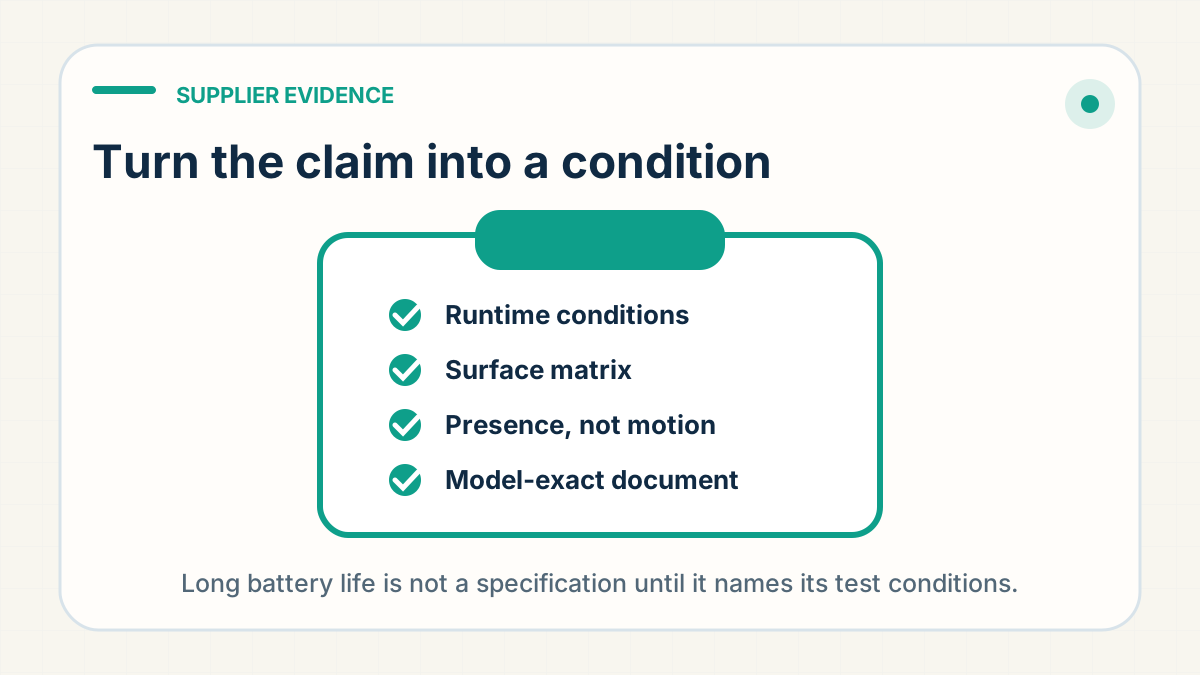
Lighting listings are unusually full of claims and unusually short on proof. Long battery life, strong magnet, bright, easy install. None of those is a spec, and you cannot check any of them when the goods arrive. The point of talking to a supplier before your first order is to turn each claim into a number with a stated test condition, so your receiving check has something it can actually fail.
Four areas cause most of what goes wrong here: the battery and how it charges, the mounting, the sensor logic, and what the certificate actually covers. Each one has a short set of questions that separates a factory with a real process from one making up an answer while you wait.
Battery and charging: the claim you have to pin down
A runtime figure means nothing without the conditions it was measured under. Never accept a headline number without them, and never repeat one on your own listing without them either, because that number becomes your promise the moment a customer reads it.
- At what brightness setting was runtime measured, and what do you get at maximum brightness, running continuously?
- How many activations a day does the figure assume, and how long is each hold time?
- At what room temperature, and what happens to the figure in a cold garage or a hot conservatory?
- How many charge cycles before capacity drops below a level you would accept, and what does the curve look like on the way down?
- What is the standby current in each mode, and how does the sensor behave as the battery runs flat?
- Is the product tested aged, or only new off the line? Complaints here cluster at several months, not on arrival.
Ask for a charge and discharge record on real production units rather than on engineering samples, and ask them to show you on video how the indicator behaves at empty, charging and full. If your customers can use the product while it charges, that needs its own functional and heat record.
Mounting: the failure nobody writes down
Adhesive and magnet failures are among the most common complaints you will get on stick-on lighting, and you can specify almost all of it in advance. The test that matters is not whether the adhesive holds. It is which surfaces it holds on, in what conditions, and for how long.
- A surface matrix covering painted wood, laminate, glass, metal, tile and the common cabinet finishes in your market, with results at 24 hours, 72 hours and after longer ageing.
- Results in cold, warm and humid conditions, not just on a comfortable factory floor.
- Magnet pull and shear force as numbers, and a demonstration that your customer can press the button without knocking the light off.
- Vertical, horizontal and underside mounting tested separately, because underside is where adhesive failures show up first.
- A written list of unsuitable surfaces and the surface prep needed, which belongs in the install guide you give customers as much as in your spec.
- Spare adhesive pads or mounting plates in the box where the format allows, which turns a return into a support reply.
Sensor behaviour: where multi-unit installs fall apart
You will get fewer sensor complaints than battery complaints, but they cost you more support time, because they come and go and customers struggle to describe them. Two questions matter more than the rest: what the sensor does when the person stops moving, and what two units do when they are installed near each other.
- Detection angle and distance mapped against stated test conditions, not a marketing cone diagram.
- Hold time and reset behaviour, and whether the setting survives a power cycle.
- The daylight level at which the light refuses to come on, measured with a meter.
- Behaviour when someone is present but still, rather than moving repeatedly. A passive infrared sensor picks up change in infrared energy from a moving warm body, so a person who keeps still can be read as absent. This is the single most common design complaint you will see about infrared sensing.
- Interference between units next to each other, tested as a multi-unit install rather than on one sample.
- Whether the sensor is genuinely passive infrared or a radar type. This matters to your costs as well as your product: a radar or millimetre-wave sensor is a transmitter and carries radio certification duties per model, and it can trigger through a cabinet panel, which in a wardrobe light is a fault rather than a feature.
Certificates: what they cover, not whether they exist
A serious buyer does not ask whether the factory has CE. Conformity marking belongs to a product, not to a factory, so a factory-level answer tells you nothing. The questions worth asking are narrower and much harder to answer vaguely.
- Exactly which model number, and does it match the item you are buying rather than a sibling in the same family?
- Which legal entity is named as applicant or manufacturer on the document?
- Which market, which directive or standard, and which report or certificate number?
- Which laboratory issued it, on what date, and valid for how long?
- Does changing the battery, printed circuit board, radio module or housing change what it covers?
A report for a related model is a lead for you to chase, not evidence for the item in front of you. Why factories often release documents only once you place a qualifying order is covered in why product certificates come with an MOQ.
The 2027 rule that changes rechargeable lighting design
If you sell into the EU, one coming requirement should shape what you order now rather than in two years. The EU Batteries Regulation requires portable batteries built into products to be readily removable and replaceable by the end user, applying from 18 February 2027, with a list of exceptions where replacement by an independent professional is enough instead.
The Commission adopted a delegated act on 14 July 2026 setting out that exception list. On the text as adopted, lighting does not appear on it. Read plainly, that means a glued, sealed rechargeable LED light would not be compliant for the EU market from that date, and that a removable battery door is a design requirement rather than a premium feature you can charge for. A separate duty requires portable batteries to stay available as spare parts at a reasonable price for at least five years after the last unit is placed on the market.
Give your factory this as a design instruction now, because the tooling you pay for today will still be running in 2027. Confirm the final published text before you rely on it commercially: the delegated act comes into force twenty days after publication in the Official Journal, and scope questions for your specific product need qualified compliance review. This is orientation, not legal advice.
Ten signs that a lighting factory has no process
These are the patterns that most reliably tell you an order is going to be difficult. None of them is disqualifying on its own. Three or more together usually means you will be having the quality conversation after production rather than before it.
- A wall of certificate logos with nothing mapping any document to any model number.
- Minimum order quantity and lead times that only emerge after you have asked several times.
- Model numbers that do not match between the catalogue, the quotation and the certificate.
- Battery life claims with no stated test basis.
- No word on which surfaces the product should not be stuck to.
- Quotations that are slow, partial, or that answer a different spec from the one you sent.
- Marketplace-style graphics sent to you instead of technical data you can buy from.
- Unclear limits on packaging and customisation.
- No golden-sample step and no change control, so a later batch can differ with no record of why.
- After-sales replacement handled as a fresh negotiation every time rather than as a stated process.
What customers actually complain about
Across published customer reviews of rechargeable sensor cabinet lighting, the recurring themes rank in a consistent order: battery, charging and long-term electrical durability first, by a clear margin; then adhesive or magnet failure; then units arriving dead or dying early; then brightness that is not enough for the job or that fades; then sensor timing and interference; then missing cables or accessories.
That ordering comes from a small sample of review texts across a handful of brands, gathered to find themes rather than to measure rates. Use it to decide what to specify and test. It is not a failure rate. It does not tell you how often any of these happen in production, and you should not quote it as though it does.
What we can set up for you
We can turn this into the pre-production checks for your product: a sourcing brief that states test conditions rather than claims, sample and golden-sample criteria, a record of the version you approved so a later batch can be checked against your first one, receiving checks written against your spec, and a route and paperwork check on your exact product. You keep the commercial calls. Contact RyanFulfil with the product and the target market when those checks have to happen China-side.
What these numbers cannot tell you
Sources as of 30 August 2026. The summary of the rules reflects published EU texts current at that date, including a delegated act adopted but not yet published in the Official Journal, and it is orientation rather than compliance advice for your product. The checklist is a starting product brief, not a complete test plan for a regulated product, and it does not guarantee product quality.
The complaint ordering comes from a small sample of public review text and identifies themes only. It does not measure failure rates, rank brands, establish the quality of any competitor product, or provide marketplace ratings, review counts or sales estimates.
Re-read this guide when the delegated act is published in final form, and whenever your supplier changes cell, module, housing or certificate. Recheck the 2027 design instruction when the final exception list is published: if lighting appears on that list, the instruction no longer applies, while the rest of the guide stands.
Want a product checked before it ships?
Tell us what to check on WhatsApp (+86 178 4666 9989), and we can build those product, packaging and quantity checks into the fulfilment process.
Request Quality Check on WhatsApp →