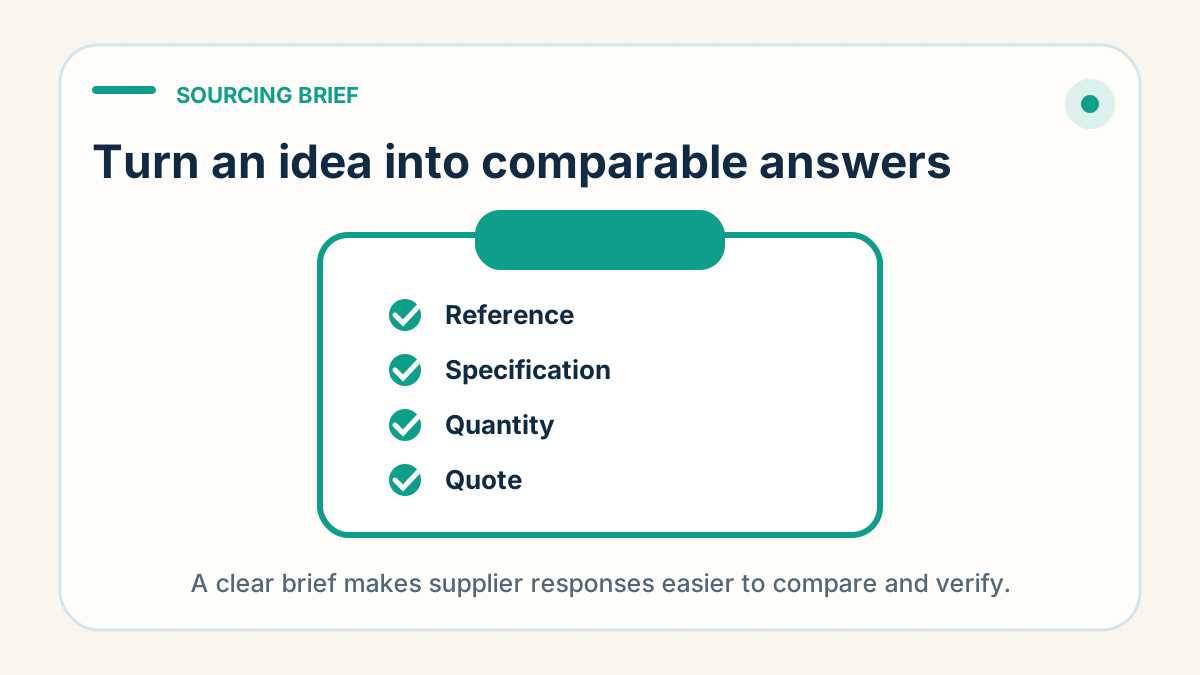
The brief is a decision tool, not a long description
A weak sourcing request asks for a product and a price. A useful brief defines what the seller is trying to decide, which product facts affect that decision, and what evidence would make an option acceptable. The goal is not to make the document impressive. It is to help different suppliers quote the same scope so their answers can be compared.
Begin with the commercial stage. A seller testing demand may prioritise low commitment, a simple package and a fast sample. A seller replenishing a proven item may care more about version consistency, lead time and batch-level evidence. The same product can require a different sourcing approach at each stage.
Give the product a testable identity
Supplier listing titles are not specifications. Record the broad product type, intended use, target customer and exact variant. Then define the attributes a receiving or QC team could observe rather than relying on words such as premium, sturdy or high quality.
- Material or composition, including any material that must not be substituted.
- Dimensions, tolerances, weight and capacity where they matter to fit, function or shipping.
- Colour, finish, construction, included components and compatibility.
- Performance or appearance checks that determine whether the item is acceptable.
- Packaging, labelling, barcode, insert and country-of-origin requirements.
If a regulated claim, certification or test matters, name the exact model and destination market. A report for a related model is a lead to investigate, not automatic evidence for the item being sourced.
Separate targets from non-negotiables
A target is something to optimise: unit cost, delivery window, minimum order or packaging level. A non-negotiable is something that makes the product unsuitable if missed: a dimension, material, compatibility requirement, safety requirement or brand detail. Labelling everything as mandatory gives a supplier no room to propose a better trade-off; labelling nothing as mandatory invites silent substitutions.
For a test-stage request, record two different stock facts: how many units are available now for individual fulfilment, by required variant, and the supplier's replenishment MOQ and lead time once those units are gone. A low one-unit quote is not enough if the available stock cannot support the test you need or the next replenishment requires a commitment you would not make; treat that as a sourcing constraint before listing.
Define the unit being quoted
Write whether one unit means one piece, one pair, one set or one customer-ready parcel. List every included component and ask for product cost, setup cost, sample cost, packaging, domestic movement and international fulfilment separately where possible. That prevents a low unit price from being compared with an all-in quote.
Ask for evidence in stages
Do not request every possible document before confirming that the option is commercially plausible. First screen the supplier and product. Then ask for current actual photos, measurements or a short functional video. Use a physical sample when feel, fit, construction, colour or function cannot be approved responsibly from media.
Use this one-page structure
- Decision: what this sourcing exercise must help you choose.
- Product: category, use, variant and complete unit of sale.
- Must match: measurable or observable non-negotiables.
- Targets: price, quantity, lead time, packaging and destination.
- Stock and replenishment: units available now for individual fulfilment by variant, plus the next MOQ and replenishment lead time.
- Evidence: actual photos, measurements, sample, report or production confirmation.
- Response format: quote scope, assumptions, exclusions and next verification step.
How to compare the replies
Place each answer against the same brief. Mark confirmed, differs and not yet verified. A supplier that says "yes" to everything without clarifying the model or scope is not necessarily stronger than one that identifies a real constraint. The most useful reply makes the trade-offs and next check visible.
What if all I have is a photo or a video?
Send it anyway, and send three things with it: where the image came from, the country you are selling into, and the variant or size you intend to list. A picture is enough to start an image search and it is often all a seller has, but it cannot carry the attributes that decide the price, so the search returns a candidate rather than a confirmation. The identity checks earlier in this brief — dimensions, material, variant, included components — are exactly what a factory quotes against, and exactly what a photograph leaves out.
Where the image came from is the most useful of the three and the one sellers most often omit. A still from an advertisement, a marketplace listing and a product page each leave a different trail back to something sourceable, and when a link is dead or was never copied, that trail is what remains to search on. Across this desk's sourcing conversations in August 2026, images arriving with nothing behind them were an ordinary daily occurrence rather than an edge case, and the request that moved those threads on was rarely a second demand for a link.
A short-form video is a picture you have to freeze first. A clip carries motion and context but no size, no material and no variant, so what makes it quotable is one clear still frame plus the two or three attributes that decide the build. Sending the clip alone asks a sourcing team to guess which frame you meant and which of the products in it you want.
Expect the honest outcome to be a near match, declared as one. When the exact item cannot be found from a reference image, a substitute should arrive labelled as a substitute with the difference named, and the material is the difference that most often matters and is least visible in a photograph. Ask what it is made of before you reuse the original listing copy — exact product vs similar alternative sets out how to approve one properly.
One caution on the source. A photograph taken from another seller's storefront shows you the look, not the licence: if the design carries someone else's mark or artwork, the sourcing question stops being whether it can be found and becomes whether it can be sold at all. Screen that before the brief goes out, not after a quote comes back.
What if no factory makes it yet, or only with a change?
Then you are commissioning a product, not sourcing one. The request becomes a custom run, priced in stages: the factory needs the design before it will develop a sample, and the bulk price and the shipping cost often wait on that sample. In late September 2026, custom-run minimums quoted to this desk ran from the low hundreds per colour to four figures per design.
A concept render or a photo set is not a design. For a range drawn as AI renders, factories needed front, back and side views, dimensions, colour references and the attachment and label positions before pattern making. The design files are your input.
When the must-have needs an existing model changed, such as a replaceable part or a personal name, ask for the existing model first and the change priced on its own lines: whether a mould or design change is needed, the tooling or development cost, the changed version's minimum, a separate part's minimum and price, and any minimum or setup cost for the name. Both change requests were queued for factories over the October closure, unanswered by 2 October; hold the listing until each line comes back in writing.
A size the factory does not make is the same decision: a missing size is a production run. Once the files exist, the factory quotes a development sample; how a sample order works before you commit sets out what that charge covers.
Write the brief that produces comparable answers
A sourcing brief is successful when it produces comparable answers and a smaller decision. It should tell you what to sample, what to verify, or why an option should be rejected—not merely generate more links.
Demand check · public sourcing communities
What 679 supplier requests actually contained
Between 7 July and 30 September 2026, our desk collected 679 distinct supplier requests from public dropshipping sourcing communities. Only 179 (26%) pointed at an exact product, and 187 (28%) named no product at all. And 260 (38%) gave no destination. Just 33 (5%) named a product, a destination and a volume together — the minimum a supplier needs to quote.
Deadlines were stated far more often than volumes. Of the 679, 190 (28%) set a delivery cap or asked for fast shipping, while only 49 stated a volume. A deadline with no product, market or quantity tells a supplier when, but not what, to price.
Test your own request before you post it. Does it name the product, the destination, the volume and the delivery window? Fill any gap using the brief on this page, so every supplier prices the same request on the same terms.
Where these numbers come from: we counted 679 distinct supplier-request posts in public dropshipping sourcing communities between 7 July and 30 September 2026 (805 collected before reposts and non-requests were excluded). We classified each post twice, independently, against fixed definitions, and a further reading settled any disagreement, so the counts understate unclear wording rather than inflate it. This page quotes, links and identifies no post and reproduces no contact details. Private client conversations are excluded. See the full breakdown in the Q3 2026 demand analysis.
The rule: Write the brief around the exact customer-ready version and the decision the quote must support. Separate fixed requirements from preferences, include destination and packing implications, and require suppliers to state deviations instead of hiding them inside a headline price.
Need a product checked before you spend on ads?
Send us the product link and destination on WhatsApp (+86 178 4666 9989). We'll check sourcing, packing and shipping with you before you commit.
Get Sourcing Quote on WhatsApp →