The next winner may look too small in a trend tool
Broad popularity makes a product easy to notice and easy to copy. Specific intent asks a harder question: can one exact product resolve a detailed need better than the generic alternatives? Shopify reported that 75% of AI-attributed purchases in Q2 2026 came from outside its top 100 product categories. That does not prove obscure products are automatic winners. It suggests relevance deserves its own score beside popularity.
Traditional product research often begins with visible momentum - ad volume, marketplace order counts, search demand or creator reach. Keep those signals. Add a specific-intent test that asks whether a buyer can describe a narrow problem, audience and set of constraints that the exact product resolves. The goal is not to avoid competition at any cost. It is to find demand where relevance can matter more than broad popularity.
Use four gates, because one zero can kill the product
A useful shorthand is: specific-intent opportunity = problem evidence × constraint fit × proofability × delivered contribution. This is a decision model, not a statistical formula. Its value is that a very high score cannot rescue a zero. Search demand cannot rescue the wrong dimensions. A perfect sample cannot rescue no buyer problem. Strong conversion cannot rescue a parcel that loses money after fulfilment.
- Problem evidence: buyers already describe the problem, workaround or failed alternative in observable language.
- Constraint fit: the exact product satisfies the size, material, compatibility, capacity or use environment that changes the decision.
- Proofability: the supplier and sample can verify the attributes the page and creative will claim.
- Delivered contribution: the customer-ready pack, route and expected exception cost leave room after acquisition.
A product that looks small in a trend tool can pass all four gates. A viral product can fail three of them. That is the difference between overlooked demand and merely obscure inventory.
Write the buyer-intent sentence
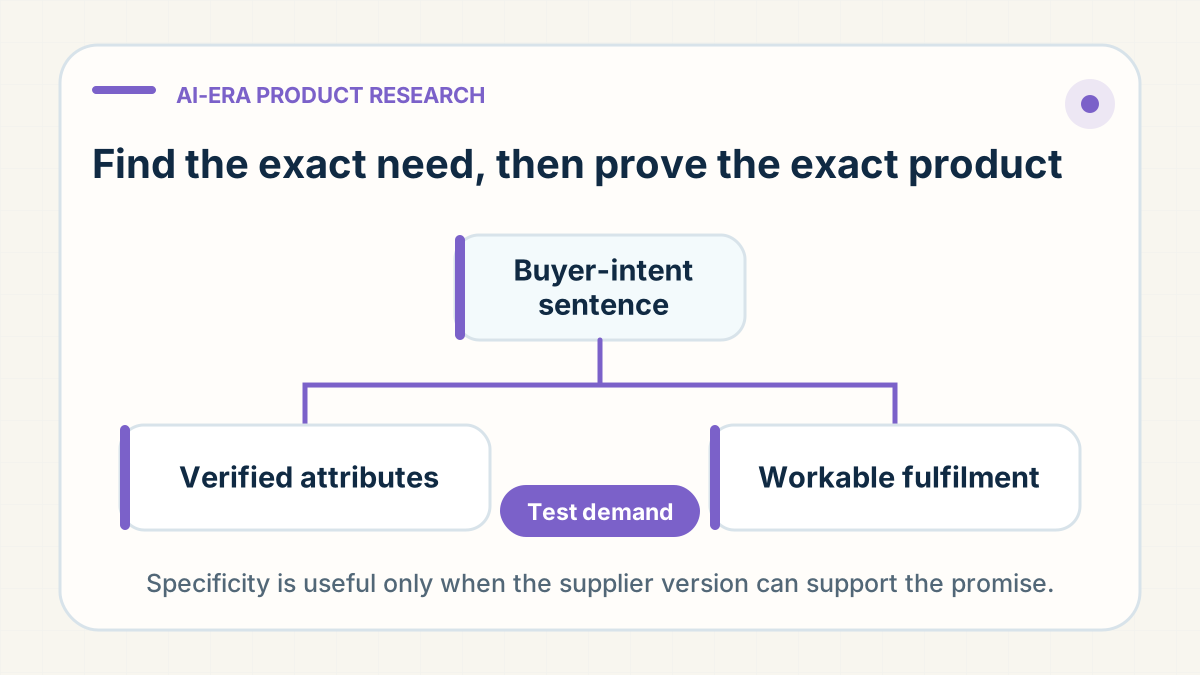
Before opening a supplier marketplace, complete one sentence: This is for a person who needs a product to do what, under which conditions, without which common problem? If the sentence remains broad enough to fit hundreds of unrelated products, the research is not yet specific.
A storage accessory, for example, becomes more useful to research when the intended shelf depth, item type, access problem and available space are known. A travel organiser becomes more specific when the exact device, cable arrangement, bag size and use environment are named. Specificity should describe genuine product fit, not a fictional marketing persona.
- Customer: who experiences the problem?
- Job: what must the product enable or prevent?
- Environment: where and how will it be used?
- Constraints: dimensions, compatibility, material, capacity or care requirements.
- Exclusions: who should not buy it, and when will it not work?
Score constraint density
A useful specific-intent product has several observable constraints that change the buying decision. Size, fit, compatibility, construction, use environment and included components can all matter. More constraints are not automatically better; they are valuable only when the product satisfies them and the seller can prove it.
Reject false specificity. Adding niche adjectives to a generic item does not create a defensible match. If the supplier cannot confirm the dimensions, material or compatibility behind the claim, the page becomes more precise while the product remains unknown. That increases refund and complaint risk.
Check whether the attributes are verifiable
Turn every important attribute into an evidence request. Use current actual photos for appearance, measurements for fit, a sample for feel and construction, a functional check for performance, and model-matched documents where a regulated claim applies. Supplier listing text is a lead; it is not the final product record.
- Can the supplier identify the exact model and variant consistently?
- Can the dimensions and materials be checked on the customer-ready unit?
- Can compatibility be tested rather than inferred from a title?
- Will a sample reveal the feature that makes the product specifically useful?
- Can a later reorder be tied to the same approved version?
Do not choose unsafe, regulated or high-liability products merely because their constraints create strong search intent. Compliance, claims, age suitability, batteries, liquids and other route or safety questions still need specialist review for the actual product and destination.
Add the fulfilment gate before the demand test
A product can be highly relevant and still be a poor dropshipping item. Check packed dimensions, chargeable weight, fragility, restricted components, supplier preparation time, route eligibility and realistic delivery before treating discovery as a commercial opportunity. AI can match a buyer to the right item and still expose the store to an unworkable margin or delivery promise.
Request the customer-ready packed unit, not only catalogue weight. Include every accessory, insert, gift, protective layer and branded component. Then compare the landed cost and delivery range with the price and promise the market can support.
Use demonstration as a separate score
Specific-intent matchability and creative potential are related but different. A product may answer a narrow need while being difficult to demonstrate. Another may be visually obvious but solve no durable problem. Score both.
A useful creative test can show the problem, the constraint and the result in a short sequence. Dimensions can be demonstrated against a real space. Compatibility can be shown on the intended model. Organisation can be shown before and after. The creative should prove the same attribute the product page claims, not introduce a different promise the sample has never been checked against.
Build the product page as a standalone answer
Shopify said half of AI-referred sessions landed directly on a product-description page. Assume the visitor may never see the homepage. The page should answer the buyer-intent sentence and make the evidence easy to inspect.
- A title that identifies the product and meaningful variant without stuffing every use case.
- A first image or demonstration that makes the central fit or function visible.
- Exact dimensions, materials, compatibility, capacity and included components.
- Clear differences between variants and stable SKUs for the versions fulfilment must distinguish.
- Who it is for, who it is not for and the limitation most likely to cause a return.
- Realistic delivery, tracking, return and support information for the target market.
Keep those facts aligned with the approved sample and warehouse record. AI readability is not created by long copy alone. Consistency across the product title, variant, image, specification, inventory and physical unit is more valuable than a polished paragraph describing a version that no longer ships.
September 2026: product truth is becoming acquisition infrastructure
On 16 September 2026, Google described more product-discovery and checkout activity around Merchant Center data, conversational product assistance, YouTube and its Universal Commerce Protocol. Its update also reported that merchants following core feed best practices saw an average 5% conversion increase in the following month, while conversational attributes appeared in 50% of relevant AI Mode recommendations in a lululemon example. Read the Google Shopping update as platform-reported evidence that product data can affect discovery and conversion surfaces, not as a traffic or sales forecast for an independent store.
OpenAI also announced on 16 September that it was testing Sponsored Agents and adding AI advertising tools with Shopify and HubSpot integrations. Its advertising update is an announcement about a changing surface and availability, not proof that a particular product will be recommended, clicked or purchased.
The practical change is in the handoff. A product record may now be read by a discovery system, a product page, a checkout surface and a fulfilment workflow. Treat that record as acquisition infrastructure: if the feed says one version, the page implies another and the warehouse ships a third, better distribution only makes the mismatch travel faster.
Run a product-truth handoff before you test visibility
- Identity: exact supplier, model, variant, SKU and approved sample are named consistently.
- Attributes: dimensions, material, compatibility, capacity, included components and important limitations are evidenced on the customer-ready version.
- Media: current photos or demonstrations show the same version that the page and feed describe.
- Availability: stock state, replenishment lead time, route eligibility and delivery range are current for the market being tested.
- Commerce: price, payment, returns and support terms do not conflict between the feed, product page, checkout and order record.
If one of those fields is unknown, mark it unresolved and narrow the test. Do not fill an evidence gap with better copy. The buyer may discover the item through a new surface, but the return will still arrive through the old physical one.
Measure the mechanism, not the headline
Use three approved SKUs for a small controlled test. Record the market, version, feed and page changes, then track any available AI or assisted referral signal alongside product-page sessions, add-to-carts, paid orders, delivered orders, refunds and contribution. Keep the denominator visible and compare like with like over a defined window. A platform-wide conversion figure or a company example cannot be pasted into a store forecast.
The test is useful even when it finds no measurable lift. It can show that the feed was incomplete, that a product-page claim did not survive direct entry, that the route or margin failed, or that the store has too little traffic to distinguish a channel effect. Those are product-research findings, not reasons to declare AI visibility a winner or a failure after one day.
Keep classic demand validation
The Shopify result is an early channel signal, not permission to skip the market. Continue checking search behaviour, competitor offers, ad libraries, comments, creator content, marketplace reviews and small paid tests. Look for the language customers use when generic alternatives fail; that language often contains the constraints a product page needs to answer.
Do not interpret a lack of trend data as hidden opportunity by default. A product can be obscure because demand is weak. The strongest candidate has both: evidence that people experience the problem and a defensible reason this exact version matches it better.
Run a two-stage test
Stage one tests the promise. Approve one exact sample, build one specific product page and create several demonstrations around the same verified attribute. Use a controlled advertising or audience test to learn whether the problem and offer attract attention.
Stage two tests the operation. Place a controlled live order through the actual Shopify flow. Verify variant mapping, address data, hold or cancellation behaviour, warehouse release, tracking return, delivery range and customer notification. A product has not passed because the ad received clicks; the commercial and physical paths both have to work.
Use a decision record, not a winning-product label
For each candidate, record the buyer-intent sentence, demand evidence, verified attributes, unresolved claims, sample result, packed economics, route, creative angles and test outcome. Finish with one of four decisions: reject, investigate, test or scale. This keeps a popular item from bypassing product control and stops an interesting niche from being promoted before it has evidence.
If a supplier, material, dimension or component changes, reopen the affected decision. Specific-intent positioning makes product drift more dangerous because the store has promised a tighter fit. Version control is therefore part of marketing accuracy, not only warehouse administration.
Use AI to narrow the test, not declare the winner
AI-era product research does not replace demand research. It adds a relevance question: can an exact, verifiable product satisfy a detailed buyer need that generic popularity signals overlook? The best candidate combines real problem evidence, defensible attributes, workable fulfilment, demonstrable creative and a product page that can stand on its own.
A smaller audience with an exact problem can be more valuable than a broad audience with mild interest. But specificity without proof is not positioning. It is a more precise refund reason.
What these figures can and cannot show
The Shopify AI-attribution, landing-page and Catalog figures are company-reported Q2 2026 metrics. Shopify did not publish all denominators or attribution details and said agentic volume remained small relative to total GMV. Use the sourcing, sampling, product-version and fulfilment steps above as a planning checklist, not as a guarantee of AI placement, traffic or sales.
Need a product checked before you spend on ads?
Send us the product link and destination on WhatsApp (+86 178 4666 9989). We'll check sourcing, packing and shipping with you before you commit.
Get Sourcing Quote on WhatsApp →