Back to blog
Sourcing Tips

The Long Tail Is a Tax: When to Kill a Dropshipping SKU

12 min read
The long tail is not free. Keep strategic tail. Sunset debt with evidence.

Make each SKU earn its place

Do not kill a product because it sells little, and do not keep it because it sells something. Name the job it does for you first. Then work out what it keeps once shipping, refunds and the late problems are in, charge it for the mess it makes, and separate a tail your supplier holds from stock you paid for. Freeze it before you delete it when you are not sure what it does for search, fit, trust, bundles or support. Then look at the result at 4, 8 and 13 weeks.

The goal is not the shortest product list. It is a list where every product, size and bundle either earns you something you can measure, does a job you can name, or has a date on which it leaves.

This is wider than planning the rows inside one multi-size product. A size and colour grid asks which exact size or colour deserves stock. This guide asks why each product is still on your site at all, what it costs you across the whole shop, and what would make you freeze it, archive it, bundle it, restock it or bring it back.

Your supplier holding the stock does not make the long tail free

A product you buy per order keeps most of your cash out of the shelf. It does not keep your time out of anything else. You still maintain the page, decide the photos, chase availability, catch version changes, map the sizes, write the check list, redo the packed cost, confirm the route, review the claims, teach support, set the refund rule and read the result. A forgotten test can keep costing you all of that for months after the idea behind it failed.

  • Bought per order: almost no cash on the shelf, but the same work on data, supplier, version, checks, route, rules, support and reporting.
  • Held in China: all of the above plus cash tied up, storage, a lopsided size mix, reorder mistakes and a problem getting out.
  • Held in the country you sell to: local stock, local fees and paperwork, markdowns and the risk of being stuck with it. It needs strong sales in that one market and a delivery or conversion gain you can actually see.
  • Your own label or custom made: MOQ, packaging, artwork, change control, rights evidence and write-off risk. It needs a customer job that will last and a planned way out.

Call the pile-up catalogue debt: products whose job and earnings no longer cover the cost and risk they create. The word that matters is measure. A spare part that sells twice a month but saves you full refunds can be worth every minute. A product with good revenue that keeps money for nobody, gets reshipped and jams your routes is debt.

What the 26 August company results do—and do not—prove

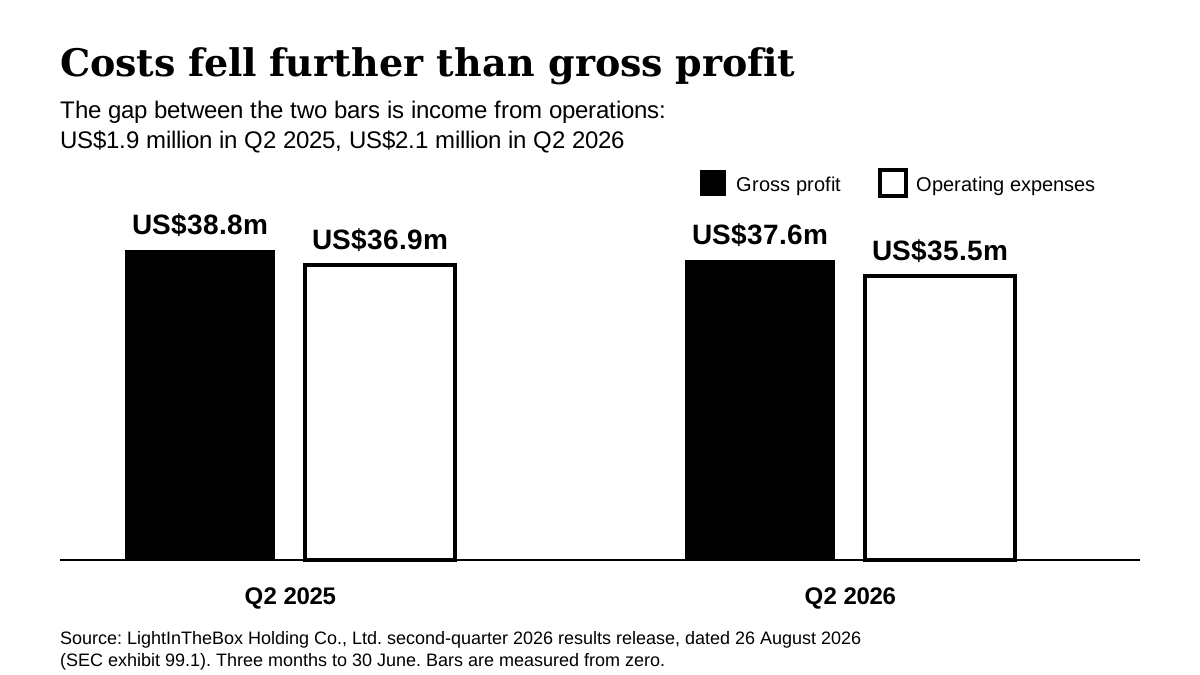
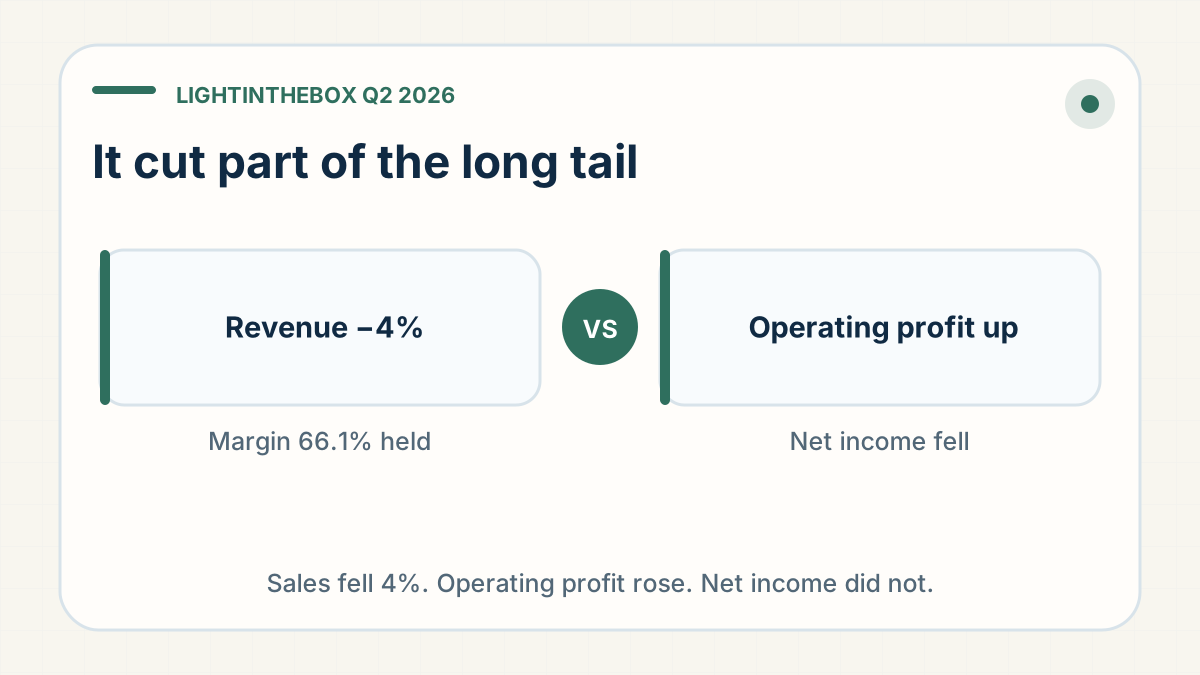
LightInTheBox said it phased out long-tail products while working on its product mix. Its Q2 revenue fell from US$58.882 million to US$56.815 million, a 3.5% drop on exact arithmetic, while operating income rose from US$2.770 million to US$3.012 million, an 8.7% rise. That is useful: less revenue can sit alongside lower costs and a better operating profit.

It does not prove that pruning fixed the business. Quarterly net income and adjusted EBITDA fell, cash fell 32.4% from the year-end, inventory rose and money was still tight. Lanvin gives the same warning from a different kind of business: revenue and store count fell while gross margin and the loss both moved the right way, yet adjusted EBITDA margin stayed at negative 34.3% and EUR47.8 million of cash still went out of the door.

Retail stores are not dropshipping SKUs, and a public filing never tells you which exact products came off the shelf or what they were doing for the rest of the range. What you can take is the test, not the action: falling revenue is healthy only when the money you keep, your cash, your customers and your spread of sales all hold up.

Look at the size of the number and the way it is moving

Put every product you are thinking about into one of four boxes. Strong and getting better can grow, as long as you are not betting the shop on it. Strong and getting worse needs a look now, before the profit goes. Weak but getting better is a repair job with steps, a budget and a kill date. Weak and getting worse is an exit, or at least a much smaller bet.

A percentage can improve while the business behind it is still too small or too hungry for cash to pay anyone. The other way round, falling revenue can be healthy when the money you keep goes up, cash comes back faster, old stock clears, customers get a better result and the shop gets easier to run. Write down both the size of the number and which way it is going at 4, 8 and 13 weeks. Never pick one because it tells the nicer story.

The sunset loop: name the exact product and where its stock sits, prove what it does and what it keeps, freeze new spending before you delete anything, clear what you still owe customers, pick a way out, and check both the size and the direction at 4, 8 and 13 weeks.

Keep one-offs out of the product decision

Three US retailers reported on the same day and show how easily a margin headline can be driven by cash that had nothing to do with better products. Abercrombie & Fitch said a US$100 million tariff refund added 790 basis points to its 19.9% operating margin. That refund was 39.6% of the US$252.7 million operating income it reported. Take it straight out and you are left with US$152.7 million and a 12.1% margin. That subtraction is ours, not a number the company reported.

Kohl's reported gross margin up 305 basis points and said US$100 million of tariff refunds ran through gross margin. US$100 million divided by US$3.318 billion of sales is about 301 basis points, which explains nearly the whole rise on its own. Bath & Body Works reported US$225 million of adjusted operating income including about US$80 million of refunds: 35.6% of the total. Take the refunds out and you get US$145 million, 15.7% below the year before.

The refunds are real cash. Pretending they never arrived would make the business look tighter than it is. Keep three views instead: what was reported, what the products actually do week in week out, and what cash turned up and where it went. Carrier credits, platform reimbursements, insurance payouts, grants, settlements and tax refunds all deserve the same treatment. None of them is a reason to buy more stock of anything.

Keep three views apart: what was reported, what your products repeatably earn, and one-off cash, so a refund or a credit never talks you into scaling a product.

Give every product a job before you give it a rule

A blanket "delete after 90 days" is easy to run and easy to get wrong. Give every product one main job and at most one side job. "Might be useful later" is not a job.

  • Hero: the one your customer came for, and the one that keeps you the most money. Protect the version, the stock, the proof and the route.
  • Brings people in: wins you a new customer at a price you can live with. Judge it on what that customer does next, not on the first order alone.
  • Goes with it: finishes the job or earns you extra on the same order. Watch attach rate, packed cost and the refunds that only bundles cause, not the average order value.
  • Makes the hero easier to buy: completes a size range, proves you are real or saves a support message. Keep it while it earns more than the mess it makes.
  • Seasonal or a test: gives people a reason to come back, or answers one question. It needs a date, a limit and a stop rule written before you launch.
  • Spare or service part: stops a full refund, closes a ticket or protects something the customer already owns. Value it on the loss it prevents.
  • Dead weight: no job you can name and nothing left once you count the work. Freeze the spending and plan the way out.

The most likely other explanation for weak sales is that people could not see it or could not buy it. It may have been out of stock, buried in the menu, mapped to the wrong size, shown with old proof, priced differently or left out of your ads. A product cannot prove anything while customers cannot properly find it or buy it.

Work out what a product really keeps

Start with the money left once the order has settled: delivered, not refunded, minus the product, the checks, the packing, the shipping, the payment fee, the ads, the reships, the chargebacks and the support it caused. Then take off what it costs you to carry it at all.

  • What a product really keeps = money left after the order settles − page and data upkeep − supplier, version and checking time − route and paperwork time − the cash it ties up and the stock you may write off.

Take a made-up product with US$1,800 left over 90 days. Knock off US$320 of page and data upkeep, US$210 of supplier and checking work, US$90 of route and paperwork review and US$240 for cash tied up and stock going stale, and you are down to US$940. Those costs are not a rule for your shop. The point is that a healthy gross margin does not settle the keep-or-kill question on its own.

Score it to start the argument, not to end it

A simple 0 to 100 score can make the hidden costs something you can talk about. Weight the weak earnings, the supplier and version wobble, how old the stock is, returns and support, page and data upkeep, awkward packing, route and paperwork risk, broken codes and the absence of any halo. A high score means freeze and look, long before it means delete. The score is there to start a conversation, not to be right, and a one-page checklist does the same job for a small shop.

  • Low: the job and the money are clear. Protect it or grow it, as long as you are not betting everything on it.
  • Watch: fix the missing evidence, the stale proof, the supplier mapping or the complexity you could just remove.
  • Freeze: stop the ads, the purchase orders, the custom packaging, the new photos and the automatic reordering while you test the job.
  • Sunset: it goes, unless somebody writes down why it stays and accepts a date to look again.

Run a freeze-before-delete sunset

  • Name the exact product, the version you approved, the sizes, the bundle parts, the suppliers, the countries, the routes and every place stock sits.
  • Name the job and the number that proves it. If nobody can, treat it as dead weight until somebody does.
  • Freeze new spending. Keep the page up for now when you are unsure what it does for search, fit, trust, bundles or support.
  • Clear the open orders, returns, warranties, spare-part promises, chargebacks, bundles and stock ownership before you touch the listing.
  • Pick the way out: let it sell through, put it in a bundle that still pays, mark it down, send it back to the supplier for credit, move it to another market you have approved, donate or dispose of it lawfully, then archive or delete.
  • At 4, 8 and 13 weeks, look at the money you kept, hero conversion, attach rate, search and AI traffic, refunds, support load, cash back in your hands, how spread out your sales are, and how much of your week the product was taking.
  • Write down what you learned and what would bring it back. If you run several stores, do not relaunch the same failed product under a new name unless the idea, the version, the market or the operation has actually changed.

What to do at your stage

  • Testing: launch fewer, clearer ideas, buy per order where you can, and write the stop rule before the listing becomes permanent.
  • First real volume: give every product a job, tie settled outcomes back to the exact product, and stop paying for ads on anything with no job.
  • Established winner: keep your core, your add-ons, your strategic tail and your dead weight apart. Concentrate the stock you pay for and buy the uncertain tail per order.
  • Several stores: keep one shared product list and one graveyard, so supplier research and past failures travel between stores even though demand does not.

Where RyanFulfil fits

We can hold the China-side facts this decision needs: your store SKU, the supplier and the version you approved; whether the tail is bought per order, held in Guangzhou or stocked in your market; what it really costs packed and handled; the supplier changes and checks behind it; the route problems; and what stock or open promises are left before you close it down.

That does not make us your finance or buying department. You own the product, the price, the ads, the job you give each product and the final keep-or-kill call. Use the exact-product landed-price quote and supplier-change control to keep the operating record attached to the right product.

What this does not prove, and when to read it again

Last verified 26 August 2026 against the official results releases and the research pack behind them. What a listed company did to its own range shows you how something can work; it is not an experiment run on a store like yours. The privacy-safe RyanFulfil portfolio review covered 145,005 unique store-orders from 1 May to 14 August 2026, but it has no full list of live products and no settled cost, refund, chargeback, support, search and halo numbers per product. It cannot set a no-sale window, a product count, a profit floor or a score to delete at.

Read this again when one of the sources is corrected or restated, when a product you froze reaches its 13-week review, or when we can join live products to settled money without exposing anyone. Here is how you would prove us wrong: find a product whose named job, plus the money it keeps once everything has settled, beats what it costs you to carry, again and again. Until you have run that test, freeze and measure instead of deleting on a slogan.

Need a product checked before you spend on ads?

Send us the product link and destination on WhatsApp (+86 178 4666 9989). We will help you assess sourcing, packing and shipping before you commit.

Get Sourcing Quote on WhatsApp →