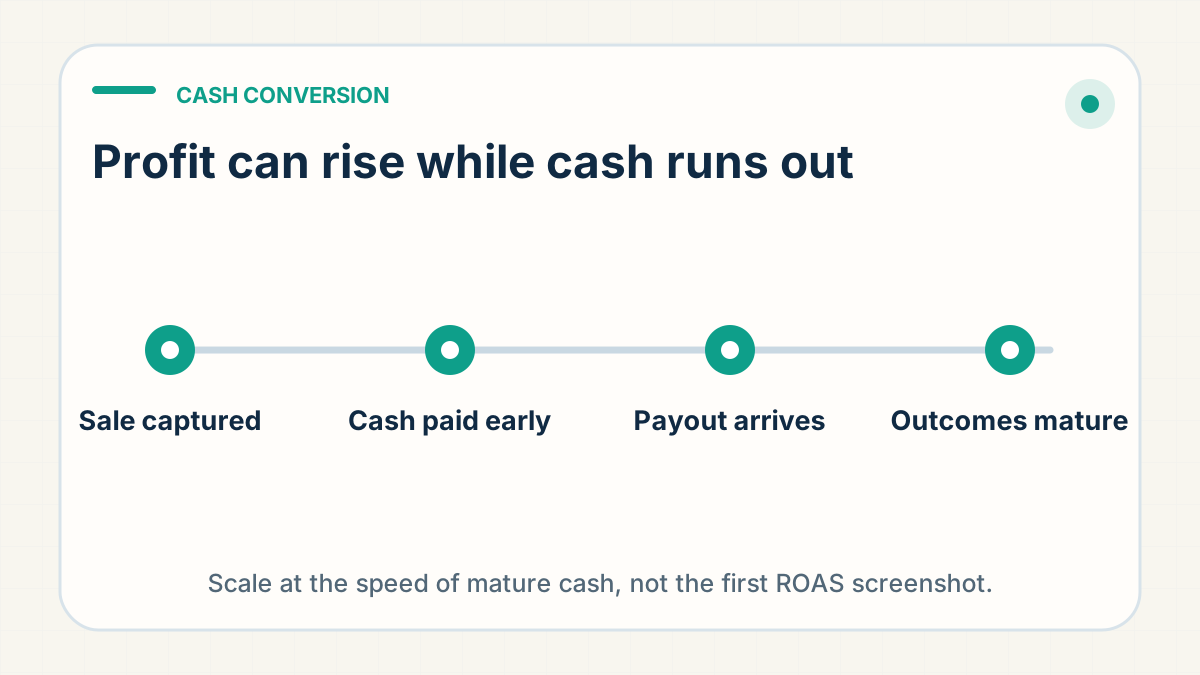
Scale at the speed of settled cash
Your store can make money on paper and still run out of cash. One order turns into a sale, then into profit, then into money you can spend, and those three things happen on three different dates. Ads, supplier bills, packing, shipping and stock deposits go out first. The payout lands later. Refunds, reships and chargebacks land last, often weeks after your dashboard called the campaign a winner. You do not fail on the final numbers. You fail in the gap.
The sales you captured are not cash you can spend. ROAS tells you what an ad bought. Profit after costs tells you whether the order was worth doing. Your bank balance tells you whether you are still trading next month. You need all three, on a calendar, and you must never count the same sale twice.
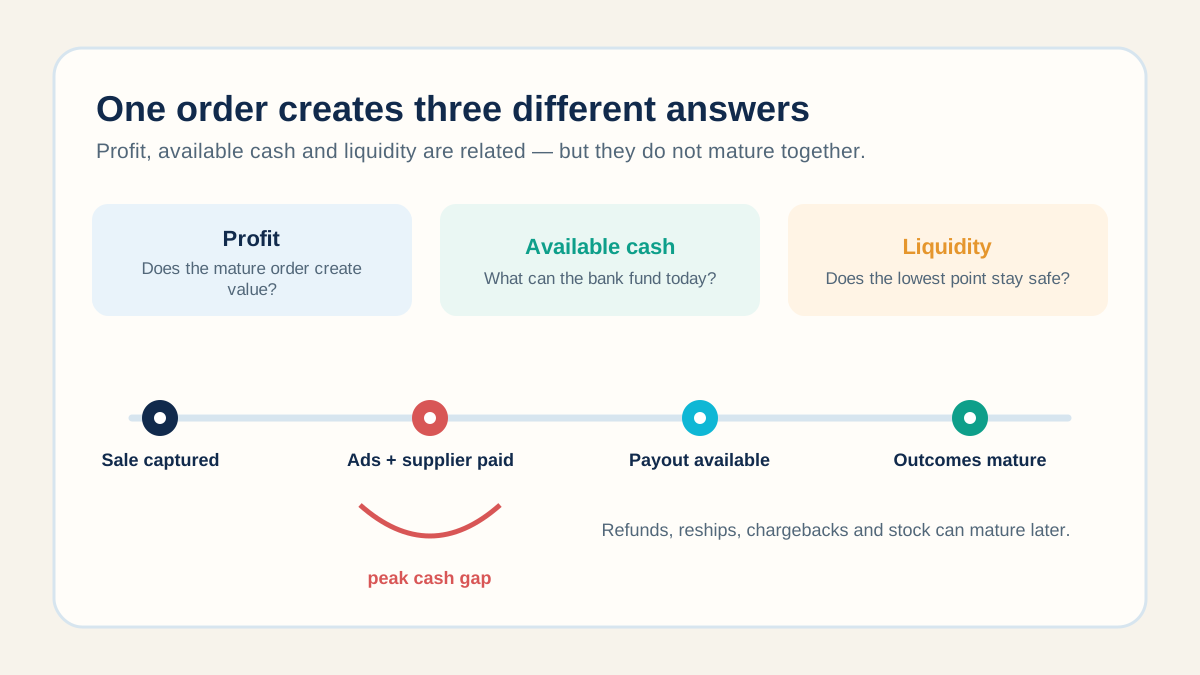
Profit, cash and the bank answer three different questions
- Profit asks whether the order is worth doing once refunds have settled, after you have paid for the product, the packing, the shipping, the ads, the payment fees and the reships.
- Cash flow asks when money really lands in your account, and when each bill you have promised leaves it.
- Your bank balance asks whether you stay above your floor at the worst point in that timing, after the money you already owe someone else is taken out.
A yes to the first does not answer the third. A campaign can look healthy on profit and still eat your cash for weeks. Your processor balance can look healthy too, while most of it is pending, reserved, or simply not yours to send the factory today.
This follows on from first-order margin against real repeat value. That guide asks whether later orders really pay back what you gave away on the first one. This one asks whether you can fund the wait.
Big-company cash flow shows the split. It is not your benchmark.
Shopify's official Q2 2026 release reported 34 per cent revenue growth and an 18 per cent free-cash-flow margin. Do not copy either number. The useful part is that sales, gross profit and cash are reported as three separate results, because doing well on paper and generating cash are related but not the same thing.
DHL reported higher second-quarter revenue and profit, then said that strong growth tied up more working capital. Its official H1 2026 release also says cash was helped by tariff refunds. So a good trading result can sit alongside cash being swallowed by growth, and a good cash result can be flattered by a one-off that has nothing to do with trading.
Zalando's official H1 2026 report reported positive free cash flow for the second quarter and negative free cash flow for the first half. That is what happens when you move the window, not a comparison with your store. None of these companies sets a target, a reserve or a safe scaling speed for you.
Map one order from the click to settled cash
Start with one campaign, one country and one exact product version. Mix stores, countries or product versions and last quarter's settled orders will hide this week's orders, which are still eating your cash. Put every event on the day money lands or leaves, not the day the order was created.
- The day you buy the click: ad money is charged, or becomes a bill you have promised to pay.
- Order accepted: the customer's payment goes through, but it may sit pending and out of reach.
- Supplier and packing released: you fund the product, the checks, the packing and the shipping on the terms your account actually has.
- Payout: net cash reaches your bank after the processor schedule, weekends, holidays, bank processing and any hold or reserve on your account.
- Delivery and early problems: cancellations, refunds, reships and support costs show up at different speeds by route and country.
- Late problems: chargebacks and some returns can arrive after you have already reviewed the campaign and called it good.
- Stock cycle: a stock or packaging deposit leaves before production, then a balance, freight, storage and the next order follow, all before your first batch has turned back into cash.
Shopify's current payout-timing guidance is clear about the boundary: when you get paid depends on your country, your account risk and the transaction; weekends and holidays are not business days; your bank can add time; and a negative balance can hold up a payout. The reserves guidance describes fixed and percentage reserves set per account. Use the terms you can see on your own account. Do not paste a payout lag or a reserve percentage you read somewhere into your plan.
Build the 13-week cash schedule before the campaign
Download the blank 13-week cash-conversion worksheet. One row is one week. Fill it from your bank, your processor, your ad account, your fulfilment bills and your stock orders. Thirteen weeks is long enough to show you several payout, refund and restock cycles, and short enough that you can redo it every week.
Your opening cash must leave out pending processor money and anything already promised to another store, to tax, to wages or to stock. Put the sales you captured in a context column, not in the cash column. Cash in means payouts that actually reached the bank. Otherwise you count the same sale twice: once when it was ordered, and again when it was paid out.
- Weekly net cash = payouts received + other cash in - every payment you made that week.
- Closing cash = opening cash + weekly net cash.
- Campaign cash so far = everything this campaign has brought in - everything it has cost you.
- Peak campaign cash gap = the deepest that number goes before the refunds and chargebacks have settled.
Tie the opening balance to last week's closing balance. Tie payouts to the processor statement, not to gross order value. Tie supplier and packing payments to the orders they released. A plan you cannot tie back to real money moving is a story in the shape of a forecast.
A made-up campaign can be profitable and still drain the bank
Say a campaign captures 20,000 dollars of sales in week one. On current assumptions it carries 7,000 dollars of ads, 8,000 dollars of product and fulfilment, and 1,600 dollars of payment costs and later losses. That leaves 3,400 dollars of profit after costs, if those assumptions hold up once everything has settled.
Now put dates on it. Only 6,000 dollars of payouts reaches your bank that week. You still pay the 7,000 dollars of ads, 8,000 dollars to release the orders and a 4,000 dollar stock deposit for the next cycle. Week one is negative 13,000 dollars of cash, even though the campaign looks profitable. The rest of the payouts may come later. Your supplier and your ad platform will not accept a screenshot of profit you have not been paid yet.
The example is made up on purpose. It leaves out overheads and tax, it is not a RyanFulfil quote, and it is not a benchmark. Change the payout, cost, loss and stock numbers to the ones on your own account. It is here to show you why profit cannot stand in for a dated cash plan.
Watch four numbers, not just the low point
Your cash floor tells you whether the plan survives. Four more numbers tell you why it is moving, and whether more spending has earned its place.
- Peak campaign cash gap: the most cash this batch of orders eats before you know what the refunds and losses really are. Fund the bad version, not just the base case.
- Cash back per customer you bought: cash this campaign has actually brought in, divided by the customers it bought. Keep the forecast and the real number in separate columns.
- How refunds arrive over time: the share of your eventual refunds you already know by day 7, 14, 30, 60 and 90 for that product, country and route. This week's orders should not inherit a settled refund rate as though they were finished.
- Stock cash-at-risk: deposits, paid stock, inbound freight, storage and setup you cannot get back, less the cash you have already recovered from units sold. Tie it to exact units and versions.
The stock word matters. A stock deposit is committed cash behind named units, while a prepaid balance and a security deposit do different jobs. Push all three into one supplier line and you hide which money you can still get back and which you have to replace.
Use three cases and make the bad one genuinely worse
A bad case is not the base case with fewer orders. It is the base case with the events that widen the gap: your cost per customer rises, conversion slows, payouts arrive later, a reserve kicks in, delivery drags, refunds or chargebacks climb, the supplier wants paying earlier, or the wrong sizes and colours sell out first.
- Base: your current processor terms, the route timing you have seen, settled loss rates and supplier payment dates you have agreed.
- Bad: money in later, customers costing more, losses higher, outcomes settling slower and less of your stock money recoverable.
- Good: better trading, but still no assumption that pending money turns up before the date your processor gives you.
Shopify's chargeback-process guidance says the disputed amount and the fee can be taken straight away, the window to send evidence is usually short, and the review can run on much longer. Providers differ. Plan around the provider you actually use, and hold money back for disputes until that week's orders are far enough past the dispute window.
Set the gate before you spend more
Only scale when the bad case still stays above your cash floor, after the payments you have promised and after a buffer you have named separately. Your floor is not every dollar in the bank. It leaves out money already owed to tax, wages, another store, stock, refunds and open orders.
- No unresolved payout hold, reserve change or negative balance is being treated as cash you can spend.
- This batch of orders has reached the refund and delivery point you agreed to wait for, or you have funded the part you still do not know.
- Supplier, packing, stock and ad commitments are dated and included up to your next review.
- The exact product version, country and route are stable. A real change starts a new batch instead of quietly rewriting the old one.
- You redo the plan every week, and again straight after a payout-term change, a stock commitment, a route delay, a jump in what customers cost you, a refund spike or a run of chargebacks.
If the bad case drops through your floor, the answer is not to hope the payouts come early. Pause the next spend or the next stock order, cut the campaign cap, agree a real payment milestone, shorten the buying cycle, or put cash back in before you take on more.
Where RyanFulfil fits
RyanFulfil can put dates on the China side of your plan: the current product and packed-route quote, when the supplier wants paying, what the checks and packing cost, the point at which orders are released, pre-stock, the stock balance, inbound timing, storage and the cost of things going wrong. That turns one vague supplier cost into dated commitments you can put in the plan.
You stay responsible for your payment provider's terms, your ad bills, tax, wages, customer refunds, chargebacks, borrowing and the final call on cash. RyanFulfil does not give accounting, tax, legal or financial advice, and cannot guarantee payouts, sales, delivery dates, loss rates, cash flow or profit.
Bring the exact product, the country, the route, your order forecast and your current payment milestones. Contact RyanFulfil when you need the China-side quote and stock commitments split into dates your plan can use.
The decision rule
Scale at the speed of settled cash. A campaign earns the right to more money when it is genuinely profitable once everything has settled, and when you can fund the bad version of its timing. Track profit to know whether the order was worth doing. Track cash to know when that profit is yours to spend. Track the bank balance to know that you last long enough to collect it.
Sources are current to 1 September 2026. Shopify Payments terms differ by country, provider, account risk and transaction, and supplier, route, refund and chargeback timing differ too. Use the 13-week schedule, peak gap, refund timing and three cases as planning prompts, not universal benchmarks. The company results show that growth, working capital and cash are different measures; they do not predict what your store will do.
Planning a product or an order?
Tell us what you need on WhatsApp (wa.link/dropship) and we'll work through the fulfilment details with you.
Get a Free Quote on WhatsApp →