Why deposits exist at all
Standard dropshipping has a specific cash-flow shape: a customer pays you, you pay your partner, your partner buys one unit from a factory, and the unit is shipped. Nobody holds inventory and nobody is exposed. The trade-off is that every order waits for a purchase, so the factory-to-warehouse leg — commonly two to three days — sits inside every delivery promise you make.
A deposit is how sellers buy their way out of that wait. Put money in front of demand and stock can be bought in batches, held, and picked the same day an order arrives. That is the whole economic argument, and it is a good one once demand is steady. The complication is that the word "deposit" gets used for at least three arrangements that behave completely differently when something goes wrong.
Three arrangements that share one word
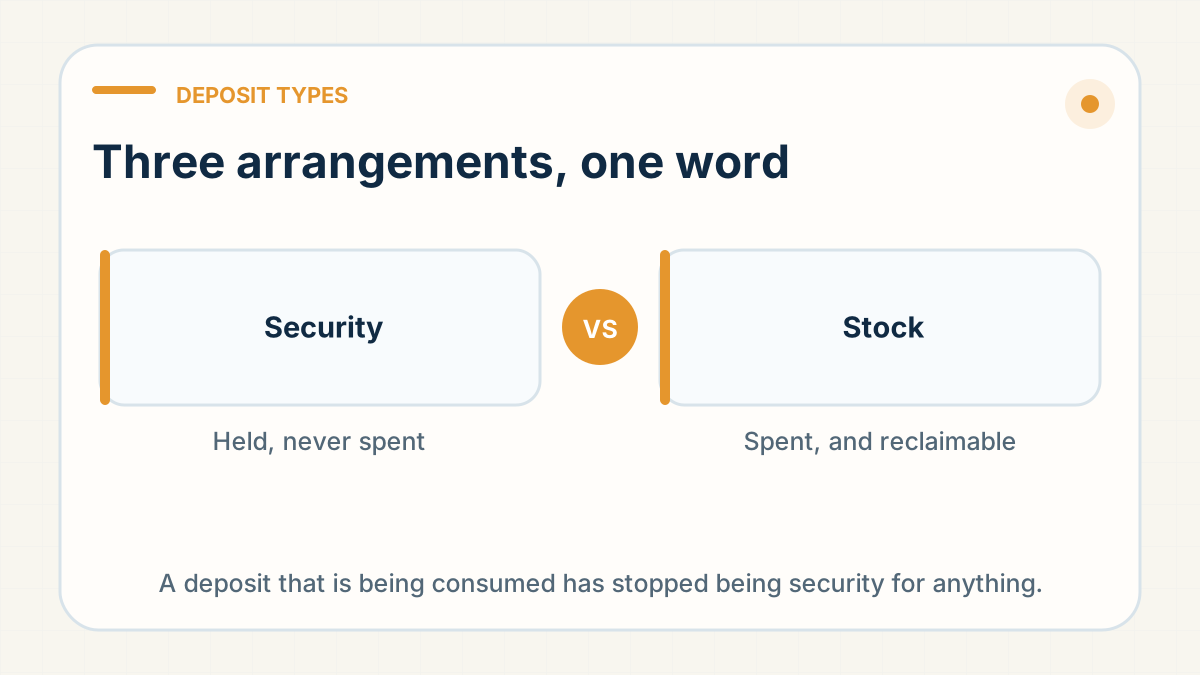
A **security deposit** is money held against risk. It is not spent, it does not buy anything, and it exists so that an unpaid invoice, a chargeback or an abandoned order queue does not land entirely on the partner. Because its whole function is to sit still, a security deposit cannot also be working capital — the moment it is being consumed it has stopped being security. Sellers under cash pressure often ask for exactly that, and a partner who agrees has quietly removed the protection both sides were relying on.
A **stock deposit** is the opposite: it is money specifically intended to be spent, on units bought ahead of orders and held in a warehouse for you. It is not a fee. It converts into physical goods with your name against them, and it should be repayable — as cash or as credit against invoices — once that stock is sold through or the line is discontinued.
A **prepaid balance**, sometimes called a float, is neither. It is an operating convenience: a lump sum sitting on account so that each order can be deducted automatically instead of generating a fresh payment request. It removes friction rather than risk or lead time, and it is the lightest of the three to unwind.
Many accounts run two or three of these at once, which is exactly why the statement gets confusing. If a single line on your invoice says "deposit", ask which of the three it is.
Sizing a stock deposit without guessing
The useful sizing method is not a percentage of anything. It is a cover calculation: daily unit velocity, multiplied by the number of days of stock you want on hand, multiplied by the unit cost.
A line selling roughly two hundred units a day, held at three and a half days of cover, at three dollars a unit, needs somewhere near two thousand one hundred dollars standing behind it. Change any input and the answer moves — which is the point. It makes the deposit a consequence of a decision about resilience rather than a number somebody proposed.
Days of cover is the judgement call. Too few and the deposit runs dry mid-week, at which point fulfilment falls back to buying per order and the delay you paid to remove reappears, typically as one to two days. Too many and you have converted working capital into slow-moving inventory for a product that has not earned it.
What happens when the deposit runs out
This is the failure mode sellers meet first and expect least. A deposit is consumed by purchasing, so a good week drains it faster than a quiet one. When it empties, orders do not stop — they revert to the slower per-order purchase path, and the seller notices as a delivery-time complaint rather than as a finance event.
Ask your partner for two things: notice when the balance falls below a stated level, and a clear statement of what happens to orders in the gap. Neither is difficult, and both convert a silent slowdown into a decision you get to make.
Stock that somebody else paid for is not free
A pattern worth recognising: a factory occasionally agrees to fund a component run itself — a batch of blank packaging, a base component, a print run — so that no deposit is required. That is genuinely helpful and it is not a gift. The usual condition is a commitment to sell through the whole batch, which is an obligation you now carry even if the product underperforms.
The same logic applies when a partner offers to cover part of an inventory deposit to expedite production. It is a real accommodation, and it also means somebody else has money in your stock. Get the terms written down: what happens if the line is discontinued, who carries unsold units, and whether the arrangement changes your pricing.
Getting the money back
A stock deposit should end cleanly in one of three ways: the stock sells and the deposit is refunded or credited, the line is discontinued and the remaining stock is either shipped to you or bought out, or the purchase never happens and the deposit is returned outright — which is the normal outcome when a variant turns out to be unavailable.
The practical friction is rarely refusal. It is that nobody agreed the mechanism, so the refund becomes an offset against a future invoice by default, which is fine if you are continuing and useless if you are leaving. Decide that in advance.
Questions to settle before you pay one
- Which of the three is this — security, stock or prepaid balance?
- If it is stock: which SKUs, how many units, and where are they physically held?
- Is it refundable in cash, or only as credit against future invoices?
- What is the notice threshold when the balance runs low, and what happens to orders below it?
- Can a deposit held for one brand or storefront be moved to another under the same account?
- Who carries unsold units if the product is discontinued or a variant is dropped?
- Does the deposit appear as its own line on the statement, so it can be reconciled independently?
Name the money before transferring it
Name the arrangement before you fund it. A security deposit protects the relationship and must stay untouched; a stock deposit buys inventory you should be able to identify and reclaim; a prepaid balance just saves everyone a payment link. Size stock cover from velocity rather than instinct, agree the low-balance warning in advance, and settle the exit route while everyone is still happy.
Demand check · public sourcing communities
One request in eight wanted stock already in the destination
In Q3 2026, 88 of 679 distinct supplier requests from public dropshipping sourcing communities wanted stock, a supplier or a warehouse already in the destination country. The UK stood out: more than half of UK-bound requests (26 of 48) asked for local stock, against a quarter of US-bound ones (29 of 115). Seven requests asked the supplier to hold inventory or extend credit outright.
Stock standing still always costs someone. When a buyer asks a supplier to carry it, the cost does not disappear. It moves into the unit price, a commitment or a deposit.
Before you pay a deposit, ask the ownership questions on this page: whose money bought the units, whose name is on them, and what happens to them if either side walks away.
Where these numbers come from: we counted 679 distinct supplier-request posts in public dropshipping sourcing communities between 7 July and 30 September 2026 (805 collected before reposts and non-requests were excluded). We classified each post twice, independently, against fixed definitions, and a further reading settled any disagreement, so the counts understate unclear wording rather than inflate it. This page quotes, links and identifies no post and reproduces no contact details. Private client conversations are excluded. See the full breakdown in the Q3 2026 demand analysis.
The rule: Record what the deposit reserves: defined units or production capacity, the approved version, where the goods sit, when title or risk changes and what happens if the balance is not paid. A payment entry without a stock-and-ownership record is not inventory control.
Have a specific fulfilment question?
Send us the product, destination and order context on WhatsApp (+86 178 4666 9989), and we'll answer for that order instead of giving a generic estimate.
Ask Questions on WhatsApp →