Prove control before you add dependence
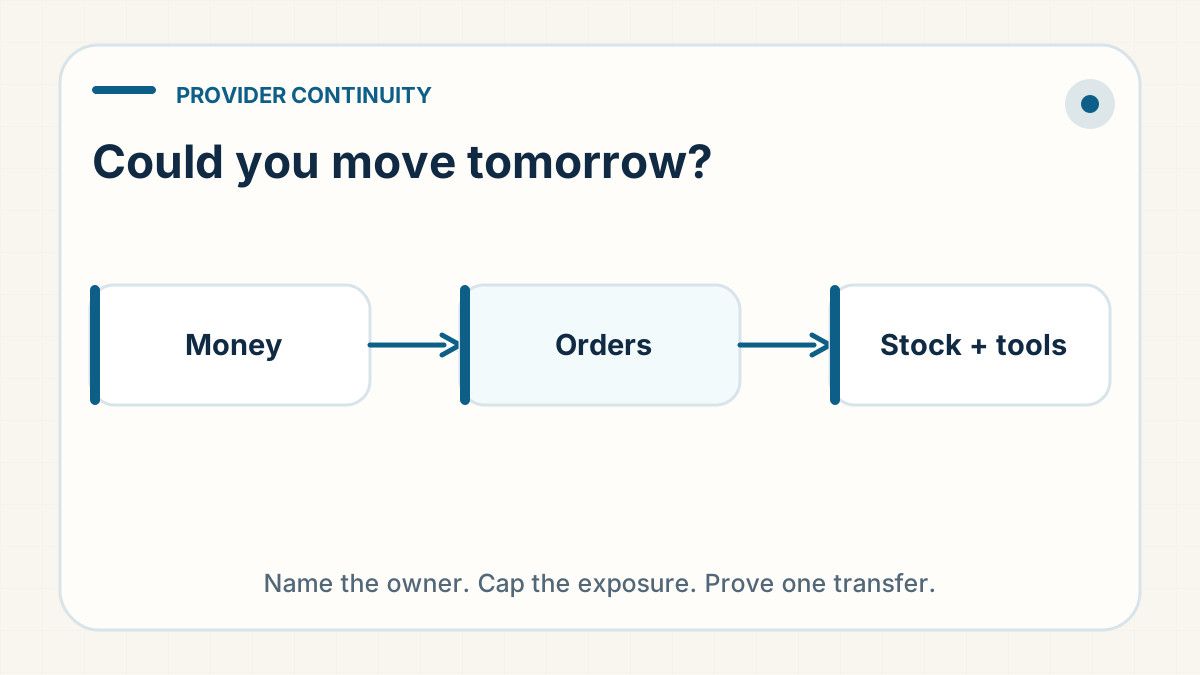
Before you put more cash, orders or stock through one fulfilment provider, prove that you could recover control of five things: money, open orders, goods and tools, data, and customer claims. Do not wait until you want to leave. Write down the exact legal party holding each item, cap how much can sit there, and run a small transfer while the relationship is working.
This is not a prediction that your provider will fail. A healthy provider can still face a route interruption, a system outage, a disputed balance, a warehouse move or a slow stock release. Your continuity plan is the time between that problem and the moment you can resume shipping without guessing which orders, units or claims are still open.
If you have already decided to move, use the practical fulfilment-agent switching plan. This guide belongs one step earlier: it asks how much of your operation can become trapped before you decide whether to scale the relationship.
A provider can grow quickly and still need your working capital
All-Link Air & Sea is a useful mechanism case because its Singapore prospectus dated 28 July 2026 describes both rapid growth and a demanding cash cycle. Revenue rose from US$4.8 million in its 2023 financial year to US$71.5 million in 2024 and US$74.1 million in 2025. Gross profit was US$1.9 million, US$10.5 million and US$8.9 million respectively, which means the reported gross margin narrowed from 40.4 per cent to 14.7 per cent and then 12.0 per cent.
The filing says customers were generally given 30 to 90 days to pay, while formal supplier terms were generally 30 to 60 days. Average payable days were 94, 111 and 161 across the three years. It says the longer actual payment period reflected commercial practice with longstanding suppliers, and that there had been no legal proceedings or formal complaints from those suppliers at the latest practicable date. It also allocated about S$11.39 million, or 64.38 per cent of net listing proceeds, to working capital and payments to airlines, carriers and co-loaders.
Those facts do not show distress, and this guide does not call the company distressed. They show why a quote is also a cash-timing arrangement. A provider may pay transport and handling costs before it collects from customers, while a merchant may prepay the provider before its own storefront payout clears. Growth can increase the amount moving through both gaps. The useful question is not whether one company is safe. It is how much of your cash and uncompleted work one counterparty can hold at once.
The prospectus also reports that the five largest customers supplied 89.9 per cent of 2025 revenue and the two largest supplied 79.0 per cent. Concentration matters in both directions. A provider can depend heavily on a few large customers, while a smaller seller can depend entirely on one provider. You cannot infer your treatment from a provider-level percentage, but you can decide what you will not leave exposed.
Start with the exact party, not the name on the website
Dickson Concepts made the perimeter unusually clear in an official announcement dated 13 August 2026 following the announced sale of Harvey Nichols UK's business and assets. It said that company was not part of the Dickson group, and that the group had not provided it with loans, guarantees, indemnities or security. It also said the Harvey Nichols operations in Hong Kong were separate in ownership, management, employment, inventory purchasing and daily operations.
The lesson is not about that retailer. It is that a brand, trading name, warehouse, payment recipient and contract party can be different things. Write down the legal entity on your service agreement, the entity named on each invoice, the bank-account beneficiary, the warehouse or subcontractor with physical custody, and the system account that controls your order export. If the names differ, record the relationship and which promise each one has actually made.
- Contract party: who owes the service and the stock release.
- Payment party: who receives your prepaid balance, deposit or freight money.
- Custody party: who can physically count, segregate and release your goods.
- System party: who controls the store connection, order records, labels and tracking export.
- Claim party: who receives a notice when stock is short, a parcel is lost or a balance is disputed.
The five things you need to be able to move
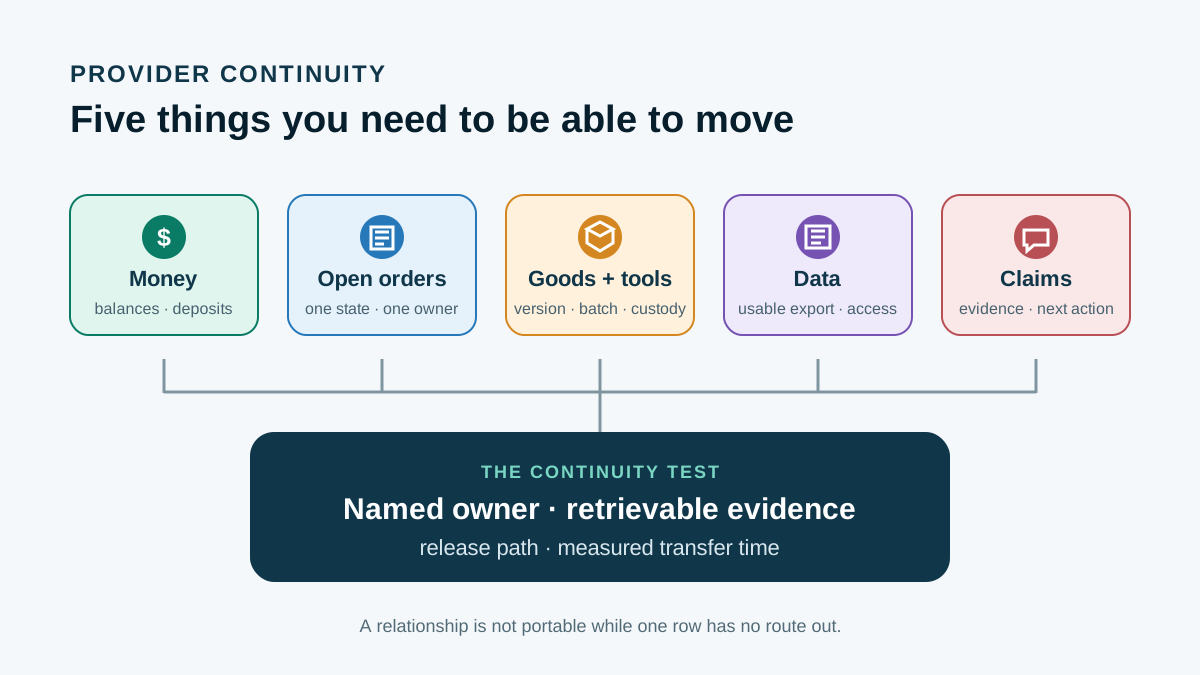
A continuity check is small enough to fit on one page. For each of the five rows, record what exists today, who controls it, the evidence you can retrieve without asking for a favour, the release condition and how long a transfer would take.
- Money: prepaid balance, stock deposit, freight funds, supplier deposits and credits. Reconcile them to invoices and completed orders. Set a maximum balance in money or weeks of expected use.
- Open orders: paid, on hold, purchased, packed, labelled, dispatched, cancelled, reshipped and refunded. Every order needs one current state and one next owner so it cannot be bought or shipped twice during a move.
- Goods and tools: saleable units by exact version and batch, packaging, inserts, labels, moulds, jigs and artwork. Record who owns them, where they sit, how they are counted and what has to happen before release.
- Data: order export, customer fields needed for fulfilment, approved product references, supplier map, packing rules, tracking history and exception log. Test an export that another operator could understand without the original chat thread.
- Claims: shortages, damaged stock, lost parcels, chargebacks, refunds and supplier credits. Keep each open amount and item linked to its evidence, owner and next review date. Moving today's orders must not erase yesterday's claim.
Download the blank fulfilment-provider continuity check. Use one row for each balance, order group, stock batch, tool, data export or claim that would need to move. It is a control sheet, not a legal opinion or proof that an asset belongs to you.
Cap exposure before you judge the provider
The most useful limit is one you can measure every week. A cash cap might be the lesser of a fixed amount and a set number of normal weeks of fulfilment. An order cap might be the number you can remake or reroute without missing the promise on your storefront. A stock cap might be the quantity your backup can receive, identify and put away inside the interruption window you have accepted.
There is no universal safe number. Your cap depends on product value, delivery promise, refund window, route availability, cash reserve and how replaceable the exact version is. The rule is to choose the cap before the balance grows, state who reviews it, and decide what happens when it is crossed: pause the top-up, reconcile, release stock, divert new orders or activate the backup. A dashboard colour without an action is not a limit.
Keep the ownership question separate from the amount. A supplier or provider can label a payment a deposit while the agreement leaves you with only a contractual claim. The guide on who owns the stock behind your deposit shows what to ask before treating paid goods as available inventory.
Run a transfer drill while nobody is in a hurry
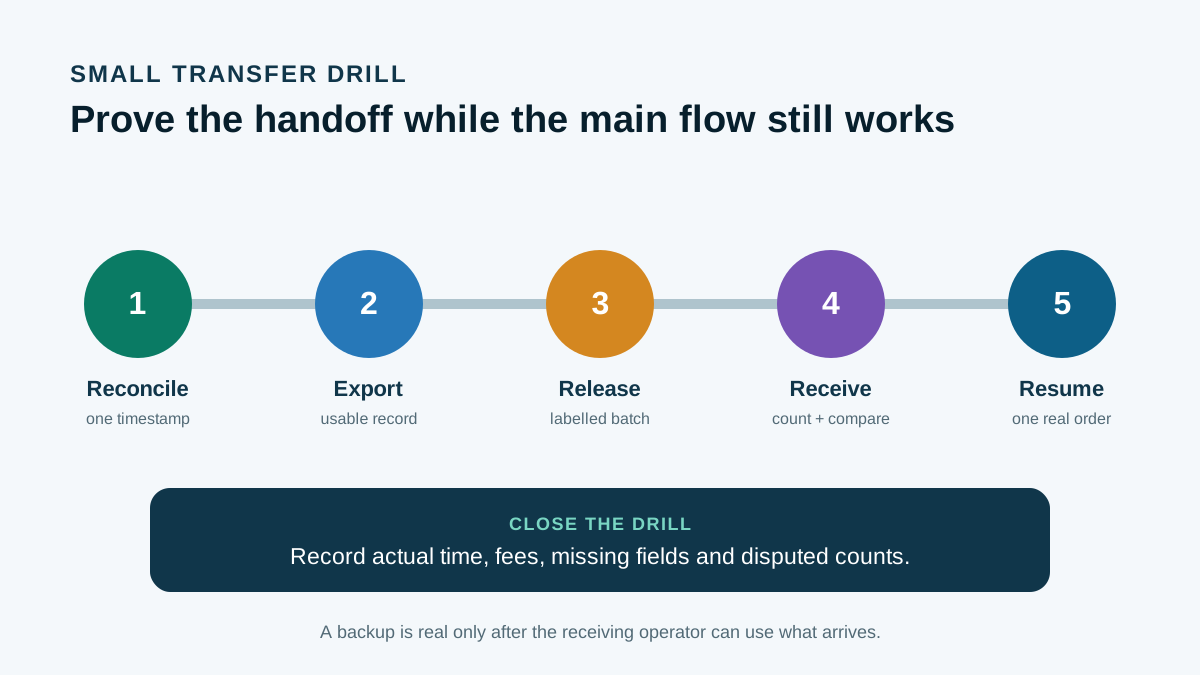
A backup name in a spreadsheet is not a backup. Use a small, non-urgent batch and one real order flow to prove the route. Tell both providers it is a continuity test, not a hidden full migration. The goal is evidence about the handoff, not surprise.
- Reconcile first: freeze a timestamp, then agree the balance, open-order list, batch count and unresolved claims at that point.
- Export the operating record: exact SKU and version, quantity, batch, packing rule, order state, tracking state and the minimum customer fields the receiving operator needs.
- Release a labelled batch: include a count sheet and keep saleable, quarantined and claim stock separate.
- Receive and compare: the backup counts, photographs and maps the units before accepting them into available stock.
- Resume one controlled order: prove the store or file handoff, picking instruction, packing evidence and tracking return without creating a duplicate.
- Close the drill: record actual time, fees, missing fields and disputes. Fix the plan while the main flow still works.
Do not copy more customer data than the receiving operator needs, and do not send credentials in a general chat. Use the platform's delegated access where it exists, remove access when the drill ends, and document who did so.
Weigh a cheaper route or provider against what it leaves exposed
When two routes or providers quote different prices, start from what you keep per order at each price. Then take off four costs the rate does not show:
- Refunds, reships and support: what parcel problems on that line cost you while it is running, including the time spent answering customers.
- Interruption: what you would pay if the line stopped, in higher emergency rates, relabelled parcels, where-is-my-order messages and refunds funded before shipping recovers.
- Fallback: the extra you pay to keep a second line working, so it can take orders when the first one stops.
- Trapped money and moving: what it costs you to have cash or stock held with the provider, plus the cost of moving it. Start from the time and fees your transfer drill recorded, scaled to the stock and orders you would actually move.
Work that sum out three times, for a low, a base and a high case, instead of guessing how likely the line is to fail.
In an illustrative pair, Route A saves US$0.40 a parcel but needs a larger prepaid balance, lets more orders sit before a first scan and has no tested fallback. Route B costs US$0.25 more but keeps your data portable and a second line open. Which wins depends on the product's margin, how many orders are exposed at peak, the destination and the cash you hold.
Before your best-selling product or one country depends on a single route, add two route caps to your cash, order and stock caps:
- First scan: the most days a paid order may sit without a first carrier scan before you move new volume to the second line. Measure it against your oldest unscanned order.
- Country share: the largest share of one country's orders you will put on one line. Past it, that country's next orders go to the second line even when it quotes higher.
Restructuring is an outcome to plan for, not an outcome you can assume
QVC Group provides a useful countercase. Its official 2026 restructuring release said the court-approved plan reduced debt from about US$6.6 billion to US$1.325 billion and that all vendor claims would be paid in full or reinstated. A corporate restructuring did not automatically mean vendors took the same loss as financial creditors.
That does not promise the same outcome elsewhere. It shows why headlines are a poor continuity control. Contract terms, legal entity, security, custody, local law and the facts at the time can all change the result. Your operating plan should work before anyone needs to predict a court process.
What RyanFulfil can help prove
A China-side fulfilment team can help make the operating evidence portable: reconcile the stock it holds, separate saleable and quarantined units, keep product-version and packing references readable, export open-order and tracking states, and coordinate a labelled release to another named location. It can also quote a receiving test for stock coming the other way.
RyanFulfil cannot decide who legally owns an asset, guarantee that a supplier or warehouse will release it, guarantee another provider's capacity, or give legal, insolvency or investment advice. The merchant should have the agreement reviewed where the amount or dependency is material. Our useful role is to make the physical and data handoff observable before a dispute makes it urgent.
If you are about to increase a prepaid balance or move a larger batch into one warehouse, send us the product, destination, current stock state and the one handoff you want to test. We can scope the operational drill and state what evidence we can produce.
Do this before the next top-up
- Write the exact contract, payment, custody, system and claim parties beside the names you use day to day.
- Reconcile prepaid money, open orders, goods and tools, retrievable data, and unresolved claims to one timestamp.
- Set a measurable exposure cap and the action that starts when it is crossed.
- Export a file another operator can understand without the original chat history.
- Move one labelled batch and fulfil one controlled order through the backup.
- Record the actual transfer time, cost, missing fields and approvals, then review the cap.
What to watch and what not to assume
- Watch: balance and open-order reconciliations drifting apart, stock that cannot be tied to an exact version or batch, a release process nobody has tested, and system knowledge held only in one person's messages.
- Ignore: "large means safe", "profitable means liquid", "we have a backup" without a completed transfer, and "the brand owns it" without the exact entity and agreement.
- Do not treat this as a provider-failure probability or stock, cash or claim-recovery estimate. No public base rate or universal safe prepaid-balance ratio is established; assess the exposure and recovery terms of your own account.
Make the small move before the urgent one
A good provider relationship should survive a calm question about transfer. Name the parties, cap what can accumulate, keep the five operating records current, and prove one small handoff before you need it. The test is not whether your provider looks likely to fail. It is whether your store can keep its promise if one part of the relationship stops working tomorrow.
Here is how you would prove us wrong. If a current stock count, usable order export and named backup still cannot move a small labelled batch and one controlled order without duplication or loss, this checklist is incomplete. Run the drill and add the missing dependency before you increase the exposure.
Where the figures come from
Sources as of 4 September 2026. The All-Link figures come from the company's Singapore prospectus dated 28 July 2026: revenue, gross profit, gross margin, customer concentration, stated customer and supplier terms, average payable days, the company's explanation of the longer payment period, the absence of supplier legal proceedings or formal complaints at the stated date, and the planned use of net proceeds. They describe All-Link's disclosed history and proposed use of funds; they are not a RyanFulfil provider benchmark, a distress signal or an opinion on its securities.
The Dickson Concepts announcement shows that a trading name and legal perimeter can differ. The QVC Group release shows that a restructuring can treat vendor claims differently from financial debt. Neither case predicts another provider's contract or outcome. Use the five-row continuity check, exposure-cap method, route comparison and transfer drill to prepare your own move; Route A and Route B figures are illustrative. No provider is rated, and this is not legal, insolvency or investment advice.
Need one order or route checked?
Worried about an order's tracking? Send us the order number on WhatsApp (wa.link/dropship) and we'll check what's going on.
Check Order on WhatsApp →