The situation
The date could not move
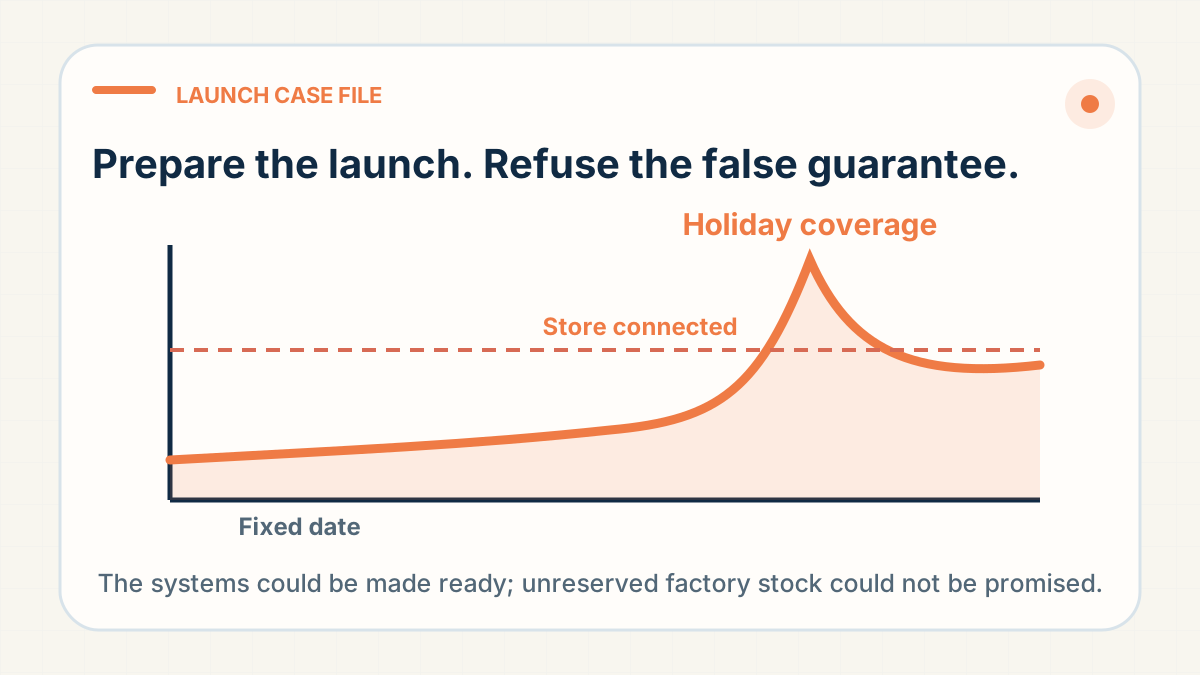
Do not accept a stock guarantee that no commercial commitment holds. A European seller was preparing a collaboration with a large regional creator. The forecast was roughly 3,000 orders in a 24-to-48-hour window. The campaign date was fixed, the store connection was unfinished and the stock position had not been secured.
This was not ordinary forecast planning. When demand is attached to a public launch, there is no quiet second attempt. If the integration fails, orders arrive without a clean fulfilment path. If stock is short, the seller discovers it after customers have paid. If the warehouse is closed, every unanswered hour compounds the backlog.
- 01Fix the launch dateThe public campaign window could not quietly move.
- 02Prove the order flowStore and fulfilment integration were completed before demand.
- 03Staff the warehouseCoverage was arranged across the public holiday.
- 04State the stock truthThousands of units were not guaranteed without a commitment that reserved them.
The limit on unreserved stock
The seller wanted certainty that several thousand units would be available immediately, and we could not give it. Nobody can reserve factory inventory at that scale without a deposit or another real commitment, and a forecast does not create ownership of stock.
Saying that plainly put the relationship at risk, and the possibility of moving to another agent came up. Agreeing would still have been worse: we would have won the campaign work and found out inside the launch that the stock existed only as an assumption.
Integration and warehouse readiness
The store and internal order workflow were connected before the campaign rather than during it. Warehouse coverage was arranged across a public holiday so the launch window would have people available to receive and process the flow. The stock position was written down honestly: what could be supported, what had not been reserved and what a deposit would change.
Readiness and inventory were separate decisions
This distinction is easy to miss. A warehouse can be staffed and a store integration can be working while factory stock is still uncertain. Conversely, stock can exist while the order path is not ready. A credible launch plan has to prove both tracks independently.
- Systems: can paid orders enter the fulfilment workflow without a manual rescue?
- Stock: is the required quantity owned or reserved, rather than merely visible at a factory?
- Capacity: are people, packing materials and collection arrangements available during the actual launch window?
- Communication: who tells customers what happens if the forecast is exceeded?
What the launch proved
The integration and warehouse coverage were ready before the expected demand window. The 3,000 orders were a forecast, not a completed sales result; the final campaign sales count is unavailable. The operational gaps were identified before the campaign.
The lesson
Tell a fulfilment partner when the campaign date becomes real, not when the orders arrive. Separate expected demand from reserved stock, and do not accept a stock guarantee unless someone can show what commercial commitment actually holds those units for you.
How we kept it anonymous
This anonymised case is based on reviewed launch-planning conversations. The forecast and time window are rounded. The seller, creator, store and exact product are omitted. The case establishes launch readiness, not a final sales result.
Facing a similar operating decision?
Send the product category, destination and current order stage on WhatsApp (+86 178 4666 9989). We'll tell you what we can confirm, what is still uncertain and the smallest useful next step.
Discuss Your Situation on WhatsApp →