The situation
The failure did not look large at first
Measure a quality problem by how often the same failure returns, not only by whether you completed each refund or replacement. This account did not arrive doing several hundred orders a day. It began as ordinary dropshipping work and grew into two related brands selling across multiple markets. By the time the combined flow was commonly around 400 to 500 orders a day, decisions that once affected a few parcels could affect an entire customer queue.
The first warning came through after-sales messages. One item was peeling or breaking unusually quickly. Each report was handled: evidence was checked, replacements were arranged and the immediate customer case was closed. That looked responsive at the level of one order. Across weeks, it was the wrong operating response.
We treated a pattern as a queue
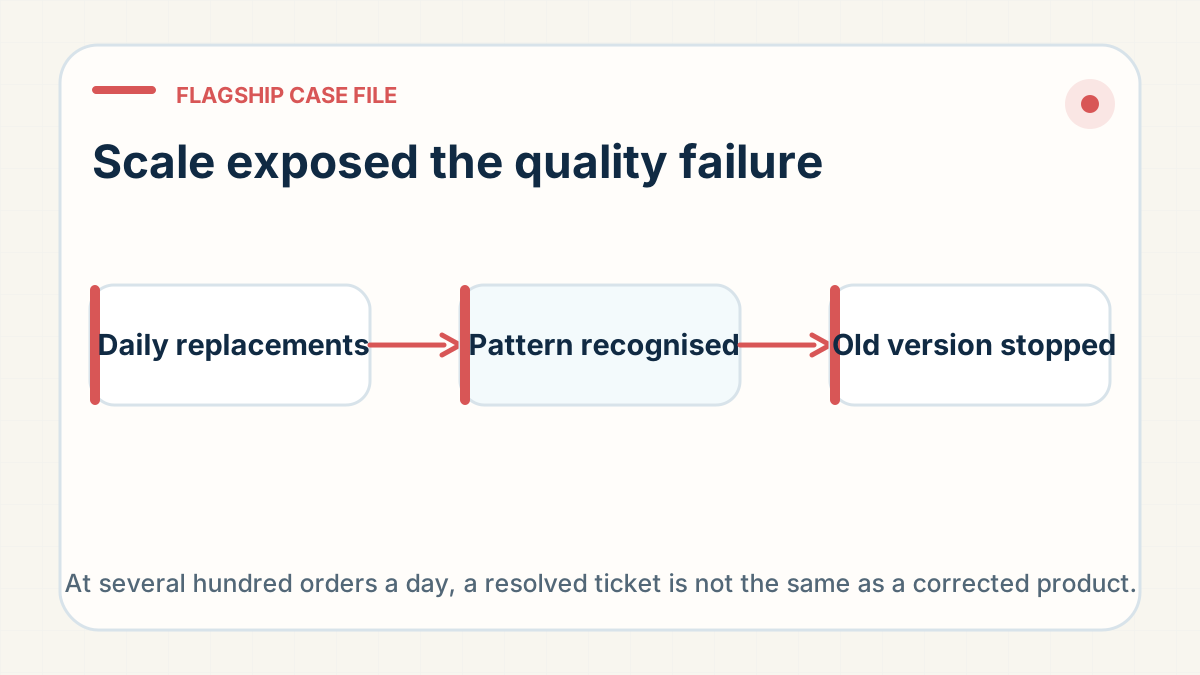
A dedicated support person was handling replacement claims close to daily. That was the point at which the work should have changed from case resolution to supplier correction. Instead, we continued solving individual cases for too long before treating the repeated failure as one root-cause problem.
The distinction matters. A replacement can make one customer whole. It does not tell the factory what failed, stop the old version shipping or prove that the next batch is different. At this volume, a defect rate that looks small in a spreadsheet becomes a steady stream of disappointed customers and support work.
Growth had changed the supply problem
The account was also moving beyond generic packing. While demand was still proving itself, the products shipped in plain packaging. Once repeat volume justified the commitment, the brand ordered 10,000 custom printed boxes. Weekly fulfilment on the account passed $20,000, and invoicing for the two related brands was consolidated into one rhythm.
Those were healthy signs, but they made version control more important. Branded packaging commits cash and creates inventory that is only useful if the product inside remains sellable. A fast-growing brand cannot afford to discover after printing thousands of boxes that the underlying item still needs redesigning.
The second failure was communication
A production backlog then forced a triage decision. European orders were prioritised ahead of US orders. The decision itself had an operational rationale, but we did not tell the client when it was made. He had to notice that one group of customers was waiting and ask why.
That was a separate failure from the defective product. Quietly changing who waits transfers the explanation problem to the seller. Even if the warehouse has chosen the least damaging option, the seller cannot manage advertising, support or refund expectations against a decision they do not know exists.
What changed
The failing item moved onto a redesigned version and the old version stopped shipping. The replacement stream was finally treated as evidence of a supplier problem rather than an endless series of unrelated cases. Operational triage decisions that change which market or order group waits are now expected to be communicated at the time of the decision, with the reason and the affected queue.
What changed after the defects
Two corrective actions followed: the old product version stopped shipping, and the repeated replacement stream was escalated from individual after-sales cases into a supplier and product-version problem. The market-triage communication gap remained part of the case. No clean before-and-after defect rate or later audit sample is available. These actions do not establish permanent prevention or guarantee that a similar communication lapse cannot recur.
The control worth judging is whether the next repeated pattern is grouped by SKU and version, escalated before replacements become routine, and followed through to a verified release decision. A future seller should ask to see that operating logic applied to their own product rather than treating one historical case as proof about every order.
The numbers in plain terms
- Roughly 400 to 500 orders a day made small process failures repeat at brand scale.
- Weekly fulfilment passed $20,000 across the related brands.
- A 10,000-box packaging order was made only after demand had proved the commitment sensible.
- Near-daily replacement work was the signal that the supplier, product version and release rule needed to change.
The lesson for a growing seller
Do not measure a quality problem only by whether each refund or replacement was completed. Measure how often the same failure returns, whether the same product version is still shipping and whether the corrective action changed the next batch. Ask your partner to flag any capacity decision that changes the order queue, with the reason, affected orders and next update, so you can manage customer expectations.
How we kept it anonymous
This case combines anonymised RyanFulfil client situations. The order bands and financial figures are rounded. The client, stores and exact products are deliberately omitted; the sequence, decisions, failures and corrective actions are retained.
Facing a similar operating decision?
Send the product category, destination and current order stage on WhatsApp (+86 178 4666 9989). We'll tell you what we can confirm, what is still uncertain and the smallest useful next step.
Discuss Your Situation on WhatsApp →