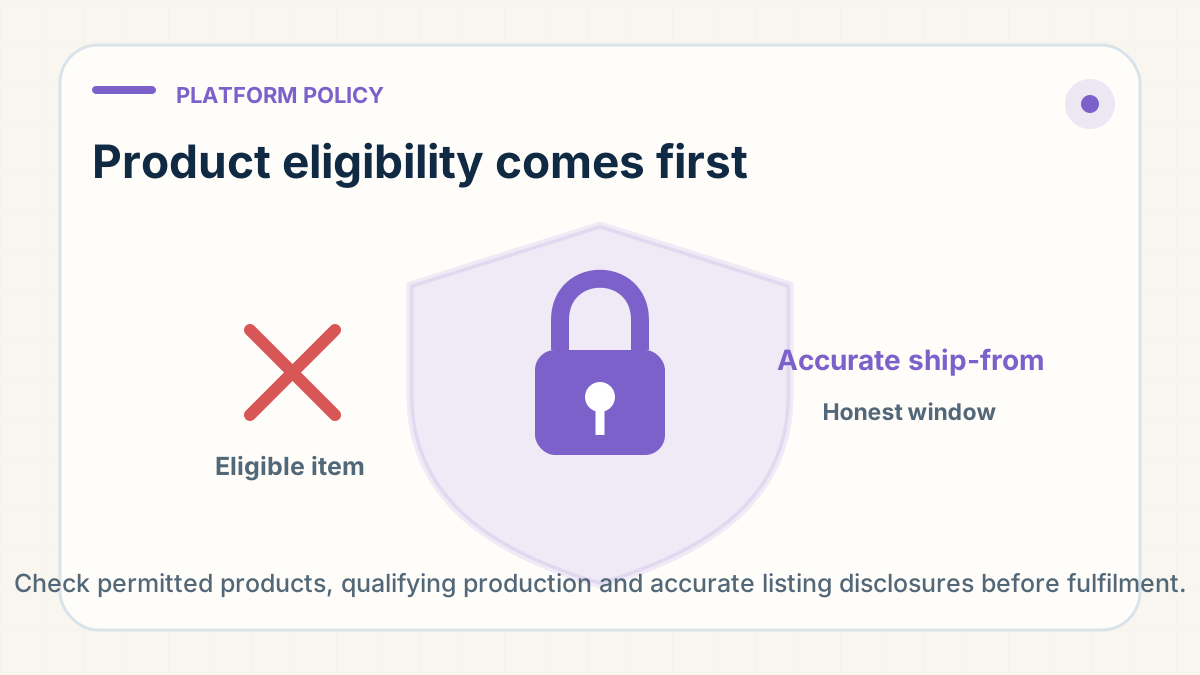
Product eligibility and accurate origin come first
Before using a fulfilment partner, establish that the item and production arrangement fit the marketplace's rules. An accurate listing must then represent who designed and made the product and where it ships from. Outsourcing does not remove product restrictions, and truthful disclosure does not make a prohibited item eligible.
That distinction decides which platform is right for a given product, and it is the thing sellers most often get wrong before they get suspended.
The platforms behave differently, and the difference is structural
Your own storefront has no origin rule. You are the merchant of record and you can source however you like, subject to consumer law, product safety and accurate description. This is why generic sourced products belong on a storefront you control.
A general marketplace typically cares about authenticity, delivery performance, tracking validity and prohibited categories, but not about whether you personally manufactured the item. Reselling is the expected model.
A curated or handmade-focused marketplace defines which items and seller roles qualify. Check the relevant category and any exceptions, the seller's required creative involvement, and the rules for external production assistance. A generic catalogue item does not become eligible merely because the seller declares a supplier. Etsy's specific distinctions are explained below.
Before choosing a channel, read the actual current policy for the platform and category you intend to sell in, because these rules change and enforcement changes faster than the wording does.
Etsy: check product eligibility before choosing fulfilment
Etsy generally prohibits drop shipping of ready-made commercially available products. Its limited drop-shipping exception covers qualifying craft and party supplies. Separate reselling exceptions include eligible vintage items and gift baskets that the seller selects and creatively packages; these are not a general permission to drop ship catalogue goods or fully resold gift baskets.
A qualifying production partner may physically make and ship the seller's original design or a product customised by the buyer under Etsy's current rules. The actual production relationship must qualify, and production assistance must be disclosed on the relevant listings. Buying a standard wholesale item and asking a warehouse to dispatch it does not establish that relationship.
Etsy lists standard white-label manufacturers, OEMs, ODMs, commercial retailers and wholesalers supplying ready-made products among businesses that should not be listed as production partners. A brand label or production-partner entry does not turn an ordinary catalogue product into an eligible seller-designed item.
Separate three checks before choosing a fulfilment route: whether the item is eligible; who physically produces the original design or buyer-customised item and what must be disclosed; and who checks, packs and ships the finished item. Keep the listing's ship-from location accurate, including when orders ship from the production partner's location.
Shipping from China is not the first eligibility test. Using RyanFulfil for fulfilment does not make a generic product eligible for Etsy, and a fulfilment agent is not automatically the production partner when another factory makes the item. Confirm the actual manufacturer, listing disclosures and ship-from location against Etsy's current policy before agreeing the order and tracking workflow.
Official Etsy sources (checked 6 October 2026): drop shipping and reselling; working with production partners. Recheck these rules for your item before launch.
Why suspensions arrive in clusters
The pattern that alarms sellers most is losing several stores at once rather than one. It happens because enforcement is rarely triggered by a human reading a single listing. Platforms link accounts through shared signals — payment instruments, addresses, devices, browser fingerprints, contact details, catalogue overlap and shipping patterns — and an action taken against one account frequently propagates to everything associated with it.
This has an uncomfortable implication for the multi-store strategy. Running many small stores is often adopted as risk diversification, and against linked-account enforcement it is closer to the opposite: it multiplies the exposure while leaving the underlying cause unaddressed. If several stores were suspended together, the productive question is not which store triggered it but which shared practice all of them had.
It is also worth being honest about diagnosis. Platforms usually do not disclose the specific signal, and reconstructing it after the fact is guesswork. That argues for fixing the compliance basics rather than hunting for the trigger.
Tracking is a compliance surface, not just a customer courtesy
A recurring and entirely avoidable failure: a platform does not recognise the carrier a parcel shipped with, so the tracking number will not validate. The order then looks unshipped to the platform regardless of where the parcel physically is. Late-shipment metrics degrade, protection can lapse, and in some programmes the seller is treated as having failed to dispatch.
Two things matter here. Confirm which carriers your platform accepts for your destination *before* you commit to a route, and make sure whatever reference you upload resolves on a tracking service the platform and the customer can both read. Where a shipment changes hands to a domestic carrier, the local reference is usually the one that validates.
Delivery promises are a policy surface too
Handling and delivery windows shown at checkout are enforceable commitments on most platforms. A cross-border route that genuinely takes eight to twelve working days cannot be advertised as a few days because a competitor does it. Repeated late delivery is one of the most common paths to restriction, and it is entirely self-inflicted.
If you have adopted a slower, cheaper customs channel, your published window has to move with it. A saving that produces late-shipment penalties is not a saving.
Access, not credentials
Use the platform's own authorisation mechanism to give a fulfilment partner access: a staff or collaborator account with scoped permissions, or an app authorisation. Never share your account password, and be wary of any workflow that requires it. Password sharing typically breaches the platform's terms in its own right, defeats two-factor authentication, and makes it impossible to attribute an action to a person afterwards.
Where a platform genuinely provides no delegated access, the correct fallback is a controlled data export — an order file containing only the fields needed to fulfil — rather than handing over the account.
Build a supply chain you could declare
- Match the item to the platform's permitted categories and current exceptions before listing it. Do not assume that generic catalogue goods qualify for a handmade-focused marketplace.
- Check that the product and actual production relationship qualify under the platform's rules before using its production-partner declaration. Disclosure does not make an ineligible product eligible.
- Keep the listing honest about what the item is and where it comes from, including in images and video.
- Ship on carriers the platform recognises, and upload a reference that validates.
- Publish the delivery window you actually achieve, including the slower route if you use one.
- Use scoped platform access. No shared passwords.
- Consolidate rather than multiply stores, and keep any separate businesses genuinely separate.
If you have already been suspended
Read the notice for the specific policy cited rather than assuming. Preserve your order, supplier and tracking records immediately, because access is often revoked. Fix the underlying practice before appealing — an appeal that does not describe a changed process rarely succeeds. And plan for the possibility that the channel is simply wrong for the product, in which case the fastest recovery is usually a storefront you own rather than another account on the same platform.
Build a supply chain you can declare
Platforms regulate product eligibility as well as accurate origin. Choose the channel that fits how your product is actually made and shipped, disclose qualifying production partners where required, ship on carriers the platform can read, publish an accurate delivery estimate, and use scoped access instead of passwords. An accurately described supply chain still needs to meet the platform's product rules.
Demand check · public sourcing communities
One request in six named its selling platform
In Q3 2026, 108 of 679 distinct supplier requests from public dropshipping sourcing communities named a selling platform. Shopify led with 68, followed by eBay (17), TikTok Shop (13) and Etsy (10). Only 5 quoted a platform rule, such as a delivery window or a tracking requirement, as the binding constraint. Five asked the supplier to hide or remove China-origin evidence.
Those two small groups show the same pressure pointed in opposite directions. A platform rule binds the seller’s account, not the supplier’s. A workaround bought from a supplier is still your listing, your account standing and your customer at risk, and platforms audit outcomes, not intentions.
Read your platform’s rules on who makes and ships the product, using this page, before you name a supplier in a listing.
Where these numbers come from: we counted 679 distinct supplier-request posts in public dropshipping sourcing communities between 7 July and 30 September 2026 (805 collected before reposts and non-requests were excluded). We classified each post twice, independently, against fixed definitions, and a further reading settled any disagreement, so the counts understate unclear wording rather than inflate it. This page quotes, links and identifies no post and reproduces no contact details. Private client conversations are excluded. See the full breakdown in the Q3 2026 demand analysis.
The rule: Map the actual manufacturer, seller of record, fulfilment location and customer-facing claims against the marketplace rule that applies to the account and market. Do not change labels or descriptions to disguise the chain; change the product or workflow when the truthful version is not allowed.
Have a specific fulfilment question?
Send us the product, destination and order context on WhatsApp (+86 178 4666 9989), and we'll answer for that order instead of giving a generic estimate.
Ask Questions on WhatsApp →