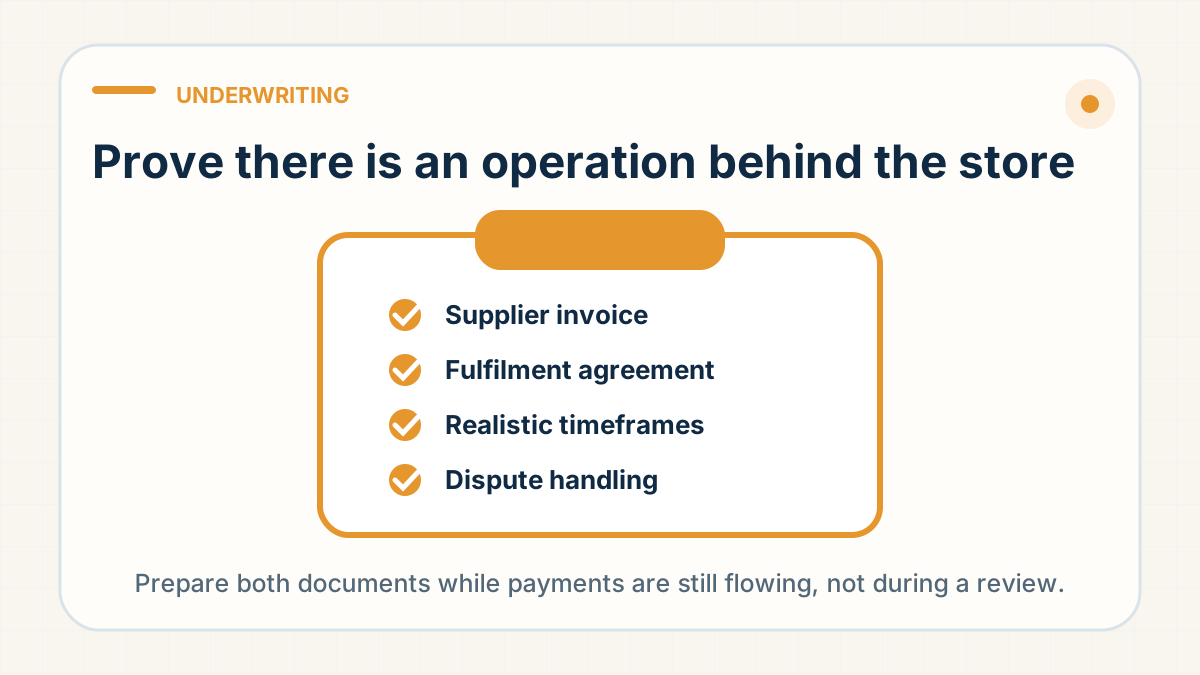
The request arrives at the worst possible moment
Payment processors and acquiring banks review merchants who sell goods they do not physically hold. Sometimes that happens at application; more often it happens after a volume jump, a dispute spike or a delivery-time complaint. The request is usually the same: show us who supplies you, show us a real transaction with them, and show us the agreement that governs it.
Sellers meet this at a bad time. Payments may already be paused, and the documents asked for are exactly the ones nobody prepares in advance. The good news is that they are not difficult to produce if you know what they are for.
What the reviewer is really checking
- That a genuine supply chain exists behind the storefront, rather than a listing with no fulfilment behind it.
- That the entity taking payment is the entity that will get the goods delivered.
- That delivery timeframes shown at checkout are consistent with how the goods actually move.
- That somebody is accountable for refunds, replacements and undelivered orders.
- That the merchant is not selling counterfeit, restricted or prohibited goods.
Reading it that way makes the document list obvious. They are not collecting paperwork; they are testing whether the promises on your checkout page are backed by an operation.
The supplier invoice
A useful invoice is a real one covering a real period of purchases, showing the supplying company's name and address, your company as the customer, dates, an itemised description at product-category level, quantities and amounts, and how it was paid. A screenshot of a chat message is not an invoice, and a blank template with your name typed in is worse than nothing.
A fulfilment partner should be able to produce this on request in a durable format. If yours cannot, that itself is a finding worth acting on before a processor forces the issue.
The fulfilment agreement
This is the document most sellers do not have. It does not need to be long, but a processor is looking for the operational substance rather than legal decoration. The clauses that matter in practice are these.
- Order acceptance: when an order is accepted, and the grounds on which it can be rejected or suspended — unavailable stock, restricted goods, incomplete customer details, suspected fraud or no serviceable route.
- Timeframes as estimates: processing and delivery windows are estimates, not guarantees, with carrier, customs and address failures outside the partner's control named explicitly.
- Product selection and intellectual property: the merchant chooses the products and branding and confirms it has the right to sell them; the partner acts on those instructions and will refuse anything it believes to be counterfeit or unlawful.
- Defects and fulfilment errors: what the partner is responsible for — a materially defective item, a wrong item, a missing item, damage caused by inadequate packing — with a claim window and an evidence standard.
- Remedies and limits: resend or refund the amount actually paid to the partner, typically after the merchant has refunded its own customer; retail price, advertising spend, chargebacks and platform penalties sit with the merchant.
- Customer data: what personal data the partner processes to fulfil, ship and support orders, who it may be shared with, how long it is kept, and the merchant's own obligation to collect it lawfully.
- Records: what documentation the partner will supply for a bank, processor or dispute — scoped to the merchant's own orders rather than to other customers or confidential sourcing.
- Termination and governing law: notice on both sides, immediate suspension for non-payment or unlawful goods, and a dispute route both parties can actually live with.
Do not sign a template because you are in a hurry
A processor deadline creates pressure to accept whatever arrives fastest. Resist that for one read-through. The clauses above are the ones that decide who absorbs a loss when something goes wrong, and a document signed under time pressure governs the relationship long after the review is closed. A partner who asks for a few days to have terms reviewed is behaving correctly, not stalling.
Prepare it before you need it
- Ask your partner now for a company invoice in a durable format covering a recent period.
- Agree a written fulfilment agreement while nothing is on fire.
- Keep delivery windows on your store consistent with what your partner actually achieves, including the slower channel if you use one.
- Keep a record of dispute and refund handling — a processor reviewing you will look at outcomes, not intentions.
Prepare the supply-chain evidence before review
An underwriting request is a test of whether your storefront has a real operation behind it. Two documents answer most of it: a genuine supplier invoice and a fulfilment agreement that names order acceptance, realistic timeframes, defect remedies, data handling and termination. Get both while your payments are still flowing.
The rule: Maintain a consistent evidence chain linking the legal seller, supplier or fulfilment relationship, product, invoice, payment and shipment. Give the processor accurate documents that already exist, explain any legitimate difference and never create a cleaner story than the records support.
Have a specific fulfilment question?
Send us the product, destination and order context on WhatsApp (+86 178 4666 9989), and we'll answer for that order instead of giving a generic estimate.
Ask Questions on WhatsApp →