A low MOQ is half a quote. Here is the other half.
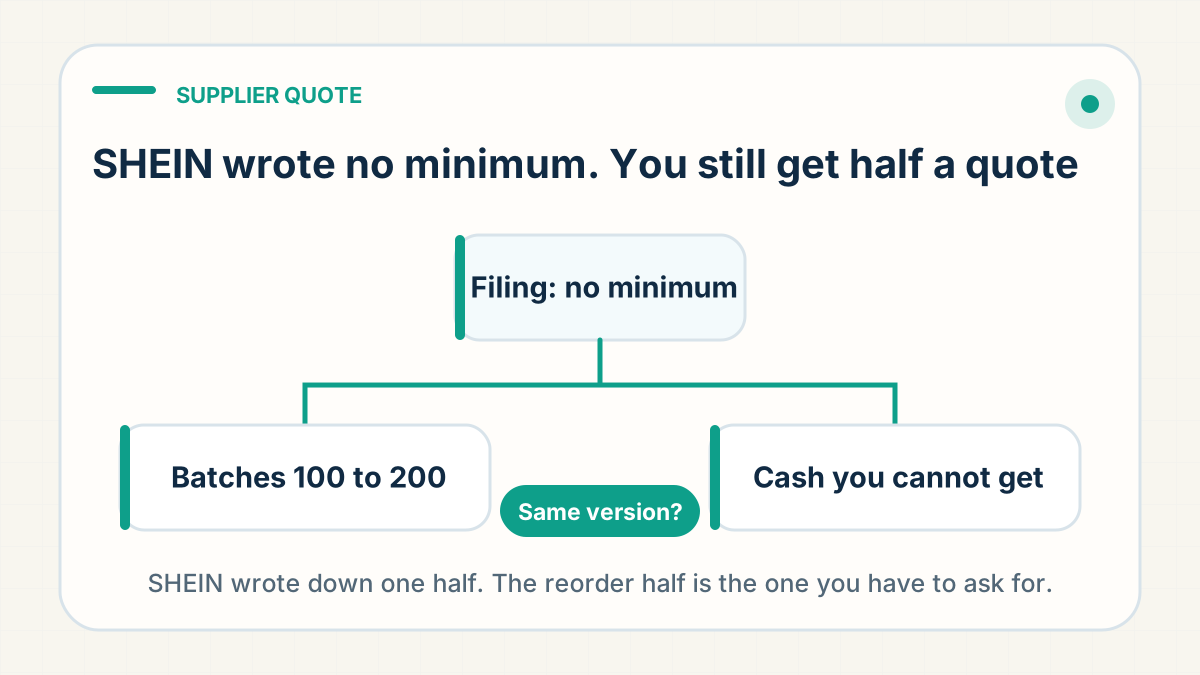
SHEIN's Hong Kong prospectus of 24 August 2026 sets out the standard terms it agrees with the contract manufacturers behind a substantial majority of its products by procurement value. One of them reads, in full: "Minimum purchase agreements. We do not specify any minimum purchase requirements." That is the buyer committing to no minimum. SHEIN still orders initial batches of approximately 100 to 200 items, and restocks the ones that sell in as few as five days. A low MOQ is half a supplier quote. The other half is what happens if the product works: whether the same version comes back, how fast, at what price, and whether the stock you were shown is held for you or for whoever orders first.
Your supplier will quote you a minimum, and that number is one half of two. The two halves are agreed separately, which is how a quote can look cheap on the first and be useless on the second. The supplier with the smallest first lot is often the one with the most cash locked in dedicated material, tooling and custom packaging, and the one least able to make the same thing again next month. That is the trap, and the rest of this page adds up both halves so the cheapest-looking quote stops fooling you.
This guide covers the low-MOQ supplier quote. For what no MOQ costs per unit, see what no MOQ really costs you. For minimums by branding level, see what private-label MOQs look like in China. For minimums tied to certificates, see why product certificates come with an MOQ.
What SHEIN's filing does and doesn't tell you
The loop itself is in low inventory is not a dropshipping moat: small initial batches of approximately 100 to 200 items, and restocking the ones that sell in as few as five days. What that guide did not cover is the contract underneath it. In the list of standard terms SHEIN agrees with its contract manufacturers, the makers who supply a substantial majority of its products by procurement value, the filing says it does not specify any minimum purchase requirements. SHEIN also reports unsold stock in the low single digits as a share, and inventory turning over in 36 days in 2025 and 38 in the twelve months to March 2026.
Read the party carefully. It is SHEIN, the buyer, that commits to no minimum; the maker carries that risk. Three more things those sentences do not mean. A contract with no minimum does not mean every style is made at zero quantity; the batches are still 100 to 200. It does not cancel an order once placed. And "as few as five days" is a restock at SHEIN's fastest; the filing does not say where the goods land, and it is not delivery to anyone's customer. You are not SHEIN, and no supplier will give you its contract.
What you can copy is the shape, and one mechanism the filing spells out. SHEIN says it uses its scale to pre-negotiate fabric prices with key mills and keeps a listing of those fabrics in a shared digital library that its contract manufacturers buy from directly. In plain terms: common, already-priced materials, so a maker does not have to buy a dedicated roll for one style. Hold that thought; it is Supplier B below.
The quote has two halves, and they are agreed separately
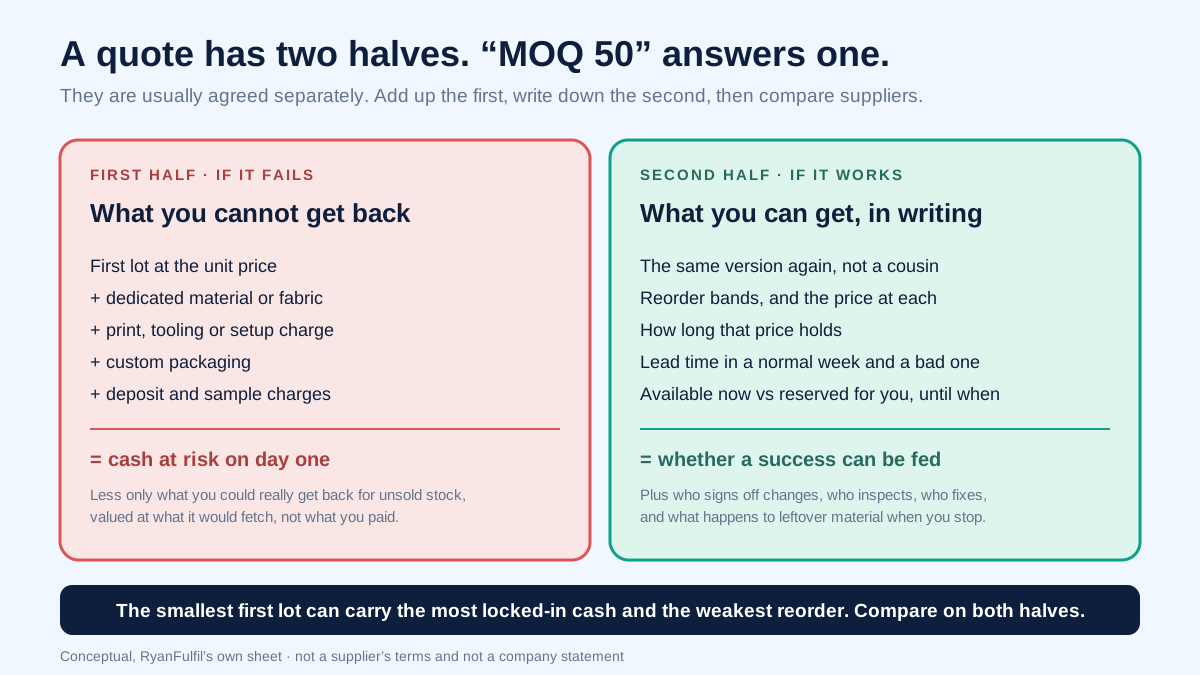
The first half is what you lose if the product fails. The second half is what you can get if it works. A supplier can be flexible on one and immovable on the other, and most sellers only ask about the first.
- First half, the loss side: the first lot, plus anything committed alongside it. Dedicated fabric or material, a printing or tooling setup, custom packaging, a deposit, a sample charge. Most of this does not come back.
- Second half, the gain side: whether the exact version can be made again, in what quantity band, at what price, how fast in a normal week and in a bad one, and whether any of the stock you saw is held for you.
A quote that reads "MOQ 50" has told you one number from the first half and nothing from the second. Until you have both, you do not know what you are buying, and a successful ad test can leave you unable to fill the orders it produced.
Add up what you cannot get back
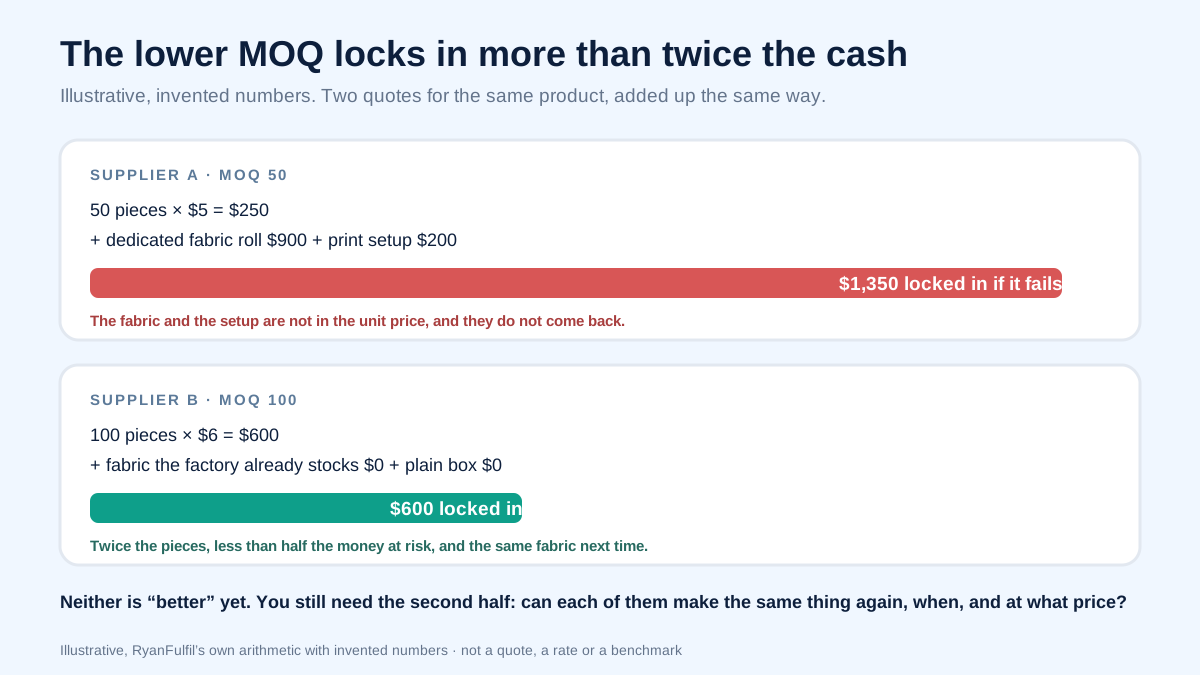
An illustration, with invented numbers. Supplier A offers 50 finished pieces at 5 dollars, but needs a dedicated roll of fabric for 900 dollars and a print setup for 200. If those are separate and you cannot recover them, your cash at risk on day one is 1,350 dollars. Supplier B needs 100 pieces at 6 dollars, uses a fabric it already stocks and a plain box, and asks for nothing else. Cash at risk: 600 dollars.
Supplier A has the lower MOQ and more than twice the money locked in. That is the whole trap in one line. It is not a rule that the higher MOQ is safer; it is a rule that you add up every committed cost before you compare quotes, and that "MOQ" on its own is not that total.
Two things the illustration leaves out on purpose, and you must not. Both totals are goods and setup at the factory door. Add freight and duty to your country, on the same shipping terms for both quotes, before you rank them; two quotes on different terms can swap places once the goods have to arrive. And in this example Supplier A has the cheaper unit price, and setup costs still outweigh it. Usually the small lot also costs more per piece, which is the trap what no MOQ really costs you covers; the two guides are describing the same supplier from two sides. Leave your ad spend out of the supplier comparison. It is spent whichever quote you pick, and belongs in your test budget instead.
Two mistakes to avoid when you add it up. Do not count the same material twice, once inside the unit price and once as a separate charge; ask the supplier which it is. And do not value unsold stock at what you paid for it. Write down what you could realistically get back for it, how long that would take and what it would cost you to do, and use that figure. One more thing about that dedicated roll: it usually exists because the mill has its own minimum, not because the factory chose to charge you. The negotiable move is a material the factory already runs, which is the fabric-library idea from the filing at your scale.
"In stock" is not "held for you"
The second half has its own trap, and it is the one that catches sellers whose ad test went well. A supplier who says the product is in stock is usually telling the truth. It means they hold some units today. It does not mean those units are reserved for you, that the next batch will be the same version, or that the price you were quoted holds at the quantity your campaign now needs.
So a successful ad test can be selling stock that is gone by the time you decide to scale. The customer paid, the ad worked, and the version you sold is now a different colour, a different material, or on a two-week wait. This is the point at which a lot of stores start substituting quietly, and it is where refunds and reviews come from.
Ask for the distinction in writing: what is available now, what is reserved for you, and for how long. Paying for a reservation can make sense if the profit it protects is bigger than the fee and the promise is one the supplier will keep. It can also be money for nothing. What you must not do is hand an untested supplier a large deposit to feel safe; who owns the stock behind a deposit is its own question, and the answer is often not you.
Write the reorder half down
The reorder half fits on one sheet, and a supplier who cannot fill it in has told you something. Record, for the exact version you approved:
- The approved version and where it comes from, so a reorder is a reorder and not a cousin.
- The first lot, and separately every material, setup and packaging cost committed with it, and who owns the stock once it is paid for.
- What is available now against what is reserved for you, and until when.
- The reorder quantity bands and the price at each, and how long that price holds.
- Lead time in a normal week and in a bad one, from your order to goods ready, not to your customer.
- Which changes need your sign-off before they are made: material, colour, component, packaging, factory.
- Who inspects, who fixes a fault, and what happens to leftover material when you stop.
Download the blank supplier commitment sheet. One row is one quote. The first columns add up the loss side, including freight and duty on the same terms; the rest record the gain side and how you checked it. Fill it in for every supplier before you compare unit prices, and the cheapest quote will sometimes change.
What a filled-in sheet is worth
A supplier can fill in every line of that sheet for free. A completed sheet is the supplier's claims in writing, not facts, and on its own it carries no more weight than the quote it was meant to test. It becomes worth something when you check the second half before the money leaves.
- Place a small trial reorder before the main one, and check it against the approved version when it arrives. A reorder that comes back right once is evidence; a promise that it will is not.
- Stage the payment so the balance falls due against the reorder terms, not up front. A supplier who will not agree to that has told you what the terms are worth.
- Confirm the party you are paying is the factory: a business licence and an address that match, or someone who has stood inside it.
- Agree in writing what happens if the reorder differs from the approved version: replacement, refund, or a price change you sign off first.
Do not treat a full sheet as diligence done. Treat it as the list of things you now know to check.
What a reservation could be worth
If a supplier offers to hold capacity or stock for a fee, here is the sum, with invented numbers. Say there is a 40 per cent chance your test succeeds, and if it does, having stock ready would let you fill 120 orders you would otherwise lose. Say each of those keeps 9 dollars after every cost. The most the reservation can be worth is 0.4 times 120 times 9, which is 432 dollars. That is a ceiling, before uncertainty, before the value of simply waiting, and before you ask whether another source could make the same version anyway. It is not a fee to pay. It is the number to compare a fee against, and you have to put in your own odds, not SHEIN's.
Speed to launch is not speed to a decision
SHEIN's five days is a restock, and it is the wrong clock to measure yourself by. Your test has two clocks. One is how fast you can launch. The other is how long until you know enough to reorder or stop, and that includes sample approval, delivery to the customer, the customer using the product, support, the refund window, and the next production run.
For a product with a short life, a three-day launch can still be too slow if the reliable answer arrives in six weeks and the demand is gone by then. For an everyday product that will still be wanted next season, a slower first answer is fine as long as the same version comes back. Record when you saw the sign, when you approved the version, when the first lot was paid, when the first deliveries landed, when the complaints settled, and when you reordered. Compare that span with how long your offer will last, not with a number from a prospectus.
The prospectus does contain a bad week, and it is worth knowing what one looks like at the top of the category. SHEIN's inventory turnover went from 36 days in 2025 to 38 in the twelve months to March 2026, which the filing describes as remaining relatively stable.
What moved was the stock itself: SHEIN's inventories rose from US$1,261 million at 31 December 2025 to US$1,384 million at 31 March 2026, and SHEIN puts that down to extended in-transit lead time resulting from the disruption of certain international shipping routes due to the Iran War. The largest online fashion destination took a war onto its balance sheet, and barely into its turnover ratio.
For you the same disruption is a reorder that lands after the season, which is why the sheet asks for lead time in a bad week and not only a normal one.
When to skip all of this
If your product is interchangeable, already compliant, and reliably available from several proven suppliers with no setup cost, the reorder half is short: buy from whoever has it. Do not customise a product that does not need it, because every custom material, unusual colour and dedicated tool moves cash from the recoverable column to the locked one and adds a way for the reorder to differ from the original.
The sheet earns its place when your product depends on a fit, a material, your own artwork, a component nobody else stocks, or a finish one factory does well. Then the reorder half is the business, and the best lesson from SHEIN may be less customisation on the first lot, not more products launched faster. Nobody publishes a base rate for how often a reorder comes back different, or how often "in stock" turns out not to be held. When it happens it is rarely visible until the customer has paid.
Do this before the next quote
- Take your current best quote and add up every committed cost beside the unit price, then freight and duty to your country. Write the total as cash at risk if the product fails.
- Ask what you would get back for unsold stock, in money and in weeks. Use that, not the purchase price.
- Ask, in writing, what is available now, what is reserved for you, and until when.
- Ask for the reorder bands, the price at each, and the lead time in a normal week and a bad one.
- List the changes that need your sign-off, and get the supplier to confirm the list.
- Pick one check from the list above and run it before you pay: a trial reorder, staged payment, or proof of the factory.
- Only then compare suppliers, on both halves.
What to watch and what not to assume
- Watch: whether SHEIN's first results after listing put numbers on its restock times and batch sizes, and whether the 38-day turnover figure keeps rising; and, for you, how many of your last five reorders came back as the same version at the same price.
- Ignore: "SHEIN has no MOQ so neither should your supplier"; "in stock means ready to scale"; "the lowest MOQ is the safest test"; and any quote that gives you a unit price without the costs beside it.
- Obtain the actual supplier terms, lead time, quote and sample for your order. The prospectus describes SHEIN's own standard agreement, not terms available to a small store, and this guide is not backed by a supplier quotation or tested product sample. Apart from SHEIN's own reported figures, every dollar figure here is invented to show the arithmetic, no product is recommended, and this is not investment research or an opinion on any share. Nothing in the prospectus is a promise to you.
Where RyanFulfil fits
The loss side of the quote is yours to negotiate. Where a China-side team helps is on both halves at once: we confirm the exact version exists at the factory rather than a cousin, ask the reorder questions in the supplier's language and get the answers in writing, sample it, check the packing, and quote the whole packed parcel to your country so the first-lot arithmetic uses a real landed cost rather than a unit price.
Factory terms and capacity are the supplier's to give, not ours to promise, and a reorder can still come back different. We check it when it arrives and tell you what changed. The decision to commit cash stays with you.
Before you pay for a first lot, send us the product, the country and the quote you have and we will fill in the other half.
Read both halves before you sign either
A low MOQ answers one question: how much you lose if the product fails. Every quote has a second question: what you can get if it works. Add up the locked-in cash with freight and duty on the same terms, write down the reorder terms, check one of them before you pay, and compare suppliers on both. The smallest first lot is sometimes the most expensive way to find out your product sells.
Here is how you would prove us wrong. If a store that picks suppliers on the lowest MOQ alone keeps more profit once refunds have settled than one that fills in both halves of the sheet and checks one, this guide is wrong. Try it on your next three quotes.
Then here is the argument worth having with another seller. SHEIN is the buyer in that contract, it got no minimum written into it, and its initial batches are still approximately 100 to 200 items. Which half of your last quote did you actually negotiate: the number you would lose if the product failed, or the one you would need if it worked?
Need a product checked before you spend on ads?
Send us the product link and destination on WhatsApp (+86 178 4666 9989). We'll check sourcing, packing and shipping with you before you commit.
Get Sourcing Quote on WhatsApp →