Branding is a ladder, not a switch
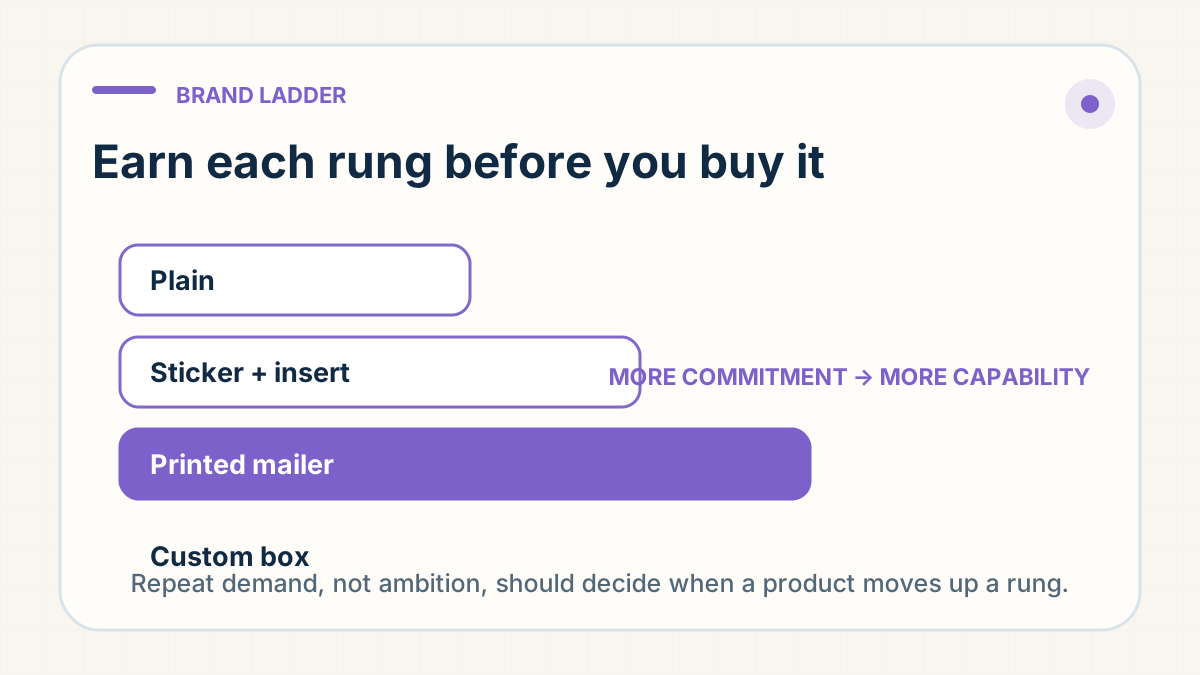
Sellers often treat packaging as a single decision: generic now, branded later. In practice there are several distinct rungs, each with its own minimum quantity, lead time and reversibility. Knowing which rung you are on prevents both of the common mistakes, which are paying for custom presentation on an unproven product and staying generic long after a product could carry the cost.
The rungs, in rough order of commitment:
- Plain packaging with no supplier marketing. The default. Costs nothing extra and hides your sourcing.
- Logo stickers or printed labels applied to a stock item or mailer. Low minimum, fast, easy to reverse.
- Printed insert cards, thank-you notes or care instructions. Cheap per unit, no tooling, and the usual first step that customers actually notice.
- Custom printed mailer bags or boxes. Real minimum quantities and a print lead time, but no product change.
- Custom retail packaging designed around the product. Higher minimum, artwork approval, and a sample round before production.
- Custom tooling or a modified product. A different order of magnitude in cost and lead time, and the point at which a decision stops being easily reversible.
The cost is not only the packaging
Each rung adds handling work, and several add weight or volume. A rigid box that presents well can push a parcel into a higher volumetric weight band, which is charged on every order rather than once. An insert card costs very little to print but adds a pick step. A gift item that is free to the customer is not free to the parcel.
This is why a packaging decision should be priced as landed cost per order rather than as a unit price for the packaging itself. The question is what the finished, protected, shippable parcel costs to deliver, not what the box costs to buy.
Earn the rung
The pattern we see on accounts that scale well is unglamorous. They stay on plain packaging while testing, add an insert card once a product has repeat orders, move to printed mailers when volume makes the minimum quantity sensible, and only commission custom boxes for products that have proven they will still be selling when the print run arrives. One anonymised accessories account followed exactly that path and its most recent packaging order was a ten-thousand-unit run of custom printed boxes, which is a very different decision from ordering the same boxes at launch.
The failure mode in the other direction is real too. A product that is clearly working, shipping in a plain bag, is leaving repeat-purchase and referral value unclaimed. If a product has survived several months and a supplier change, it has probably earned a rung.
Protect the spec when anything changes
A branding spec is only as good as its continuity. If a factory changes mid-relationship, the replacement may not offer the same service, and a spec can lapse without anyone raising it. We have had this happen: an agreed logo sticker stopped being applied after a factory switch and the client found out himself rather than being told. That was our failure to communicate, and the fix was procedural rather than technical. Any factory change now triggers an explicit check that every agreed specification still holds before anything ships.
Ask your partner to confirm the same. The question to put in writing is simple: if the supplying factory changes, who checks that my packaging and branding specification survives, and when do I hear about it?
What to confirm before committing to a rung
- Minimum order quantity, and whether it applies per design or per size variant.
- Artwork format, print tolerances and whether a physical sample is produced before the full run.
- Storage. A large print run has to live somewhere until it is used.
- What happens to unused stock if the product is discontinued or the design changes.
- The effect on parcel dimensions and therefore on shipping cost per order.
Is that quantity a minimum order, or one plate's capacity?
A minimum order is a floor you have to reach; one plate's capacity is how many units a single printing setup covers before a second setup is paid for — and one quoted number can be either. The rung-by-rung figures are a different question, answered on the guide to what private-label minimums look like by branding rung. What that page cannot tell you is what the figure on your own quote is counted in, whether it is a minimum at all, and how often the one-off charge comes back.
As of September 2026, across this desk's sourcing conversations in the two weeks to 11 September, a branding minimum came up in low tens of separate conversations over nine trading days, and the figure often needed a second question before it could be priced. An apparel enquiry was given one quantity covering five separate garment styles, and had to ask whether that was a minimum or one plate's capacity. It was a minimum order, and it ran per style, multiplying it five times — which no one could price against until the seller asked.
The one-off charge behaves differently: it can be charged more than once. Adding a logo to a stock drinkware line was quoted as a plate charge against the artwork, and the supplier warned in advance that one more revision would count as the third and carry a further plate-making fee, named before the revision was authorised rather than billed after it. How many proof rounds that charge covers is a separate question from whether a reorder triggers it again. On a packaging order the run was fitted to two bag sizes the supplier already had; whether the seller would pay plate charges for three further sizes was still open at the close of the window.
A cheaper rung has to fit the surface the logo sits on. A seller wanting his logo on a kitchen appliance and its box was quoted a four-figure customisation minimum; a clear sticker was suggested for the appliance itself, and was not expected to cover a logo already printed on the box, so the printed box stayed behind the minimum.
A product link alone prices none of this; the branding type, the artwork file and its finished size go with it. Then ask the two things a rung list cannot answer: whether the quantity quoted is a minimum order or one plate's capacity, and how many artwork rounds the one-off charge covers before it is charged again.
Climb the packaging ladder only when demand pays
Move up the ladder deliberately, one rung at a time, and let repeat demand rather than ambition decide the timing. Price each step as landed cost per order rather than as a packaging unit price, keep early rungs reversible, and make specification continuity an explicit agreement so that a supplier change never quietly undoes what you paid for.
Operating rule: Move up the packaging ladder only when the customer value and repeat volume justify the cash, lead time and stock commitment. Approve each asset on the finished packed unit and reprice dimensions, handling and route eligibility before ordering more elaborate packaging.
Planning branded packaging or a private-label run?
Share the product and the level of customisation you need on WhatsApp (wa.link/dropship). We will help you understand the practical next step.
Discuss Branding on WhatsApp →