Field note
The situation
Screen the exact product against the exact destination before you spend on ads, creatives or a landing page. Monday produced an unusual number of answers that were some form of no. A device whose overall appearance is covered by a registered design. Apparel printed with recognisable sports figures. Replica versions of well-known branded goods. A bladed item. Food destined for the EU. A wellness product too large and heavy for any route we could stand behind. In each case the seller had already invested attention, and in several cases advertising, before asking whether the item could ship.
For regulated goods such as batteries, cosmetics and liquids, see what special-goods shipping actually covers.
- 01Identify the exact itemTwo similar products can sit on opposite sides of a rule.
- 02Check brand, design and licenceCustoms can assess overall appearance, not only a printed name.
- 03Check destination rulesEligibility is item plus destination, never category alone.
- 04Answer plainly, in writingIf a seller proceeds anyway, the risk should be stated and owned.
Eligibility is decided by the item, not the category
A category rarely answers the question. Two visually similar products can sit on opposite sides of a rule because one carries a battery, a protected shape, a licensed image or a regulated formulation. The check therefore has to run against the exact item and the exact destination. One request this week was for an item whose packaging carried no brand name at all — but customs assessments can look at the overall visual appearance of a product, not only the label, and the underlying shape was the protected part.
An early no is cheaper than a late one
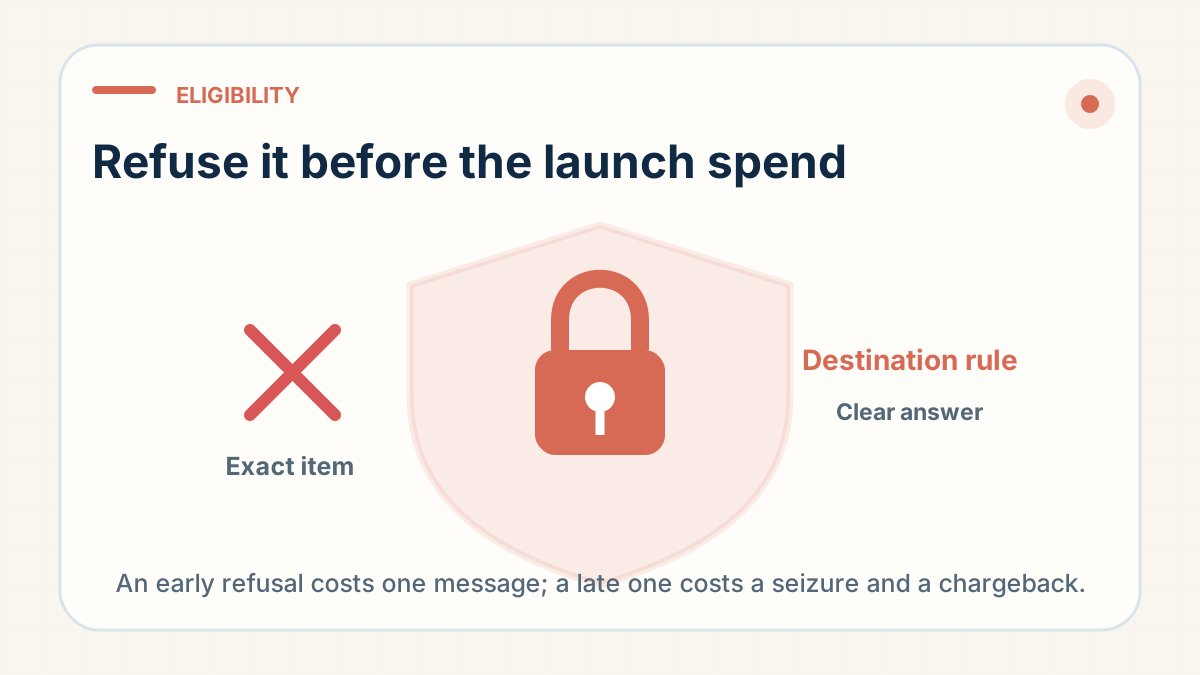
The cost of a refusal at enquiry stage is a disappointing message. The cost of the same refusal after a customer has paid is a seizure, a possible penalty, a refund, a chargeback and a store reputation problem, all landing at once. Sellers do sometimes want to proceed anyway. When that happens the answer is not a lecture; it is a clear written statement of the risk and of who carries it, so the decision is informed rather than assumed away.
Answer the question that was actually asked
A separate thread on Monday was a good reminder in the other direction. A seller asked whether a garment would fit a particular body measurement. The first reply gave the largest available clothing size, which is a related fact and not an answer. The seller had to ask again to get the specific measurement confirmed with the factory. Screening is about precision in both directions: precise enough to refuse the wrong product, and precise enough to answer the right question the first time.
That thread had a real commercial cost attached. The seller could see customers arriving at the product page, failing to find their size in the chart, and leaving without ordering — so the unanswered question was not academic, it was a measurable conversion problem. When the manufacturer finally confirmed the specific measurement, the answer turned out to be that a different style in the same category did cover the range. The seller could have had that a day earlier.
"Similar" is a finding too
Monday also produced a run of sourcing replies where the honest answer was that an identical item could not be found and only a near equivalent existed — a different closure, a different fabric weight, one size band instead of several, a colour that photographs warmer. Those replies are more useful than they look, provided the reply names the difference rather than smoothing it over.
The failure mode is a reply that says "similar product found" and attaches a price. The seller then builds a listing around images of the original and receives the equivalent, and the gap surfaces as a return. Naming the specific difference lets the seller decide whether it is cosmetic, whether their copy needs to change, or whether the product is simply not worth selling in that form.
Restricted does not always mean refused
Not every constraint is a flat no, and treating them all the same wastes options. Some products are genuinely unshippable on any route we would stand behind. Others are shippable but only on a slower or costlier channel — oversized items that have to travel by sea, or goods with a power source that need a dedicated battery lane and therefore price very differently from the seller's expectation.
The useful reply separates those cases. "We cannot ship this" and "we can ship this, but it changes your delivery window and your unit economics, here is by how much" lead to completely different decisions. Collapsing them into a single refusal loses a product the seller could have sold profitably at a different price point.
New seller desk
The Monday intake spanned apparel and footwear, electronics and devices, home and lifestyle goods, and health and fitness items. The route questions centred on European destinations with recurring US enquiries. Several of the newer conversations were still choosing a product, which is the ideal moment for an eligibility check — before creatives, before a landing page, before a single paid click.
Screen the product before accepting the order
Screen the exact product against the exact destination before you spend on demand. A partner who tells you early that something cannot ship is protecting the launch you have not run yet, and that is worth more than a quote you could never have used.