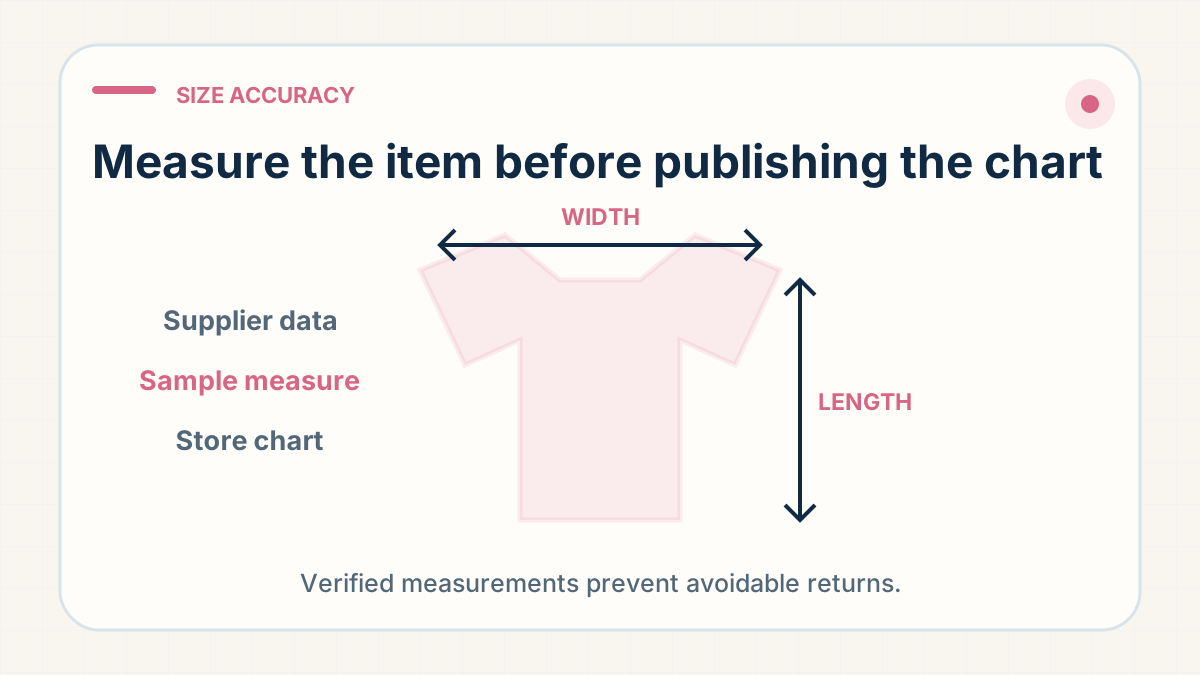
Apparel and accessories are one of the best margin categories in dropshipping, and also one of the easiest to get badly wrong. The reason is simple. You're not physically handling the product. You never try it on. Your only connection to what a garment actually fits like is a size chart, usually copied from a supplier listing that was written by someone whose main job wasn't writing accurate size charts.
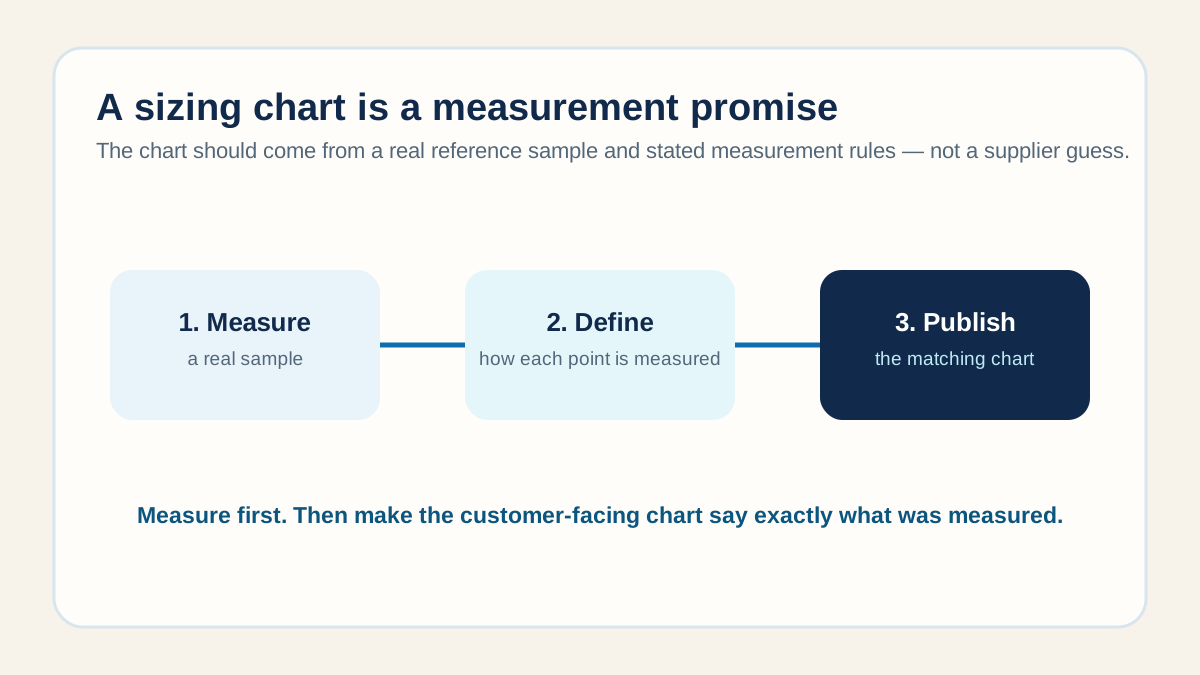
Get this wrong and it shows up as returns. Get it right and it quietly becomes one of your biggest advantages, because most competitors don't bother fixing it.
Why Chinese sizing doesn't map cleanly to US, EU, or UK sizes
This is the part people underestimate. It's not just that a Chinese "L" is smaller than a Western "L." The whole system of labeling is built differently.
A few things worth knowing:
Chinese clothing is generally cut for a slimmer build. Narrower shoulders, shorter torso and arm length, generally sized for a smaller average body frame than US or UK sizing standards. It's common for Chinese sizing to run one to two sizes smaller than the equivalent US label, sometimes more depending on the category.
The letter or number on the tag means almost nothing on its own. An "L" from one factory and an "L" from another can differ by several centimeters in chest or waist measurement. There's no single enforced national standard the way there roughly is in US or EU retail. Always work from the actual centimeter measurements, not the label.
Measurement units differ, which causes its own errors. UK and US sizing conventions are often built around inches. Chinese and most of the rest of Asia and Europe measure in centimeters. If you're converting a supplier's cm chart into inches for a US audience and you round sloppily, you can be off by enough to push a customer into the wrong size.
Shoe sizing runs on an entirely different scale. Chinese shoe sizes are usually given in centimeters of foot length, not the same numbering as US, UK, or EU shoe sizes. Converting shoe size accurately requires actual foot-length-to-size tables, not just a rough label match.
None of this means Chinese-made apparel is bad quality. It just means the label on the tag is not something you can hand your customer as-is and expect a good outcome.
The return-rate impact of getting this wrong
Sizing is consistently one of the top return reasons in apparel ecommerce generally, and it's worse in dropshipping specifically because you often have no local exchange option. A customer who gets the wrong size can't just walk to a store and swap it. They're stuck mailing it back internationally, waiting on a refund, and probably never ordering from you again.
We see this constantly with new apparel stores. They copy the supplier's size chart straight onto their product page, size labels and all, without converting to real body measurements. First month, everything looks fine because volume is low. Then orders scale and so do the "wrong size" returns, and by the time someone looks into it, it's already eaten a chunk of that month's margin.
A practical process for building accurate size charts
Never publish the supplier's label-only chart. If the sheet you got just says S/M/L/XL, that's not a size chart, that's a starting point. You need actual body measurements in both cm and inches attached to each label.
Get real measurements, not marketing copy. Ask your supplier or fulfilment partner for the actual garment measurements, chest, waist, hip, length, taken flat off a physical sample. Not the "recommended body size" text a factory sometimes throws in, which is often optimistic.
Build your own chart in both units. Show centimeters and inches side by side on every listing. Don't make the customer do the math or guess.
Add a plain-language sizing note. A single line like "this runs small, we recommend sizing up one size from your usual fit" prevents more returns than a beautifully formatted chart most customers won't read closely anyway.
Re-verify after every restock or new supplier. Sizing isn't fixed forever. If you switch suppliers for the same SKU, or the factory changes the pattern, your existing size chart may no longer be accurate. Treat it the same way you'd treat a material or color change, it needs a recheck.
Track returns by size, not just by product. If a specific size is coming back at a noticeably higher rate than others, that's usually a chart problem, not a product problem. Fix the chart before you touch the product listing.
Use customer measurement data if your platform supports it. Some apps let customers input their own measurements and get a size recommendation. This is worth the setup time on any apparel SKU doing real volume, since it takes the guesswork away from a chart the customer might skim past anyway.
Where we help on this
We're handling physical product for clients, so when a sizing complaint or return comes back tagged "wrong size," we can trace it. Is it consistently the same size running small, is it a specific SKU, did something change with the latest restock. That pattern is invisible if you never see the actual returns coming back, but obvious once someone's looking at them across orders.
Getting a size chart right isn't glamorous work, but for apparel it's one of the highest-leverage things you can fix. It's the difference between a customer keeping their order and a customer mailing it back and leaving a two-star review about fit that has nothing to do with your product's actual quality.
The rule: Publish measurements tied to the exact supplier version and explain how the customer should use them. Recheck after supplier, pattern, material or construction changes; a generic size label cannot carry the promise when the physical garment is outside your direct custody.
Want a product checked before it ships?
Tell us what to check on WhatsApp (+86 178 4666 9989), and we can build those product, packaging and quantity checks into the fulfilment process.
Request Quality Check on WhatsApp →