Field note
The situation
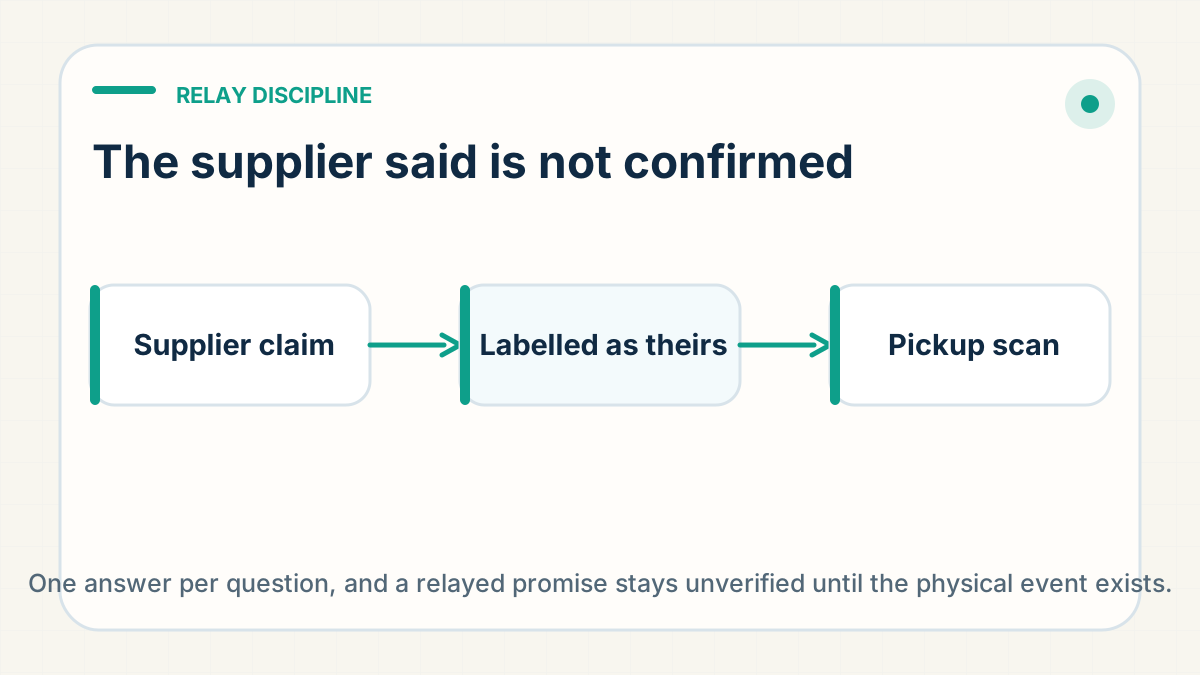
Relay a supplier or carrier claim with its source named, because a claim stays a claim until the scan exists. Wednesday was a heavy quoting day with a long after-sales tail. Prospects across Europe and the US wanted landed prices on batches of marketplace links, first-order sellers were placing manual orders, and the after-sales groups carried stalled parcels, an overseas redelivery, a refund on personalised goods a factory could not make, and a mouth-contact product with no paperwork. The day's pattern was easy to name and hard to live by: much of what the desk passed on was somebody else's claim, and it went out as if it were ours.
A supplier claim stays a claim until the scan exists
The desk told a seller of personalised goods that the factory had dispatched and the goods would reach the warehouse within days. An hour later it told the same seller the factory could not dispatch at all, and offered a refund. The desk itemised the refund and paid it the same afternoon, which is how it should go. But the hour between the two messages cost more than the refund did, because the first message relayed a factory's promise in the desk's own voice. No scan and no handover note existed, only a sentence from a supplier.
The same shape repeated with carriers. A brand asking about a difficult destination was told in one hour both that parcels could move on a recipient-clears basis and that no channel existed. A stock-holding seller was promised a fresh tracking number for an overseas redelivery and chased it for two days before hearing that redelivery there runs on the original number. Two answers an hour apart, or a promise of a number that will never be generated, do more damage than one slower reply that separates what is verified from what is still the supplier's or the carrier's word.
The pre-generated label is the clearest case. A first-order seller asked for a tracking number before the goods had been bought, to calm a customer. The warning was given and consent taken; the better answer is a dated status note the seller can pass on, because a number that sits at label created for a week produces the complaint it was meant to prevent. The same goes for figures: a seller holding stock overseas asked for delivery averages to print on its storefront and got them from memory, when what it wanted was a dated export. Every status we relay should carry its source and its evidence, and the tracking status glossary shows what each scan does and does not prove.
Ask for every missing field in one message
Ask for every missing field in one message. The desk asked a first-time buyer on a manual order for the address in plain text, then a phone number, then the recipient's name: four messages for a one-line order. A seller correcting a Nordic address got the phone-number question two hours later, and the number arrived two days after that. A custom-logo textile enquiry got the colour-count question one evening and the artwork-size question the next morning; three days on, it had no price. The printed-insert spec came in pieces across three days. None of these questions was wrong. The desk asked each one on its own.
A manual order, an address fix, a logo quote and a printed-box quote each have a fixed field list. The bulk buyer asked for drawings and dimensions in the first reply had a quote the same evening — that is the shape to copy. The checklist for a deliverable address and the one for a brief a supplier can quote already exist; the practice to adopt is sending the whole list in the first reply and marking which fields are still open.
Relaying the factory's answer is not the end of the matter
A seller building a European catalogue asked for safety certificates and a per-flavour ingredient list for an inhaled-aroma accessory. The factory said neither exists beyond a one-line material description, and that answer was relayed accurately and without comment. Accurate is not enough for a product that goes near the mouth. The desk's job is to say the risk out loud — an undocumented product of that kind is a customs and liability problem in the EU — and to offer to find a factory that can document it.
The template existed on the same day: a personalised photo-gift quote carried an unprompted warning about portrait rights and the risk of seizure. It also helps to explain the supplier stance that EU certificates are released only after an order, because earlier buyers misused them — a seller deciding whether to commit deserves that reason. Who answers for the product in the EU is the question behind all three, and the responsible-person guide and the FAQ set out what the desk can and cannot certify on a factory's behalf.
Label a supplier claim until it is verified
Before forwarding any date, status or document claim, ask whose it is and what evidence exists for it, and relay it with that label attached. Ask for every missing field in one message, and when a factory cannot answer a safety question, say the risk plainly and offer the documented alternative rather than passing the silence along.