The direct answer
Say "this needs that lane", never "this cannot fly". Almost every consumer light you could sell is legal to send by air. What changes is which lane you have to buy, what paperwork rides with your parcel, whether the post office stays open to you, and when your cut-off falls. Most sellers find this out after they have promised a customer a delivery date, which is the expensive way to learn it.
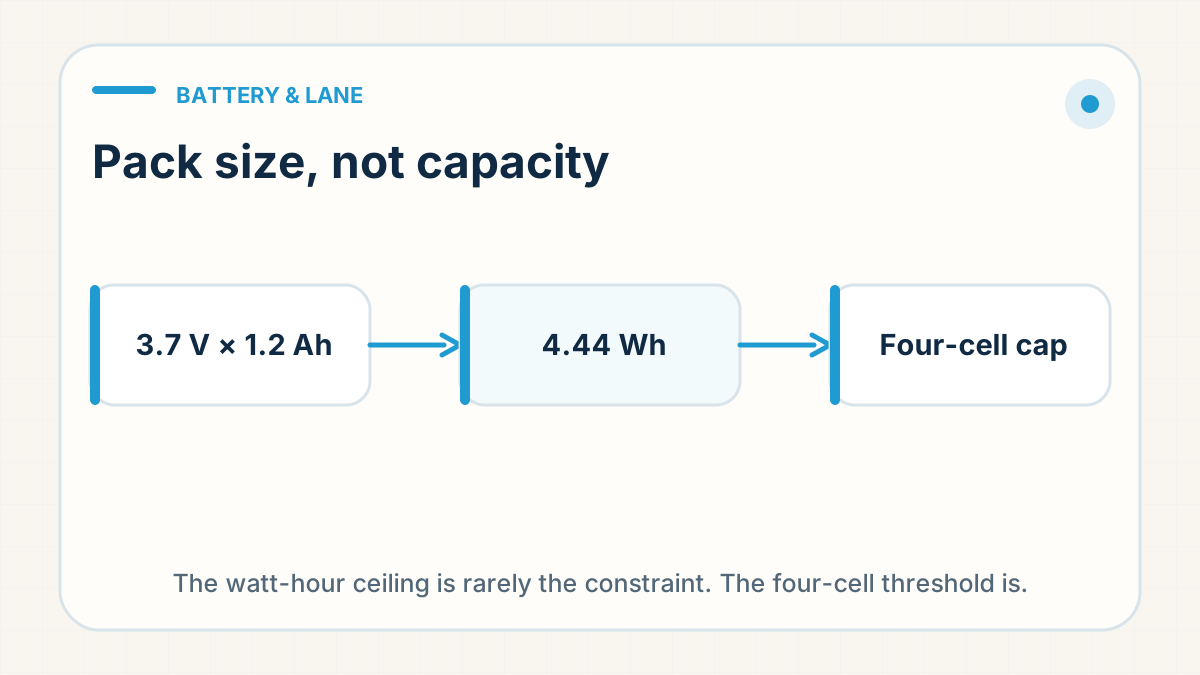
Here is the part that surprises people. With lighting you almost never hit the watt-hour ceiling, so the size of your cell is rarely the problem. Any lithium cell at all puts your parcel into a documented regime with a four-cell threshold. So the thing that breaks your numbers is how many units you put in the box, not how much capacity each one holds.
Work out your own watt-hours
Watt-hours are volts times amp-hours. That is the whole sum, and you should run it on your own product before you brief a factory. Take a typical 45 cm USB rechargeable motion-sensor cabinet bar with a 3.7 V, 1200 mAh cell. Turn milliamp-hours into amp-hours by dividing by 1000, which gives you 1.2 Ah. Then 3.7 multiplied by 1.2 gives 4.44 watt-hours.
Now put your number against the ceilings that matter. The single-cell ceiling for lithium-ion batteries contained in equipment under the relevant Section II packing instruction is 20 Wh, and the multi-cell battery ceiling is 100 Wh. At 4.44 Wh your cell sits at roughly a fifth of the single-cell ceiling. The net battery weight limit per package is 5 kg, on both passenger and cargo aircraft, and at roughly 25 grams a cell that is some two hundred cells. You will never hit it with lighting.
Two more reference points, so you can place your own product. A standard 18650 cell of the kind used in solar lights is 3.7 V by 2.0 Ah, which is 7.4 Wh. A two-cell work-light pack at 7.4 V by 2.6 Ah is 19.24 Wh. Both sit comfortably inside the same Section II regime. You will struggle to build a consumer light that goes over these thresholds.
What actually stops you: four cells and two packages
The relief that lets a parcel of batteries contained in equipment travel without the lithium battery mark applies only to a consignment of no more than two packages, each holding no more than four cells or two batteries installed in the equipment. Industry guidance is blunt about it. You may not send more than two such packages without the mark, and you and your forwarder should not split a consignment across several air waybills to get around it.
A six-pack of cabinet lights is six cells. You are already over the threshold. Once your parcel has to carry the mark, you need a carrier account approved for lithium batteries and a restricted service code, some road legs may refuse it, and postal is closed to you. That is why a product that prices beautifully as a single unit prices badly as the multipack your marketing wants to sell.
Postal operators worldwide work to the same international ceiling: lithium cells only when they are installed in the equipment they run, and no more than four cells or two batteries per mailpiece. Batteries packed alongside but not installed in the equipment are out, standalone batteries are out, and so is any package that has to carry the lithium battery mark. Confirm the exact terms with the origin operator that actually handles your parcel, not with the post office at the other end.
The spare cell trap
Putting a free spare cell in the box looks like a better offer to your customer and is a much worse shipment for you. It moves your parcel from batteries contained in equipment to batteries packed with equipment, which is a different packing instruction. From 1 January 2026, under the applicable special provision, Section II lithium-ion cells packed with equipment and rated above 2.7 Wh must be offered for air transport at a state of charge no higher than 30 per cent of rated capacity. Cells installed inside the equipment stay under a recommendation rather than a requirement.
So the instruction you give your factory is one sentence: ship the cell fitted, not bagged. The old advice that shipping the battery loose in the box is the safer way to pack it was never well founded, and it is now the wrong answer.
Which lane your product buys
- Mains-powered or alkaline, with no lithium at all: every lane is open to you including postal, and there is no battery paperwork. Alkaline and other dry cells are not dangerous goods, so you only need packing that stops short circuits.
- Rechargeable, one or two units per parcel: postal and express are both open to you, and you need no mark.
- Rechargeable multipack, or consolidated cartons: marked, express only, and you need an approved carrier account and a restricted service code. Postal is closed to you.
- Rechargeable with a spare cell in the box: the packed-with-equipment packing instruction, a compulsory state-of-charge limit above 2.7 Wh, and postal closed to you.
- Loose cells or power banks sent on their own: a cargo-aircraft-only dangerous goods lane with a shipper declaration. This is not a parcel product you can sell to consumers.
A button-cell design is the lightest lithium tier you can buy. It comes with relief from the battery mark and from chasing the test summary, but it is still lithium under a relief rather than a free good, and the postal cap per mailpiece still applies to you. Watch for one more thing: plenty of products sold as coin-cell night lights actually run on alkaline AA or AAA cells, which sit outside all of this.
The one supplier test that matters
Ask for the UN 38.3 test summary as a PDF, and check that the model number on it matches the cell actually fitted to your product. It is a ten-field document: the manufacturer and test laboratory contact details, a unique report number, the date, a description of the cell including its watt-hour rating, the list of tests and their results, and the edition of the test manual used. Manufacturers and distributors have to make it available when you ask, a link or a QR code counts, and it does not have to travel with every shipment.
A factory that cannot produce it on request has no air lane you can practically buy. Treat that as a hard fail at supplier qualification. Watch one more thing: changing cell supplier mid-production quietly invalidates the summary, and that is a common and baffling reason for your repeat order to be refused on a lane that worked perfectly last month.
This guide answers which lane your product buys. Which compliance documents your product needs at all, what each one covers, what it costs you and how long it takes, is answered in UN38.3, EN71, CPSC and LUCID.
The other half of the cost: you are paying for air
Lighting is a category where you usually pay for volume rather than weight. An 80 gram light bar in a 50 by 8 by 5 cm mailer bills you several times its real weight. Long bars, reels and anything you ship in a display box are the worst offenders, and the packing that protects them adds bulk that never shows up on the product datasheet.
Volumetric divisors on lines like these vary a lot by product line and destination, and the number moves your margin, so ask for the divisor that applies to your line rather than assuming one. On the US domestic leg, nonstandard-size surcharges begin at a package length of 22 inches, rise again past 30 inches, and apply again above two cubic feet, so your 60 cm bar in a 65 cm box crosses the first tier on shape alone.
Quote a lighting product on the final packed box, never on the bare spec you were sent. Why the same box prices differently on different lanes is set out in why the same box can price out differently.
What we can check for you
Send us the product link, the cell spec, the pack size you want to sell and the destination, and we will run the route check before you list: which lane your product buys, whether postal stays open at your pack size, what paperwork your factory has to produce, and what your packed box does to chargeable weight. Contact RyanFulfil before you promise a customer a delivery date, not after.
What these numbers cannot tell you
Sources as of 30 August 2026. The thresholds, packing instructions and the state-of-charge rule are summarised from published air transport and postal guidance current at that date. This is orientation for a commercial decision, not dangerous goods advice. Acceptance is decided per product, per pack, per destination and per service line, and a yes for the category is never approval for your customer-ready item. Rules here change on a yearly cycle, so re-check anything on this page before you rely on it.
A general battery-lane price premium or transit-day penalty is not established by the cited carrier material. Restrictions on service codes, approved accounts, accepting operators and cut-offs explain the constraint, not its exact cost. Per-kilo surcharge figures circulating online lack primary support. Check your product-specific quote against a current rate card.
Re-read this guide whenever your cell supplier, pack size, packing method or destination changes. Recheck the marking conclusion if a carrier routinely accepts an unmarked consignment above the four-cell threshold, because the practical relief would then be running looser than the published rule says.
Need one order or route checked?
Worried about an order's tracking? Send us the order number on WhatsApp (wa.link/dropship) and we'll check what's going on.
Check Order on WhatsApp →