The direct answer
Lighting is a real e-commerce category with steady, non-trend demand. It is also a category where the decisions that set your shipping lane are made at the factory, long before you see a rate card. Demand is the easy half and most of it is public. The half that decides whether you make money is whether the item carries a lithium cell, whether it touches mains voltage, and how many units you put in a parcel. A product with strong demand and a battery setup that forces you onto a marked, restricted lane can be a worse business for you than a duller product that travels on any lane.
Three switches at the factory decide what you can sell
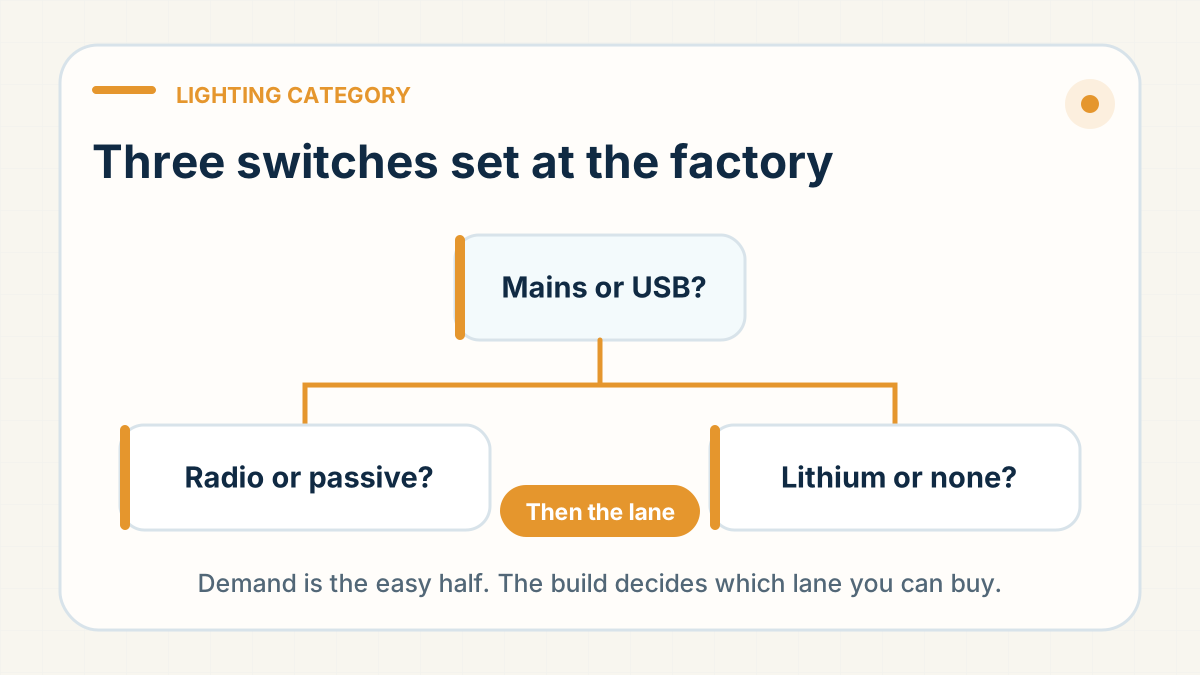
Before you compare products, learn to read three switches. Each one is set while the product is designed, and each one changes what you can sell, where you can sell it, and what it costs you.
- Does it touch mains voltage? The EU Low Voltage Directive applies from 50 V AC. Below that, you have no low-voltage safety file. Above it, or if you put a mains power supply in the box, you pick up a safety file, an EU energy label and EPREL record, an efficiency marking on the adapter body, and four physical plug SKUs for the US, EU, UK and Australia.
- Does it transmit radio? Wi-Fi, Bluetooth, Zigbee, a 433 MHz remote or an mmWave presence sensor all pull your product into radio equipment rules, and into certification issued per model rather than self-declaration. A passive infrared motion sensor is not a radio and does not.
- Does it carry a lithium cell? This decides your lane, and it is the switch sellers understand least.
One design decision settles the first switch completely: ship a cable, not a plug. A USB-C-only product sits outside the Low Voltage Directive, outside EU lighting energy labelling, and outside the four-way plug split. That one sentence is worth more to you than any demand chart. What the third switch does to your parcel is worked through in the guide on how the battery decides the lane.
The four picks
Non-lithium push and puck lights running on AA or AAA alkaline cells. This is the boring winner. Large home-improvement retailers keep dedicated filtered category pages for battery-operated and motion puck lighting, which is a merchant telling you that shoppers filter for exactly this. It is the only lighting shape with no lithium consequence at all: no test summary for you to chase, no battery mark, no air waybill statement, postal lanes fully open, and the EU removable-battery rule arriving in 2027 is already met by the battery door the product has. What you can copy here is one tooling that earns its money through pack count, control method and thickness, with no app, no cloud, no firmware and no support cost to carry.
USB-powered, cell-free ambient lamps: sunset, galaxy, projector and mood lighting. These ship on any lane, sit outside the Low Voltage Directive, outside energy labelling and outside EPREL, and need no plug split. The product photographs itself, which is most of how you will get customers. The honest risk here is not shipping, it is demand. This is a fast-cycle line where a trend can die while your stock is still in the air, so buy small, reorder fast, and never carry it as base-load stock.
The rechargeable motion-sensor bar, in one setup only: packed length at or under 50 cm, sold as one- and two-unit orders so postal pricing stays open to you, with a screw-access battery door, a spare-cell supply line, and the cell fitted rather than bagged. Set up that way, it is a good business. In the setup the category actually sells in, which is four- and six-packs of 60 cm glued sealed bars, it is a worse business for you than the puck light above. Choose it only if the packed length, pack count, serviceable battery and lane economics work for your target market.
Solar path and stake lights, as a line you deliberately pre-stock against the season. Nobody should air-freight solar lights to customers one at a time. The panel-and-stake shape means you pay for air, and the cell is built in so you cannot avoid the battery lane. Pre-stocked into your destination market in December and January, it becomes the natural counter-season to a fourth-quarter indoor decorative line, using the same warehouse on the opposite calendar. It also sits outside EU lighting energy labelling and carries no plug split.
The three traps
The mains 12 V RGB strip kit. It appears on every list of winning dropshipping products and it is a poor first line for you. You are not selling a light, you are selling a light plus a regulated power supply. The adapter carries an efficiency file and a marking printed on its body, visible in your own product photos, plus an electromagnetic compatibility file and a safety certification route.
For the EU it adds a low-voltage file, an A-to-G energy label and an EPREL record you cannot create from a supplier datasheet. It then splits into four plug SKUs, multiplying your working capital and your dead-stock risk on the line carrying the heaviest paperwork, while the stack of adapter, controller, remote and retail sleeve blows a small reel up into a worse chargeable-weight bracket.
The version you can save is a short USB 5 V strip: same look, none of the file.
Smart, app-controlled and mmWave presence lighting. Three separate problems. On the rules: connected-product cybersecurity duties are moving from radio equipment rules toward the EU Cyber Resilience Act, so if you start a smart line now you have to design it for where the rules land, not where they are. On the money: radio certification is issued per model, which rules out the SKU churn dropshipping depends on.
Commercially: the app is not a moat, it is a recurring cost and a single point of brand death. Sengled cloud outages in mid-2025 left working bulbs uncontrollable in customers homes, and its Alexa skill was discontinued on 1 August 2025. Nanoleaf was acquired in 2026 for about US$40.5m having never turned a profit, despite major retail distribution.
Watch the specific trap for lighting: a passive infrared sensor is not a radio, but an mmWave presence sensor is a transmitter, and most factory listings do not flag the difference.
The multipack and the free spare battery. This is the least known and most expensive trap in the category. The relief that lets a rechargeable parcel travel unmarked applies only to a consignment of two packages or fewer, each holding no more than four cells installed in equipment. A single six-pack already puts you over the line. Once your parcel is marked, you need a carrier account approved for lithium and a restricted service code, and postal is closed to you. Separately, adding a loose spare cell to the box moves your shipment to a different packing instruction with a compulsory state-of-charge limit. The old advice that shipping the cell loose in the box is the safer way to pack it is now exactly wrong.
A note on how crowded these are
Every crowding call in this guide is our judgement, based on the mix of brands we can see on marketplace category listings. We counted no sellers and measured no market shares. Read crowded and open as directions, not as numbers you can rely on. The general shape is that puck lights, strip kits, night lights and solar security lighting are densely contested, camping and work lighting less so, and that the entry price in any of them is set by an established brand you will not undercut on cost.
What to launch when
- December to January: stock solar garden, path and stake lighting. Your selling ramp runs from mid-March to the end of May.
- January: closet and pantry organisation lighting, which reuses your fourth-quarter sensor-light stock into the decluttering moment.
- February to May: sell solar, stock camping and outdoor. Camping demand is triggered by trip planning, so advertise three to six weeks ahead of the travel itself.
- Stock by early July for back-to-college. This is the most reliable demand figure in the category: the National Retail Federation forecast a record US$103.5bn back-to-college season averaging US$1,437.79 per household, with electronics the largest category and dorm or apartment furnishings close behind.
- Order July to August and sell September to December: decorative strips, fairy lights and gift-priced sensor lights. Many shoppers browse early but most still buy over the Thanksgiving weekend, so do not plan your stock turn as though October is the peak.
- September to January: motion-sensor closet, wardrobe and pantry lighting. Clocks go back and wardrobe interiors are dark by late afternoon.
- Do not carry decorative and fairy lighting past mid-December. Demand falls away sharply in January.
What we can check for you
We can check a lighting product before you commit: the battery setup and which lane it actually buys you, the packed dimensions against a chargeable-weight bracket, whether the compliance file matches the exact model, and what your pack size does to your parcel costs. The commercial calls stay yours. Contact RyanFulfil with a product link, a target market and the pack size you want to sell, and we will tell you which of the three switches you have already flipped.
What these numbers cannot tell you
Sources as of 30 August 2026. The rules and carrier guidance come from published regulator and industry documents, summarised so you can get your bearings, not as compliance advice for your specific product. The retail-demand discussion rests on the existence and shape of named marketplace and retailer category pages, which you can re-check in a browser, and on published National Retail Federation survey figures. Company events are press-reported.
This is category guidance, not a measured demand forecast. Marketplace rankings, units-sold estimates, review counts, search-trend indexes and third-party sales-tracker figures are not established by the cited primary sources. The lane guidance comes from published rules, not a RyanFulfil shipment-history analysis.
Re-read this guide when a product changes cell supplier, power input, pack size or destination market, and whenever a rule named here reaches a new stage. Test the pack-size assumption against your own landed costs. If a lighting line held its margin at scale in a marked lithium multipack, the pack-size problem would be cheaper than we say it is.
Need a product checked before you spend on ads?
Send us the product link and destination on WhatsApp (+86 178 4666 9989). We'll check sourcing, packing and shipping with you before you commit.
Get Sourcing Quote on WhatsApp →