Direct answer: what does the EU charge?
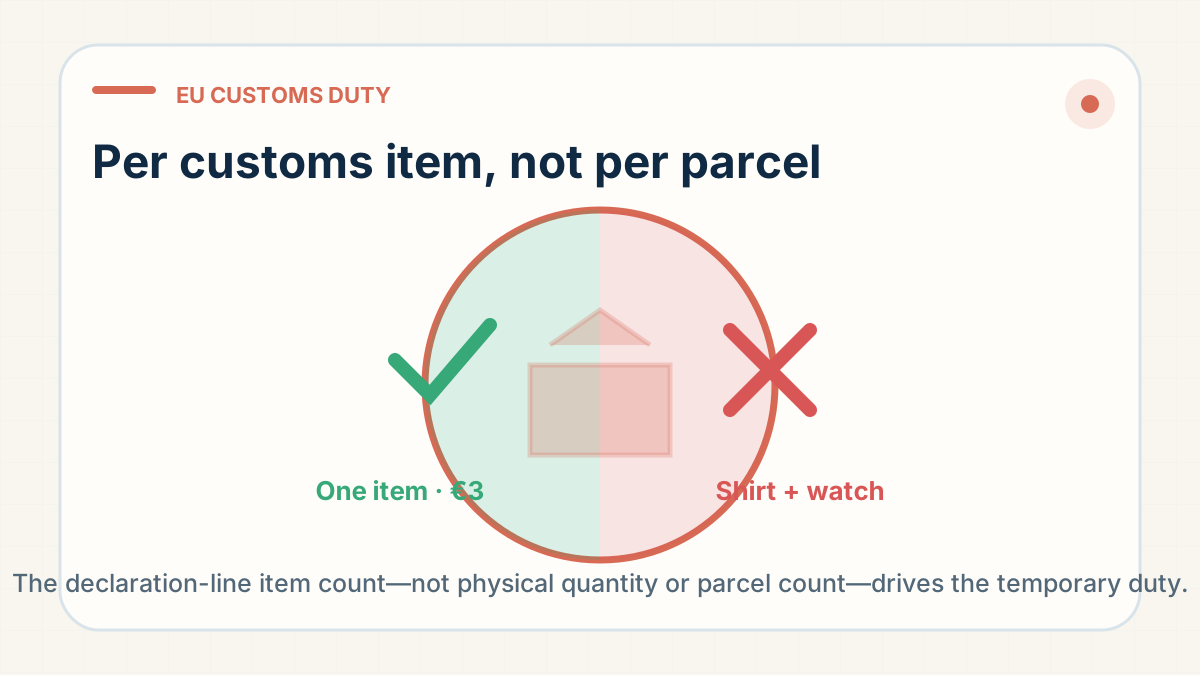
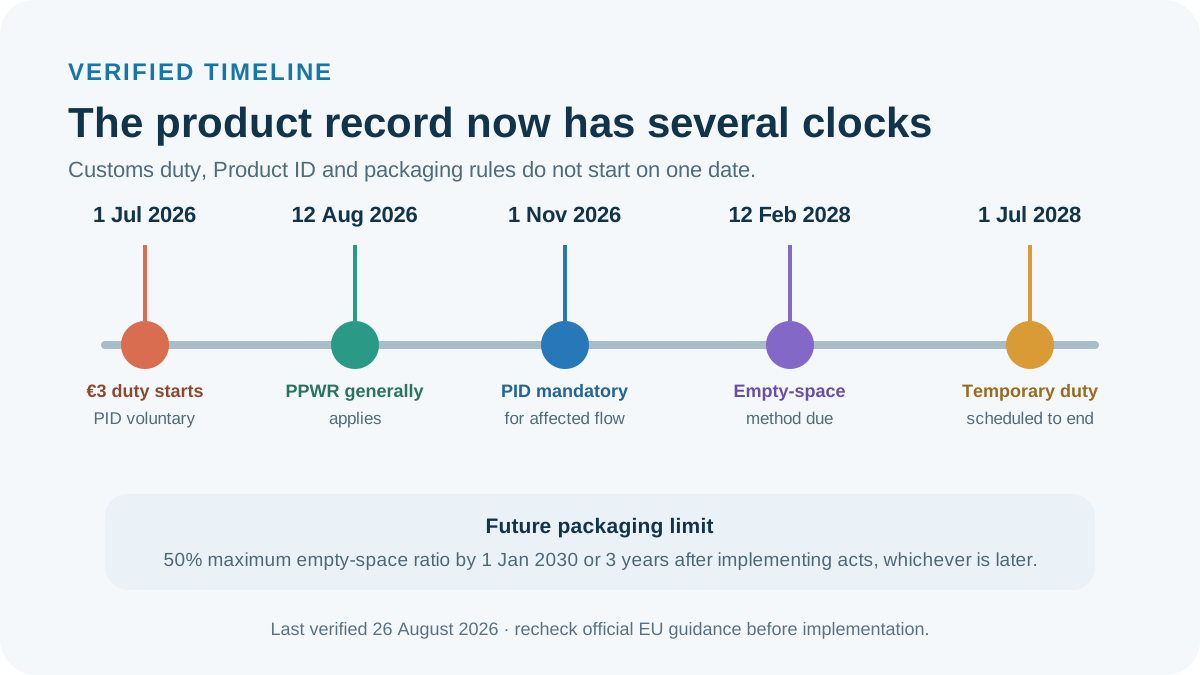
Since 1 July 2026, the EU applies a temporary €3 customs duty to each customs "item" in a low-value consignment with an intrinsic value up to €150. It is not €3 per parcel and not €3 per physical unit. Official guidance says the system calculates the duty per declaration line, regardless of quantity. The measure is scheduled to run until 1 July 2028.
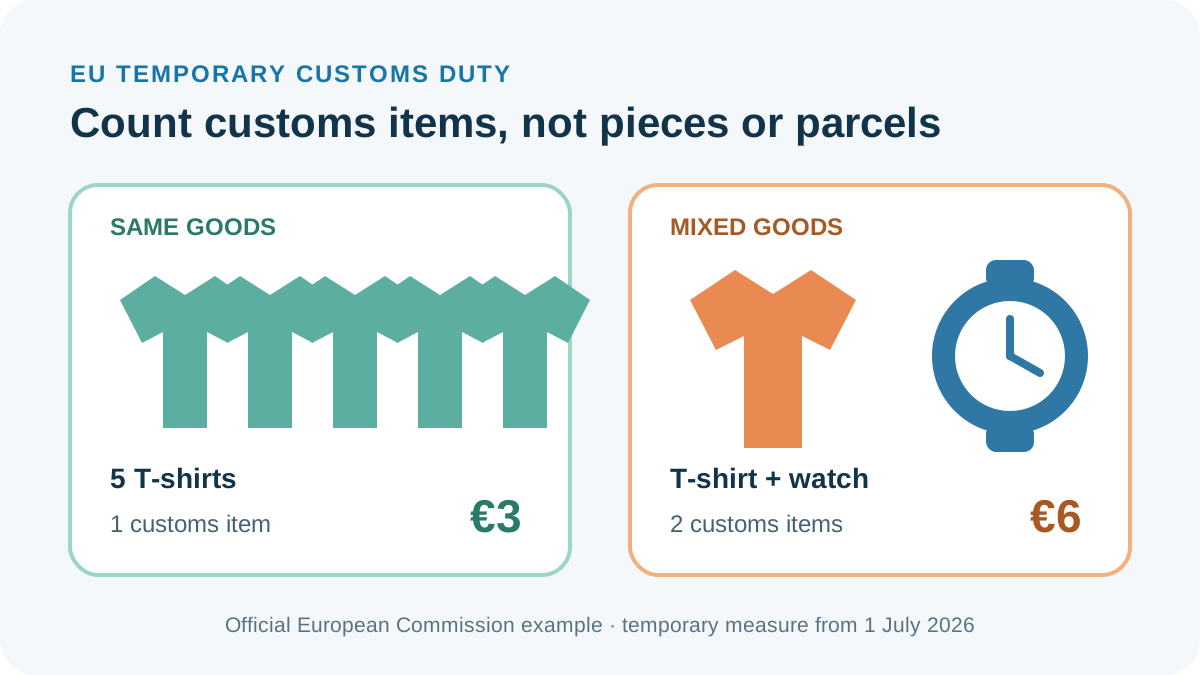
The official example is deliberately simple: five T-shirts in one consignment are one item and attract €3; one T-shirt plus one watch are two items and attract €6. VAT and IOSS are separate from this customs duty.
What counts as one customs item?
"Per HS code" is useful shorthand, but it is incomplete. The Commission guidance defines an item as goods in the same consignment that share tariff classification, description and, where provided, origin. Operationally, the temporary duty is calculated for each declaration line. That means the safe question is not "How many pieces are in the box?" It is "How many customs items and declaration lines will this exact order create?"
Do not infer the answer from storefront SKUs alone. Two quantities of the same approved product may remain one item. A shirt and a watch clearly do not. Colour, size, composition, origin, product description and the data sent in the declaration can affect how variants are represented. The declarant or customs representative must use the actual goods and current guidance; a merchant should not invent a classification to make the basket cheaper.
This distinction also corrects a common headline. The duty is not an EU "handling fee". A separate Union handling-fee mechanism exists, but its amount and application timetable were still not final when this page was verified. Do not add an unpublished future fee to a live quote.
Why this matters to RyanFulfil merchants
The RyanFulfil portfolio reviewed for this analysis covered 145,005 unique store-orders and 360,691 units from 1 May to 14 August 2026. Europe represented 57.3% of orders, bundle-heavy stores represented 45.9%, and the portfolio averaged 2.49 units per order. Those are public-safe aggregates, not a prediction for an individual store.
The combination makes the rule unusually relevant: European exposure is high and many merchants deliberately increase basket depth. It does not prove that 2.49 units create 2.49 customs items. That would confuse physical quantity with declaration structure. It does show why the customs-item count belongs inside bundle, gift and add-on economics instead of being left to the carrier invoice.
How can €3 change a bundle that appears profitable?
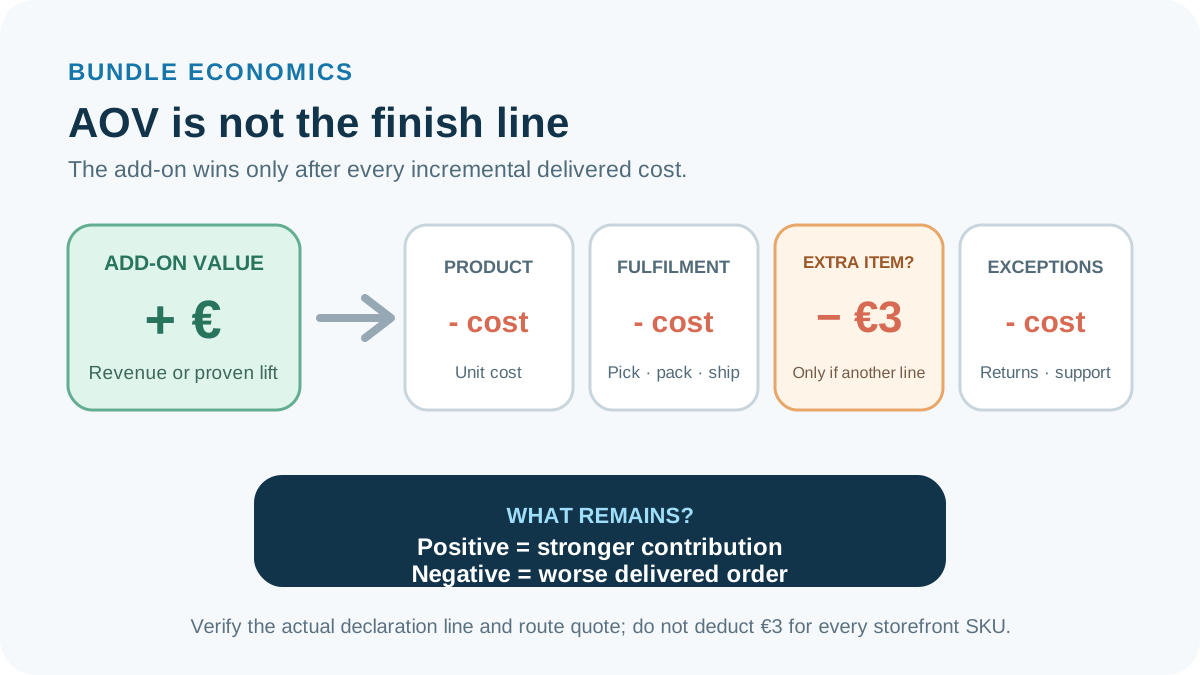
A bundle should earn contribution after every incremental physical and customs cost. For one extra add-on, test this sequence:
- Incremental revenue collected from the add-on or the conversion lift attributed to it.
- Minus the add-on product cost, pick or kitting work, packaging and incremental freight.
- Minus €3 if the add-on creates another customs item on the applicable low-value EU consignment.
- Minus the expected refund, replacement and support burden created by the more complex order.
If what remains is negative, a higher AOV has produced a worse delivered order. If the add-on shares the same customs item or the route quote absorbs the line, do not deduct another €3. Use the declaration or a route-specific quote, not a blanket SKU rule.
This is the customs layer of a wider calculation. Use the bundle and free-gift cost checklist for packing and inventory, then the AOV and cart-quality audit to test whether the offer improved delivered contribution rather than only checkout value.
Where does the merchant actually see the cost?
Most customers will not see a line labelled "temporary customs duty" at checkout. The amount normally reaches the merchant inside a landed quote or a route charge. That makes three prices easy to confuse:
- The official EU duty: €3 per customs item under the temporary measure.
- The amount a carrier, clearance channel or fulfilment partner passes through in a particular quote.
- Any future EU handling fee, whose final amount and implementation must be checked when adopted.
Ask for those layers separately. A landed quote should state the destination, route, included duties and tax, declaration-line basis, product restrictions and validity date. If the quote says only "EU fee", it is not specific enough to audit.
For the rest of the quote, use the landed-price quote guide. If responsibility for the declaration is unclear, also identify the importer of record before changing the product classification or customer promise.
Why does RyanFulfil sometimes quote €2 instead?
RyanFulfil currently has a tax-inclusive clearance channel in routine use for eligible EU orders with a €2 per-code pass-through. This is a RyanFulfil route observation and commercial pass-through, not a second EU legal rate. The temporary duty remains €3. What changes is the eligible clearance channel and the price carried into the landed quote.
The lower pass-through usually trades roughly two to three additional working days for cost. Product category, destination and special-goods handling can make the channel unavailable. Confirm it for the exact product and destination; do not copy a route observation into a universal store policy.
Does splitting the parcel avoid the duty?
Usually not. If a T-shirt and a watch are two customs items, putting them into two parcels does not turn them into one. It normally adds another label, more freight and another delivery path. Consolidation can still save per-parcel cost while leaving the customs-item count unchanged.
Split only when packed dimensions, route eligibility, fragility, stock timing or customer promise justify it. Compare the total landed cost and expected exception cost, not the duty line alone. The article on when one order becomes two parcels shows the packing and tracking side of that decision.
Would stock inside the EU avoid the duty?
A parcel dispatched domestically from stock already in the EU is not the direct low-value import described by this measure, so this particular €3 import duty is not charged again on the domestic customer shipment. That does not make local stock automatically cheaper. Inbound freight and import costs, receiving, storage, domestic parcel minimums, working capital, markdown risk and split inventory replace the direct-parcel cost.
Use local stock when proven destination demand, delivery value and product economics repay that commitment. Do not move a light, uncertain product into an EU warehouse solely to remove one customs line.
Compare the full choices in dropship, China pre-stock or overseas warehouse, with the same SKU, destination mix and demand evidence in every scenario.
What about returns and replacement parcels?
Do not assume the €3 can be recovered through the low-value simplification when the customer returns an item. Commission guidance says the simplified mechanism itself cannot be used to reimburse or remit the temporary duty; the general customs repayment rules remain available where their conditions are met. Returns therefore need an evidence and responsibility process, not an automatic margin credit.
A replacement is a new physical movement. Ask the declarant how the exact replacement is entered and quoted rather than treating "free to the customer" as a customs classification. Keep the reason, original order, replacement contents and route evidence together so a support promise does not become an unexplained second landed cost.
What else changes in 2026 and after?
Product data becomes more important, not less. A Product ID (PID) is voluntary from 1 July 2026 and mandatory from 1 November 2026 for the affected low-value import flow. The guidance describes one exact variant—including brand, size, colour and packaging—as one persistent PID. A supplier link is not enough: merchants need stable product records that can survive listing, declaration, warehouse and after-sales handoffs.
The Packaging and Packaging Waste Regulation generally applies from 12 August 2026. Its future empty-space rules are not a reason to guess a 2026 carton ratio: the calculation method is due by 12 February 2028, and the 50% maximum applies by 1 January 2030 or three years after the implementing acts, whichever is later. The practical action now is to measure the shipped package and control components, not to claim early compliance from a supplier photo.
The strongest alternative explanation—and how to test it
A seller may see landed cost rise after 1 July and blame the €3 duty when the real cause is heavier packaging, a new carrier band, a different destination mix, a supplier version change or a quote that stopped absorbing a route cost. The customs rule is one mechanism, not a universal diagnosis.
The conclusion is falsified for a specific offer if the pre-change and post-change quotes use the same product, packed dimensions, destination and route, and the declaration shows no additional customs item while the cost still moved. In that case audit freight, weight, channel and product version before changing the bundle.
A practical audit for dropshippers
- Export the top multi-item EU orders by delivered contribution, not only by AOV.
- Attach the exact product record, description, origin where provided, packed dimensions and current declaration-line count.
- Recalculate mixed bundles, gifts and add-ons using the incremental margin gate above.
- Request a route-specific landed quote showing official duty, pass-through, transit trade-off, restrictions and validity date.
- Test one controlled order before changing a store-wide promise or moving stock.
- Record the result by SKU and destination so the next store does not repeat the same experiment as an assumption.
Evidence boundary and last verified
Last verified 26 August 2026 against European Commission customs guidance, its implementation Q&A, the official PPWR page and Regulation (EU) 2025/40. The legal and carrier detail can change. Recheck this page when the EU publishes the separate handling-fee amount, when the temporary duty ends or is amended, when PID implementation guidance changes, or when a route quote changes.
Portfolio figures are aggregate observations from 15 supplied order-export archives covering 1 May to 14 August 2026. They are not a random sample of all dropshippers, do not identify any merchant, and do not prove that a physical unit or storefront SKU equals a customs item. Merchants remain responsible for their products, declarations, tax and legal advice; RyanFulfil can help verify the physical product, route and quote fields it actually handles.
Model the temporary duty by customs item, declaration line and destination before changing…
Model the temporary duty by customs item, declaration line and destination before changing prices or routes. Separate the official €3 rule from a route-specific pass-through, verify who owns the declaration, and recheck the page when EU guidance, PID implementation or the separate handling fee changes.
Need a route or order checked for a specific order?
If a specific order's tracking has you or your customer worried, send us the order number on WhatsApp (wa.link/dropship) and we'll check what's actually going on.
Check Order on WhatsApp →