From the operations desk
The month in one line
June showed the difference between answering a question and building an operating plan. Across DropFulfill and YRFulfill conversations, sellers arrived with product links, ambitious forecasts, delivery problems, custom-branding ideas and growing order flows. The useful work was turning each request into checkable product facts, a physical fulfilment path and a clearly owned next decision.
- 01Define the customer-ready unitOne piece, one pair, one set or one packed parcel.
- 02Match evidence to the itemDocuments and photos must map to the exact version being sold.
- 03Name stock and delivery statesAvailable, committed and incoming are not interchangeable.
- 04Own the next decisionEvery enquiry should end with one named next step.
June by the numbers
The evidence base for this review is 30 dated daily operations notes and five weekly review windows that touch June. From that material we grouped four recurring case clusters—sourcing briefs, growth and capacity, rule changes, and delivery exceptions—and carried six controls into the operating playbook. The archive covers both DropFulfill and YRFulfill work under RyanFulfil, so it is a view of the collective desk rather than one staff member, one client or one unusually busy chat.
Commercial context also came in three visibly different bands: people still exploring a product or first sample; sellers with first orders, single-digit or low-tens live flows; and separate factory or sourcing discussions measured in hundreds of units. US, UK and broader European markets recurred, while the product mix crossed apparel and accessories, electronics, home and lifestyle, beauty and personal care, and custom-branded goods. Those broad bands are useful because they explain the decision without exposing an identifiable store or exact order history.
Based on 30 dated daily notes and five overlapping weekly windows. Chat and message totals are not unique people or paid demand. Four recurring problem clusters and rounded operating stages describe the observed work; they are not a customer conversion measure.
Who came to the desk—and what they needed
At one end were early sellers whose apparent request was a price. In practice, they needed help defining the customer-ready unit, confirming whether the wanted variant could reach the target market, deciding whether neutral packing was enough and working out what a first order or sample should prove. One composite European apparel enquiry, for example, began with a particular size and colour for one customer. The useful work was not merely locating a listing: it was confirming the actual variant, its delivered cost, availability and the next commitment without turning a one-order request into a promise of scale.
In the middle were stores already processing first orders or low-tens flows. Their risks were different: a missing best-selling variant, an address change arriving near release, tracking that existed but had not meaningfully moved, or a quality issue that could be either isolated or the first sign of a batch problem. These sellers needed a repeatable handover more than a larger catalogue. The operational question became: can another person see what was approved, what state the order is in and what evidence closes the issue?
At the other end were larger sourcing, replenishment and inherited-backlog conversations. Some were discussing hundreds of units or a sharp demand increase; others were changing factories or taking over an existing queue. Scale made product identity more important, not less. A small difference in material, device version, colour or included component could spread across a large buy, while a reassuring total stock figure could conceal that the variant actually selling was unavailable.
For a dropshipper, this is the central relevance of June: the right fulfilment setup depends on the stage the evidence supports. A first-product seller usually needs one controlled product-and-route test. A store with live demand needs variant-level stock, an approved reference and an exception workflow. A seller considering hundreds of units needs supplier capacity, working-capital and replenishment evidence before treating a forecast as inventory demand.
June at a glance: markets, categories and operating stage
The reviewed work covered US, UK and broader European-market questions, plus smaller groups of international destinations where route coverage needed checking. Product categories included apparel and accessories, electronics, home and lifestyle goods, beauty and personal care, and custom-branded items. Commercial stages ranged from product exploration and first samples through single-digit or low-tens live order flows, with separate sourcing discussions in the hundreds-of-units range. These are pooled bands across conversations, not the footprint of one identifiable seller.
That mix matters because the same question meant different things at different stages. "Can you source this?" could mean finding one sample for a seller with no paid orders, validating a substitute for a store already selling, or confirming whether a factory could replenish a proven SKU. June became more useful when the team recorded the stage, exact decision and evidence gap before treating the conversation as an order plan.
The month week by week
May 31–June 6 was about the front end of the operation: converting a product question into a brief that covered the customer-ready unit, target market, evidence and sensible first commitment. The daily notes added the texture—branding requests, a rights-sensitive product the team would not copy, a difficult destination check and a stock-count scare all showed why price alone was not enough.
June 7–13 moved into exact product identity and scale. A seller forecast a rapid increase, another operation was outgrowing a factory, and a large inherited backlog arrived with a version dispute. The recurring question was whether the physical product, evidence and capacity plan still matched the commercial promise.
June 14–20 connected store data to the warehouse. Pricing pressure, an approaching tax change, a holiday deadline and an unusually broad technology request all had to be reduced to a practical handover: what the store sends, which variant is approved, what milestone counts as dispatch and who owns an exception.
June 21–27 showed the value of decision-led calls. The week included an onboarding conversation, a cluster of device complaints, a change to a seller's IOSS position, a larger accessories sourcing request and an internal mistake that needed to be owned rather than softened.
June 28–July 4 closed the month with stock, surcharge, address, refund and route questions colliding. The first three dated notes—hold, check, then move, stock, surcharges and clear updates and when tomorrow's constraints arrive today—show the month-end handover in practical form.
Case file: a sourcing enquiry became a customer-ready brief
Several early conversations began with a link or broad product category and a target market. Once the request was unpacked, the real decision included the exact variant, included components, neutral or branded packing, sample evidence, route eligibility and what the seller needed to prove before committing stock. For an early-stage seller, that often meant one priority product and one route test. For a growing seller, it meant preserving the approved version while adding repeatable purchasing and QC references.
The daily record on a compliance checklist and a logo that was not ours to ship shows why the brief also needs boundaries. A sourcing team should separate a legitimate customisation request from a rights-sensitive shortcut, then state what evidence or artwork ownership would make the request workable. The reusable control is a one-page brief that another person can quote and inspect without reopening the whole chat.
Case file: growth exposed variant and capacity risk
June included sellers moving from tentative demand into more serious replenishment discussions. Rounded scale ranged from low-tens live flows to hundreds of sourcing units, but total volume was not the only risk. The best-selling size, colour or device version could still be unavailable; a replacement factory could still interpret the approved item differently; and a campaign could still outrun replenishment even when the total stock number looked comfortable.
The week a seller forecast a sudden order surge is the clearest capacity example. How to compare an exact product with a safe alternative adds the evidence problem, while product-version control for a changed supplier or batch shows what happens when inherited demand and product identity arrive tangled together. The practical response is variant-level stock, an approved reference, a replenishment date and a small first batch from any changed source.
Case file: a policy headline became an order decision
European tax and fee questions spread quickly through June conversations. The generic headline was less important than five operational fields: destination market, shipment timing, product classification, whether the charge was already inside the quote, and which party would explain the landed-cost change to the seller. A broad rule could not safely be copied onto every parcel or every product.
The per-HS-code customs guide turns that information pressure into a verification process. The day someone deregistered from IOSS mid-conversation shows why account status and route assumptions must be checked together. By month end, the operating improvement was to date route assumptions, name the affected order set and prevent an old quote from silently surviving a changed rule.
Case file: "shipping delay" split into different queues
Customer pressure often arrived under one label—late parcel—but the records contained several different physical states: label created, awaiting carrier movement, export handoff, customs review, incomplete address, failed delivery attempt, overseas return and credible loss. Each needed different evidence and a different party to move it. Treating them as one queue produced generic updates; separating them created the correct next action.
The week finally exhales and Tuesday: When Tomorrow's Constraints Arrive Today show the handover pattern: state the last meaningful event, identify who can act, record the next escalation time and separate customer communication from an unverified carrier conclusion.
Where the internal tool helped—and where it did not
Dianxiaomi was useful as a high-level part of RyanFulfil's internal order-management flow: helping connected orders become visible and supporting tracking information moving back toward the seller's store. It did not decide whether a variant was approved, whether a late address edit beat the warehouse cut-off, whether a customs event justified a refund, or whether a physical parcel had actually reached the release milestone. June's practical lesson was to automate the stable handoff and keep judgement visible at every exception.
Checks to agree before your next order
- A customer-ready product brief with exact variant, components, packing, market and evidence requirements.
- Separate demand fields for forecast, paid orders, sellable stock, reserved stock and confirmed inbound stock.
- A first-batch reapproval whenever a factory, material, model or meaningful product version changes.
- Delivery-exception states with evidence, owner, next escalation time and customer update.
- Dated route and fee assumptions tied to destination and product classification rather than reused as generic country rules.
- A written post-call handover that distinguishes enquiry, quote, sample, onboarding, first paid order and repeat fulfilment.
Where your order needs an explicit agreement
- Incomplete first requests. Product links and screenshots often showed the idea but not the exact variant, components, packing treatment, destination or evidence standard needed for a safe quote.
- Demand that arrived in different forms. Forecasts, paid orders, available units, reserved units and supplier promises were sometimes discussed as though they were one stock number.
- Fast-moving external rules. European fee and tax questions reached live quotations before every operational detail was settled, so assumptions needed dates, destinations and product classifications.
- One customer-facing label hiding several physical states. "Delayed" could mean no carrier handoff, customs review, address trouble, a failed attempt, a return or credible loss; each required a different owner.
- Context split across conversations. Calls, seller groups, supplier checks and warehouse actions could each hold part of the answer, making a written post-call handover essential.
The team did not overcome those problems by promising certainty where none existed. The more durable response was to make uncertainty inspectable: show what had been confirmed, what remained dependent on a supplier or carrier, who owned the next check and when the seller should expect a meaningful update. That is less dramatic than an instant answer, but it is much more useful when a store has customers waiting.
What improved—and why it matters to a dropshipper
A price request increasingly became a compact product brief. That reduces the chance of comparing a fully packed customer unit with a bare factory item, or approving a "similar" version that changes the listing promise. For the seller, the benefit is a quote that can survive the handoff from sourcing to purchasing, QC and dispatch.
A stock conversation increasingly separated forecast, paid demand, sellable stock, reserved stock and confirmed inbound stock. That does not guarantee a product will never stock out. It does make the replenishment decision visible early enough to choose a smaller test, a staged buy or a second verified source before a campaign magnifies the gap.
A delivery complaint increasingly received a physical state, evidence requirement, owner and next review time. The immediate customer remedy—investigate, reship, replace or refund—remained important, but the record also made repeated address, carrier or packing failures visible as a process signal rather than a string of unrelated tickets.
A supplier or factory change increasingly triggered reapproval of the affected product version and first batch. That matters because a dropshipper's customer buys the listing promise, not the supplier relationship. If a new source changes the feel, fit, colour, connector, included part or packaging, the store needs the chance to approve that change before customers discover it.
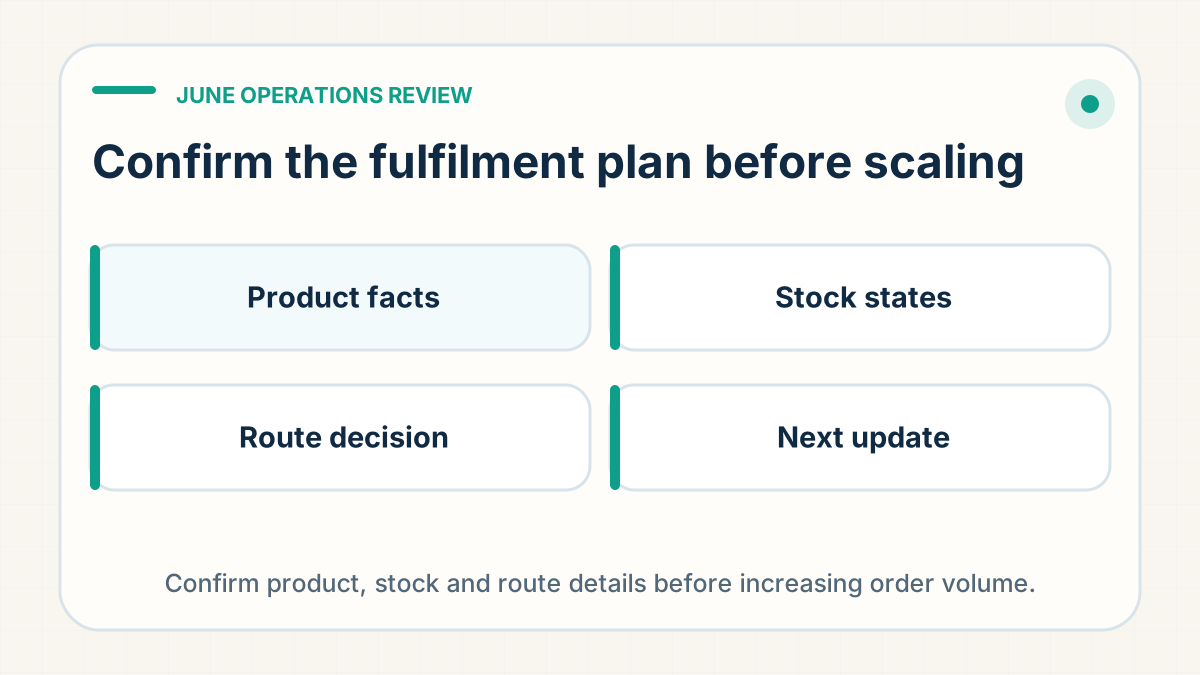
Before your next order, agree the product brief, stock states, reapproval trigger, exception contact and written handover. The June records illustrate these controls but do not quantify sales or delivery improvement.
If your operation is facing the same transition, use the product sourcing brief for one priority item, then ask RyanFulfil to help test the product, route and fulfilment handoff before adding complexity.