From the operations desk
What was happening
Across the RyanFulfil operation, the week mixed new product enquiries, multi-part quotations, samples, store connections, tracking questions, quality complaints and high-volume after-sales work. The strongest conversations used exact references, visible carrier or supplier evidence, shared exception records and explicit completion. The weakest moments were rarely total silence; they were partial answers that left an adjacent action unresolved.
The theme of the week
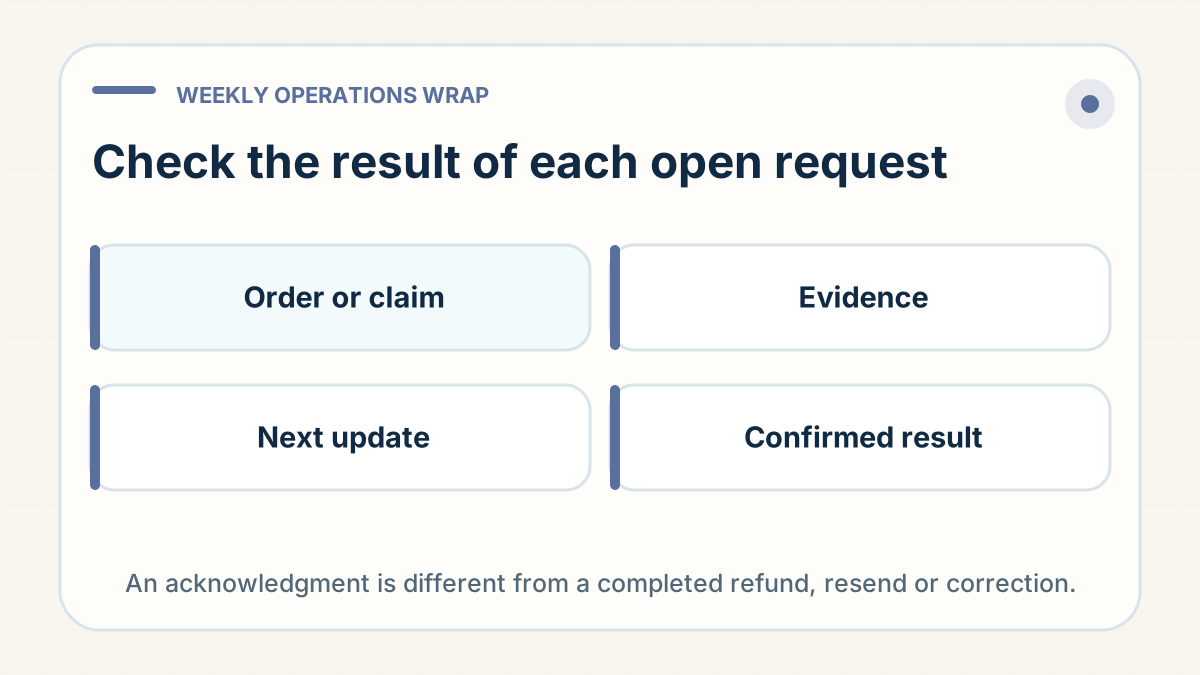
The common thread was the difference between replying and closing. A quick acknowledgment can be polite and useful, but it does not replace the operational state of the request. Closure needs a named owner, evidence, the next meaningful deadline and a clear condition for calling the work complete.
What new sellers kept asking
The new-seller conversations often began with a product link and an apparently simple question about price or delivery. They covered broad accessories, apparel and footwear, home and lifestyle, electronics, beauty and personal care, pet, and health and fitness categories. The complete requests were usually much broader: exact-match quality, destination-specific timing, a sample, neutral or branded packaging, tracking, store or marketplace handoff, and what happens after a defect, return or lost parcel. Answering only the price left most of the buying decision unresolved.
What the intake volume actually meant
The private intake showed dozens of likely new-seller conversations, not dozens of automatically confirmed clients. The supported stages ran from introduction and enquiry through quotation, sample, onboarding, first paid order and live repeat fulfilment. Choose your next commitment from your actual stage: product research, sample approval, first paid orders or repeat demand. A forecast alone should not trigger an inventory purchase.
Country-level context made the requests more concrete without exposing addresses. The US appeared most often, with repeated UK and European-market questions and a smaller spread of other international destinations. Commercial scale ran from no paid orders and single-product tests through single-digit and low-tens order requirements; separate sourcing conversations considered hundreds of units. The team therefore needed several different next steps, not one standard new-client package.
The anonymised examples made that distinction practical. An accessories seller needed sourcing, sample evidence, branded packing and a scalable store workflow. An apparel seller needed a customer-ready quote rather than a factory price alone. A home-and-lifestyle seller was weighing a small test against stocking for speed. A seller comparing agents cared less about a broad promise than responsiveness and clear ownership when an exception occurred. These are composite patterns across conversations, with names, stores, exact products, unusual destinations and precise volumes deliberately removed.
Match the answer to the seller's stage
Some sellers were still choosing a product with no paid orders. Others had their first orders, an established store, or hundreds of listings they wanted to move away from marketplace fulfilment. The useful next step changes with that stage. An early seller usually needs one or two priority products and one target market, not a complicated integration. A seller with live demand needs a reproducible product reference, an actual route, clear quality checks and an order workflow that can be tested.
A product link starts the brief; it does not finish it
A useful quotation needs the exact variant or non-negotiable specification, destination, current order stage or likely volume, delivery priority, packaging requirement and any quality point that requires a sample, photo, measurement or functional check. Those inputs let the team explain the product cost, packed shipping cost, preparation time, route and open assumptions as one comparable answer.
An estimate and a quotation are different promises
Custom and fragile products exposed a limit worth stating openly. A price can be given before a sample exists, but until a unit has been produced and physically packed, the packed dimensions and weight are unknown — and on cross-border routes those are what set the shipping figure. Tooling, decoration and lead time can be firm well before the delivered cost is, and protective packing for fragile goods often cannot be costed at all until a sample has been packed and measured.
The workable format is a quotation in three labelled parts: what is fixed now, what is still an estimate and why, and the specific event that turns the estimate into a firm number. A seller can price a product page against that. They cannot price against one figure that quietly moves later, and a low early number that has to be corrected costs more trust than a wider honest range would have.
Sell the bundle you can actually pack
Gift-with-purchase and multi-item offers repeatedly needed a physical check rather than a spreadsheet one. Whether a free item fits inside the main product's existing box decides whether an order ships as one parcel or two — which changes shipping cost, customs treatment and how many deliveries the customer waits for. Measuring the packed result before the promotion goes live is cheap; discovering it at dispatch during a live campaign is not.
The commercial lesson
The best first conversation reduces uncertainty and ends with the smallest useful commitment: provide one missing detail, receive one complete quote, approve a sample, test one order or schedule a short call. It does not force a seller to perform progress, and it does not treat interest as inventory demand. In that sense, good sales communication is already part of good operations.
Platform promises need a preflight
Marketplace and store workflows were a repeated pressure point. Carrier recognition, address visibility, fulfilment mode, cancellation cut-offs and customer-facing tracking events can vary by setup. For RyanFulfil, that often means validating the handoff from the seller platform into Dianxiaomi and onward through the tracking workflow. The safer approach is a controlled test order that proves the complete path before live volume depends on it. A label or number created internally should not become a customer-facing shipped signal before the parcel reaches the agreed physical milestone.
Evidence has to match the exact product
Sourcing and compliance questions also showed why similar is not the same as verified. Documents, supplier claims, samples and quotations need to map to the exact version, factory, components, brand treatment and destination. When that mapping is incomplete, the update should say so directly instead of using certainty to fill the gap.
Privacy belongs inside the operating process
Accurate fulfilment needs personal and account information, but team coordination rarely requires that information to be repeated in full. The better pattern is restricted access, masked confirmation in broad channels and platform-supported permissions rather than shared credentials. If information reaches the wrong audience, containment and acknowledgment come before explanation.
Repeated remedies should change the system
The week contained many examples of useful refunds, replacements and carrier follow-ups. Those actions protect individual customers. When the same failure mode repeats, however, the operation also needs batch traceability, a defect threshold, supplier root-cause work and verification that the correction held. Otherwise good after-sales service can conceal a preventable product problem.
What to carry into next week
The practical control is one open-action register reconciled against the chats: request, owner, evidence, current state, next update, proposed remedy and closure proof. It does not need to be complicated. It needs to make every promise recoverable and every completed action visible.