Field note
What was happening
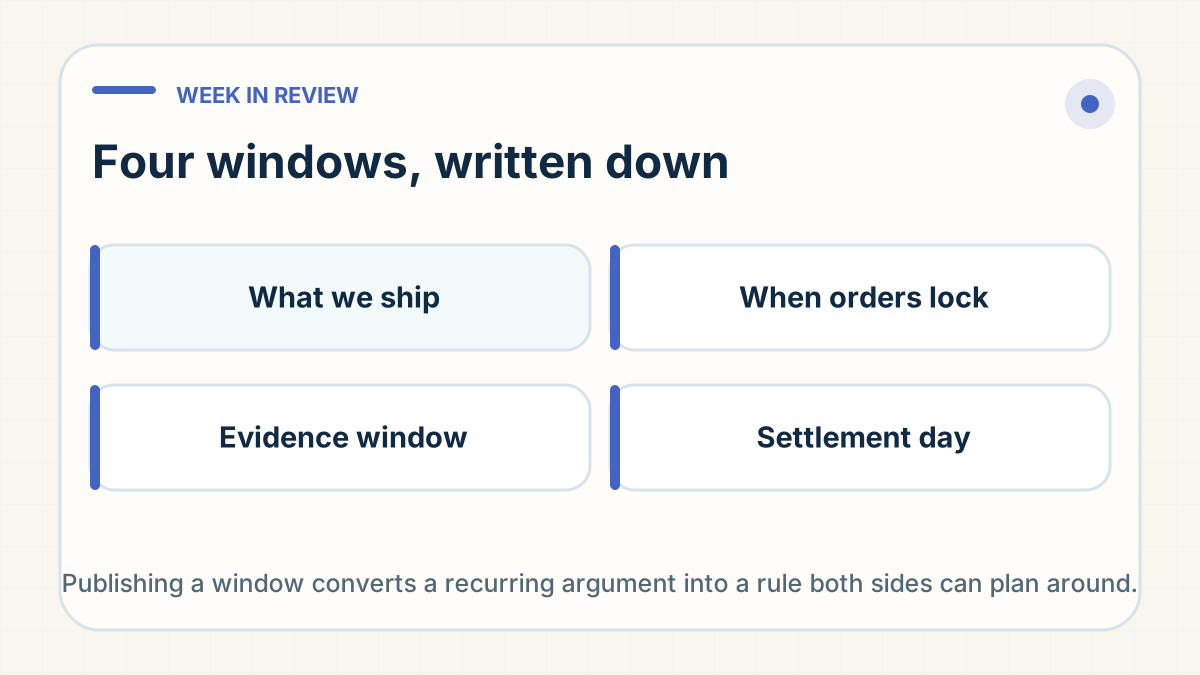
Publish four windows before anyone needs them: what will not ship, when orders lock, what a claim needs and when invoices settle. Across the week the operation handled new product enquiries, multi-part quotations, samples, customisation questions, store connections, a large volume of address and tracking exceptions, and a steady stream of after-sales claims. Underneath the variety, one question kept repeating in different costumes: is this still changeable, or is it already fixed? Almost every difficult moment came from a mismatch between what a seller assumed was still open and what physically was.
- 01What we will not shipScreened against the exact item and the exact destination.
- 02When orders lockThe hour after which a batch stops being editable.
- 03How long a claim hasThe window, and the evidence that has to exist inside it.
- 04When invoices settleA named cycle, so funding never becomes a delivery problem.
The theme of the week
Operations run on windows. A product can be refused cheaply at enquiry and expensively after a customer has paid. An order can be edited before packing and not after handover. A claim can be evidenced in the first days and not months later. A payment cycle can be designed, or it can be argued about every time. The useful control in all four cases is the same: publish the window before someone needs it.
Eligibility belongs at the start, not the end
The week produced an unusual number of refusals — protected product shapes, licensed imagery on apparel, replica branded goods, restricted and dangerous items, food into the EU, and goods too large or heavy for any route worth standing behind. In every case the seller had already invested attention before asking. Screening the exact item against the exact destination costs one message at enquiry stage. The same conversation after a launch costs a seizure, a refund, a chargeback and a reputation.
A cheaper customs channel arrived, priced in days
Since the EU's per-consignment customs charge took effect, orders shipped from China have carried a fixed charge per distinct commodity code in the parcel. A tax-inclusive channel is now in use that reduces that charge on EU orders, in exchange for roughly two to three additional working days in transit. That is a genuine saving and it is a trade, not a discount — for a seller competing on delivery speed the slower channel can be the wrong choice even though it is cheaper.
The related question, asked more than once, was whether shipping from an EU warehouse avoids the charge entirely. It does, and for lightweight products it is often still more expensive overall, because domestic carriers in several European markets have minimum parcel rates that exceed the saving, on top of the cost of getting stock into the warehouse in the first place. The honest answer depends on weight, volume and how much inventory a seller is prepared to hold.
Write the order-change cut-off down
The most reusable outcome of the week was an explicit cut-off matrix agreed with one warehouse workflow: which day's orders ship on which day, the hour after which a batch stops being editable, and a separate row for weekend orders. It replaced a recurring negotiation with a published rule. Sellers can quote it to their own customers; the warehouse no longer has to choose between a broken cut-off and an unhappy client.
Evidence decides claims, and evidence expires
Two failure modes recurred. The first was photographs of packaging standing in for photographs of the product, which cannot distinguish a wet outer bag from a failed item. The second was time: claims raised long after delivery, when the supplier after-sales window had closed and nobody had captured evidence while the goods were fresh. The workable pattern is to resolve the first occurrence fairly, state the evidence standard for the next one, and tell sellers the window exists before they need it.
Most delivery exceptions are address problems
A large share of the week's exception work traced back to data a store accepted and a carrier could not use: missing recipient telephone numbers where the network requires one, missing house or unit numbers, island and offshore destinations with no serviceable route, and forces or post-box addresses. Separately, several parcels marked delivered had not reached the recipient — a scan is strong evidence and not proof, and the right sequence is last-mile reference, delivery photograph, local checks, then a decision between recovery, reship and refund.
Settlement is a design question
A long-standing seller asked to have orders fulfilled without waiting for each invoice to clear. The resolution was a fixed weekly settlement cycle with advance notice for exceptions and a stated fallback, rather than either a blanket concession or a standoff. The security deposit stayed untouched, because a deposit being spent is no longer security. Invoices were also split to match the seller's own trading days where that made reconciliation easier at their end.
A supplier adjective is not a product claim
One cosmetics seller drew a distinction the whole week could have used. Told a product was waterproof, they asked separately whether it was also transfer-resistant, because those are different properties and only one was going into the advertising. Elsewhere the same issue appeared as colour: a shade that looked one way in a supplier product shot and noticeably different in a swatch photograph, with the honest explanation being that promotional images are processed and were never a colour reference.
The rule that falls out of both is simple. Every performance word and every colour name on your own store is something a customer can hold you to, and a factory listing is not evidence. Confirm each claim separately, say which ones came from the supplier and which were tested, and either verify on a sample or leave it out of the copy.
Some sellers are not asking for dropshipping at all
A distinct kind of enquiry ran through the week: sellers who want contract manufacturing and are using the language of dropshipping to ask for it. The requests were specific — name the factory, sign a non-disclosure and non-circumvention agreement, agree an acceptable quality limit, confirm who owns a new mould, produce lead-free documentation, run a live video call from the production floor, and quote three factories for comparison.
Those are legitimate asks for a brand at that stage, and most of them have real answers: a factory can sign a customised production contract, third-party laboratory testing can be arranged and priced, and production video can usually be recorded. Some do not: factory identity is commercially confidential, unannounced live floor access is not available, and a design in a material the trade rarely uses becomes a custom production run with a genuine minimum rather than a sourcing question. Saying which is which early is the difference between a serious conversation and a slow disappointment.
Two sellers left, and both explanations were useful
One had brought fulfilment in-house after buying his own stock, and named his reasons plainly: parcels ordered in early summer had still not arrived, and our pricing was higher than an alternative. The other had moved to a cheaper provider months earlier and, when asked why, said the cheaper price still did not make the product profitable once advertising was counted — so he was changing product, not provider.
Only the first is a service failure, and it belongs in the record unsoftened. The second is a seller discovering that a product cannot carry its acquisition cost, which no fulfilment price would have fixed. The reason to ask on the way out is that the two look identical until somebody does.
Where the conversations actually sat
The newer intake again spanned introduction and enquiry through quotation, sample, onboarding and live repeat fulfilment, with the majority earlier in that sequence than a headline count would suggest. Country-level context was mainly European markets with recurring US and UK questions and a smaller spread of other destinations. Commercial scale ran from no paid orders and single-product tests through low-tens live operations, with separate sourcing conversations in the hundreds-of-units range. These are pooled patterns across several conversations rather than the profile of one seller.
What to carry into next week
Four windows, written down and shared: what we will not ship and why, when an order stops being editable, what evidence a claim needs and for how long, and when invoices are issued and settled. None of them are complicated. All of them convert a recurring argument into a rule that both sides can plan around.